

Letter from Orkney
Jon Gower
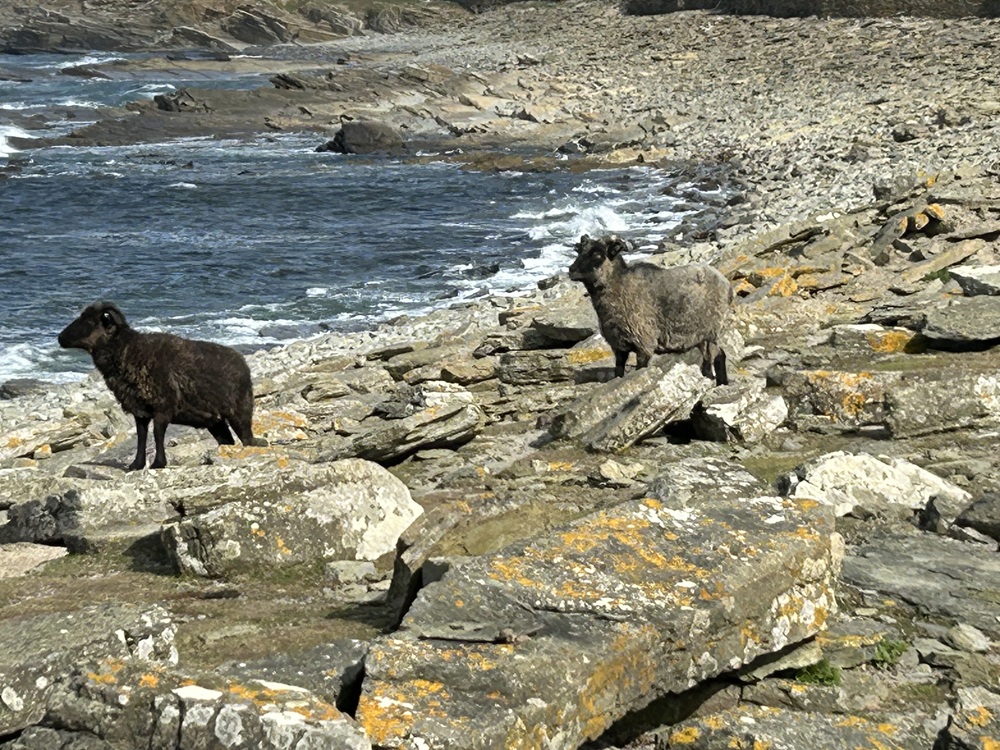
The ultra hardy sheep of North Ronaldsay are made of quite the sternest stuff. Grazing on sea-rocks, jagged skerries and sandy beaches, the dark fleeced beasts munch on drifts of seaweed rather than swards of grass, one of very few mammals that can do this.
These small sheep have long been associated with the place: today’s feral flock has ancestors going back to the Iron Age and possibly before that even, making them some of the earliest ovines to make it to Britain.
They feed on the shore at low tide before retiring to ruminate on drier stretches of shore at high tide, a feeding rhythm at one with the pulse of the sea. And before you ask the meat doesn’t have a coastal tang, like salt marsh lamb, but is rather quite gamey.
Luckily the coast of this, the most northerly island in Orkney, is blessed with thick blankets of kelp and the hardy animals are quite happy to dine unperturbed by the waves as they crash in.
Stone wall
To keep them away from the island’s arable crops a 6 foot stone wall was erected in the early 19th century around the entire coast of the island. Twelve miles long and six foot high, the dyke is one of the largest dry stone walls in the world. It helps both the crofters and the sheep as the animals, which have adapted to their seaweed diet would find grass not only indigestible but toxic.
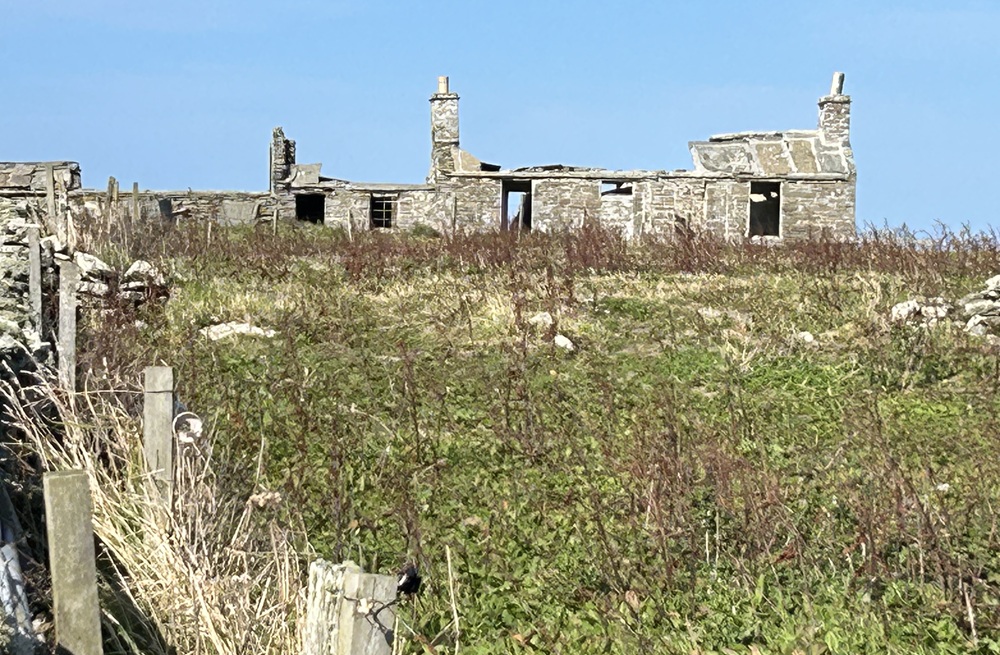
The island has many other walls that aren’t so well maintained. The wind-flensed terrain is studded with tumble-down bothies, evidence of the steady and ongoing emptying of the island of its human population. At its peak in 1881 some 550 people lived on North Ronaldsay. A hundred years later it was a fifth of that and by now there are now just 59 island residents.
Next week that number will reduce to 55 when a family of four leave the island for good. This will leave just three names on the register of the island school.
If you peer through the windows of some of the deserted homesteads it looks as if someone has only just left, although the rooms have probably been empty for two decades. There are the utensils of a simple domestic life. Jugs and ornaments arranged on shelves. Window curtains turned into ragged ribbons by the wind coming through the cracks. A formal grey suit hangs on a hook as if ready for a visit to the kirk.
Depopulation
It’s a story of island depopulation familiar from so many places – the Aran Isles, the Blaskets, Ynys Enlli – but those are historical rather than contemporary. On North Ronaldsay, where many of today’s inhabitants are elderly there is a crying need for young blood and fresh arrivals.
Or as one inhabitant told me ‘We’re in danger of becoming another St Kilda’ – a remote rock bereft of people.
Today the income of islanders is drawn in the main from crofting or tourism. Many people come to the bird observatory, which is one of the best places in Britain to see rare birds.
Sightings this past week have included red-backed shrike, greenish warbler, barred warblers and a couple of wrynecks. Some longer-staying birds have included dotterel, a species normally found on the top of mountains and notably tame and confiding, here choosing the highest ground on this low-lying island, at Turrieness Hill.
But the commoner birds are a treat indeed. Gannets offshore become living spearheads as they fold their wings before they dive, in what the writer Tim Dee describes as folding into ‘the living origami of themselves.’ The six foot wingspans, the titanium white plumage and black ink-tipped wings are visually dramatic against the pewter surge of the sea as they patrol off the Point of Twinyas.
There they join swirling petrels, aerobatic as can be on straightened wings. And a few late terns, skirriking as they head south.
Place names on the island are so very evocative: Garso Wick and Sinsoss Point; the Brae of Stennabreck and the Knowe of Samilands; Muckle Gersty, Purtabreck and Brides Ithy.
There is ample evidence of Scandinavian influence, from the Norwegian Consulate in Kirkwall to the Viking names all over the map, from island names such Rousay, Stromsay, Flotta and Green Holm to the names of townships such as Skaill.
Nowhere is this influence more evident than in the beautiful cathedral of St Magnus, which dates back to the eleventh century. I’m not one to tarry long in such places but this one is special.
Miracles
Magnus Erlendsson was Earl of Orkney in the early 1100s. His cousin Hakon shared the earldom with him but when they fell out in a dispute Hakon ordered his chef to kill his cousin, who died whilst praying, felled by an axe blow to the head. He was buried at a place called Birsay and when stories were told of miracles at his grave Magnus’ reputation as a holy man grew and then consolidated.
The cathedral which bears his name is a fascinating place. It’s said that the stonemasons who built it had learned their craft at Durham cathedral. Magnus’ bones are interred inside one of the pillars while another houses those of his nephew Rognvald, who founded the cathedral in his uncle’s name.
You can also look up and see the entrance to ‘Marwick’s Hole,’ a windowless cell placed between choir and transept where those accused of witchcraft, predominantly women, were incarcerated while awaiting execution.
Known familiarly as ‘The Light of the North’ St Magnus’ cathedral is full of engrossing evidence of Orkney’s rich history just as the landscape beyond is stippled with standing stones and burial cairns suggesting great busyness during Neolithic times and even earlier.
Fought over by Denmark, Norway, Scotland and England, Orkney is, in the words of Orcadian historian Peter Marshall ‘a world in and of itself, domed by the sky and belted by the sea.’
Support our Nation today
For the price of a cup of coffee a month you can help us create an independent, not-for-profit, national news service for the people of Wales, by the people of Wales.



A splendid piece by Jon Gower. Orkney is top of my list of places to visit – when I can get round to organising it – although I’ve been to virtually every nook and cranny there thanks to tours on YouTube! My interest in Orkney was kindled, and then set ablaze, because of my great admiration for the wonderful Orcadian writer George Mackay Brow. So, my first destination, after the magnificent St Magnus Cathedral, would be Maynard Court in Stromness, where GMB lived for the latter part of his life; it’s a modern 1970s or so, council built first floor… Read more »