


Port Talbot, one year on: steelworks closure shows why public is losing trust in net zero
Nicholas Beuret, Lecturer in Management and Ecological Sustainability, University of Essex
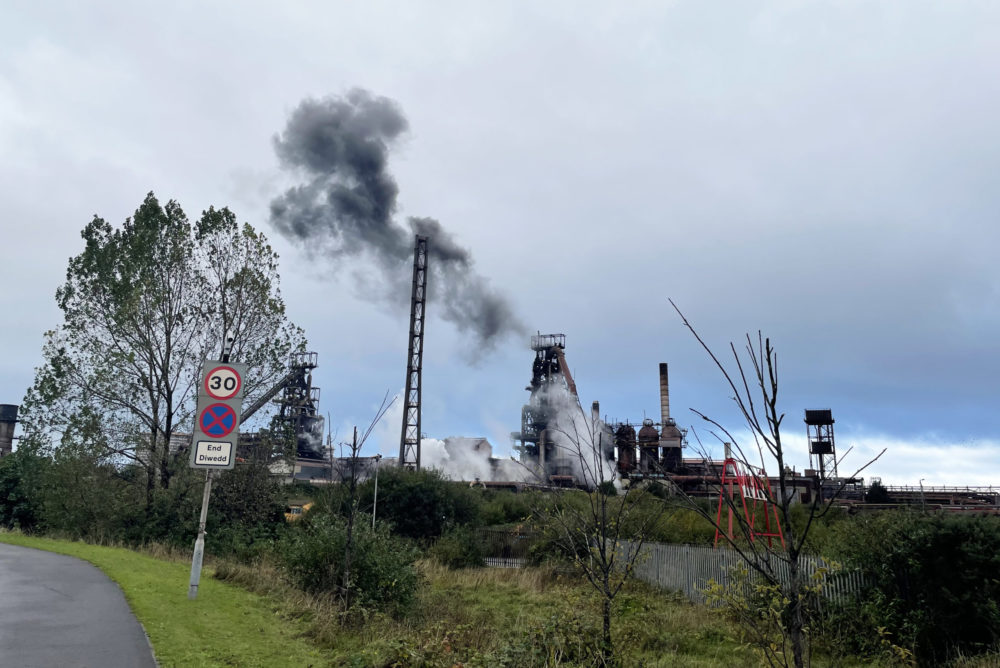
The rolling mills are still working, but the furnaces are long cold. Of the 4,000 people previously employed at the steel mill in Port Talbot, Wales, only half still work there. Despite union protests and local rallies, one year ago on September 30 2024, the plant’s last coal-burning blast furnace was shut down.
This ended more than a century of steelmaking in the UK’s biggest plant – one of the largest in Europe. The owner, Tata Steel, blamed high energy prices and competition from cheaper Chinese steel, claiming ongoing losses of around £1 million a day. It warned the plant would close entirely unless the UK government stepped in to help replace its ageing furnaces with lower-emissions electric arc furnaces.
Steel manufacture contributes around 7% of global climate emissions, and Port Talbot alone accounted for 1.5% of the UK total. Faced with the choice between the closure of the mill and supporting its transition to greener production, the government committed £500 million to this transition.
Job losses
Tata Steel then announced 2,800 job losses – around one in ten jobs in the town of 35,000. Up to 9,500 more could be lost in the supply chain and broader sector.
This is not how successive governments have sold the transition to a net zero economy. Both Labour and the Conservatives promised net zero would create skilled, well-paid work that would not only make up for losses elsewhere, but generate economic growth and lower bills.
Some data suggests they were right: the UK’s net zero sector is growing far faster than the rest of the economy at 10% per year, and already supports close to 700,000 jobs.
However, polling shows only about one in five voters think the energy transition will create jobs in their area, while only one in three think the transition will have a positive impact on jobs anywhere in the UK.
So why does no one believe the politicians? And where are the jobs?
A series of betrayals
Partly this is about geography. Old centres of industry like Port Talbot are struggling to retain jobs, while net zero businesses tend to be far more dispersed nationally, with many in London and the south-east. As the transition progresses, industrial towns will feel even more abandoned.
The jobs themselves are also different. Many new net zero jobs are in installation, waste processing and other services, often for small businesses and with worse working conditions than those that predominate in heavy industry.
Even within heavy industry, low-carbon technologies tend to mean fewer jobs, as greener versions generally employ fewer workers. Electric furnaces need less labour than coal-burning furnaces, for instance. Facilities tend to be more automated, and supply chains are shorter.
And where there could be a pipeline from fossil fuel jobs to renewable industries, as in Scotland, most workers say there is far too little support from government and industry for them to make this change.
Political fallout
Reform has been quick to seize on the closure of Port Talbot, with its leader Nigel Farage declaring he’d open the furnaces again, despite this being physically impossible.
Reform more generally has declared net zero to be an expensive farce, one that costs jobs and drives up energy bills. Across a swathe of local councils where Reform has overall control, it has promised to cancelled net zero policies and renewable energy projects.

Though critics suggest Reform’s promises threaten billions in investment and upwards of 1 million jobs, the party’s claims are finding a welcome home among workers in industry, with unions warning that their members are increasingly drawn to Reform as they desert Labour.
The steel industry isn’t the only one undergoing job losses. From oil and gas facilities to fertiliser and car plants, heavy industry is shedding jobs under pressure from high energy costs, competition, and the need to reduce greenhouse gas emissions. As the transition continues, these losses are likely to mount.
The household budget myth
It is not just the “jobs gap” that generates the sense of betrayal among workers. Since the 2008 financial crisis, the myth that the UK government’s finances work in the same way as a household budget, thus justifying one of the most dramatic programs of government austerity seen among the world’s wealthier countries, has become a well-established common-sense framework.
And this mindset associated with austerity has also come to haunt the UK’s net zero transition.
Surveys repeatedly list local decline as among the main reasons why people are turning away from the major parties and towards Reform. And when the UK government hands hundreds of millions to companies like Nissan or Tata Steel, only for them to cut hundreds of jobs, this feeds a sense that money is flowing to corporations, not communities.
Reform has capitalised on this by contrasting supposed subsidies for solar farms with the closure of vital services in those same towns and regions. When combined with the steady flow of commentaries in the right-wing media declaring net zero a burden on the taxpayer and a waste of scarce government resources, the narrative that net zero is a “con”, taking money and jobs from the British public to give to big business, seems more credible.
The bitter irony here is that not only do most people in the UK, including most Reform supporters, still back taking action on climate change, but that climate change will hit deprived areas hardest. Yet without visible local benefits, warnings about future risks won’t cut through.
One year on from the Port Talbot closure, I believe it’s vital that the net zero transition comes to mean something more than broken promises and betrayed communities. Reform’s anti-net zero rhetoric is no panacea. Yet without a program to ensure a just transition, we risk this becoming hostage to such reactions – a transition to nowhere that anyone wants to go.
This article was first published on The Conversation.

Support our Nation today
For the price of a cup of coffee a month you can help us create an independent, not-for-profit, national news service for the people of Wales, by the people of Wales.



The poor handling of Port Talbot steel works was a shocking failure of the 2 labour governments and Jo Stevens. They have driven many in the useless arms of Faraaaage.
Net zero isn’t the issue. It’s the money and people behind the effort to stop it.
No Planet B but they don’t care.
And thatcher selling off British Steel as it was. Way to go conservatives, so much damage in the UK.
The change from coal to electric in steel making does not have to see thousands loosing their jobs. The German French and Dutch Govs have invested Billions into their steel industries also followed by EU cash, to prevent mass job losses, but a combination of Brexit, yes that did help in the loss of Port Talbot works, when it lost EU funding and as the Tory gov did nothing, followed by Labours £500 million pocket money style investment has lead to where we are today. But never mind, the architect of Brexit has the answers, and some who followed his… Read more »
Mostly agree with. Being outside the EU when Carbon border taxes emerge(as they do this Jan) and the EU Green deal was catastrophic for the industry. The timing couldn’t have been worse. But it was Tata that dictated the direction, not Tories or Labour – Port Talbot isn’t state owned and it’s a company matter to decide the future, which is particular complex as the EU treats Tata UK the same as tata Netherlands. Labour haven’t given any investment yet, as far as I know. They actually can’t under state aid rules due to the terms of the TCA with… Read more »
Closing the blast furnaces has nothing to do with net zero. The Port Talbot sure produced its own electricity using power stations powered by coke gas produced by the steel making process. This is purely a business decision by TATA. Since they took over ownership they’ve wanted to bring in slabs from their world wide steel making operations. But the harbour and infrastructure was set up for the making of virgin steel. The closure of the existing blast furnaces and replacing them with arc furnaces. Is the perfect opportunity for them to be able to do this. With the steel… Read more »
As the article shows, a large minority of the glorious British public are too stupid, uneducated and bigoted to listen to, or understand, a reasoned argument. At the moment that minority seems to be around 30%, and in a mature democracy with a PR voting system, they would never get into power. In the UK however, they very well could, then heaven help us. Look at Milei’s Argentina and of course Trump’s US to see what awaits us. One in six of the adult UK population are functionally illiterate; perhaps if you had to earn the right to vote by… Read more »