

Yr Hen Iaith part 70: Time out of Time – the life of an anterliwt player
Jerry Hunter
In addition to composing interludes (or anterliwtiau), Twm o’r Nant (1739-1810) also performed in many of his own plays. His short autobiography provides some of the best information we have about the nature of this eighteenth-century Welsh dramatic tradition.
He tells us that he began his acting career at a young age:
Ond cyn fy mod yn ddeuddeg oed, fe gododd saith o lanciau Nantglyn i chware interlute, a hwy a’m cymerasant gyda hwynt, rhwng bodd ac anfodd i’m tad a’m mam, i chware ‘part’ merch, oblegid yr oedd gennyf lais canu, a’r gorau ag oedd yn y gymdogaeth. Mi gefais y part i’w ddysgu, mewn cwrw gwahawdd i ddyn tlawd, yn y Fach yn agos i Felin Segrwyd, lle y telais y tair ceiniog cyntaf erioed am gwrw.
‘Before I was twelve years old, seven of Nantglyn’s lads went about playing an interlude, and they took me with them, my father and mother grudgingly permitting it, to play the part of the woman, because I had a singing voice, the best one in the area. I received the part to learn, [and] in a bid-ale event [held to raise money] for a poor man yn Y Fach near the Segrwyd Mill, I paid three pennies for beer for the first time ever.’
Much of what Twm says here is supported by other kinds of evidence. The anterliwt company – often called just that, cwmni, ‘a company’ – could vary in size. Like the one with which Twm o’r Nant first performed, many had as many as eight actors or ‘players’ (‘chwaraewyr’, ‘chwar’yddion’). Evidence suggests that other companies were smaller, sometimes with only four performers. Twm composed anterliwtiau later in life for a bare-bones company of two players.
Economic strategy
This was a bold economic strategy; as he also performed in the plays which he wrote, this was a way of increasing his share of the pennies collected from the audience. We can thus say that the size of an anterliwt company varied between two and eight performers. All of these performers were men – or at least male.
Although Twm was obviously at the young end of the spectrum, note that he calls the other seven players llanciau, ‘lads’. This word usually describes a teenager or an unmarried young man (the phrase hen lanc – literally ‘an old lad’ – is used in Welsh to describe an older bachelor).
Anthropologists sometimes use the term ‘liminal’ to describe a state of being between two other states; somebody in a liminal state is neither X nor Y, but in a conceptual grey zone between more clearly defined categories. It is often used to describe the middle period of a ‘rite of passage’, after an individual, group or community is symbolically severed from the previous state and before he, she or they are reincorporated into a new place in society.
We can say that anterliwt players were in a liminal stage of their lives, neither children nor men. Twm tells us that he first bought beer when he first performed in an anterliwt; this, along with his parents’ partial reluctance to let him go, suggests that the entire experience was a rite of passage for him, marking the beginning of his transition out of childhood.
The lads would be released from their usual occupations – as farm labourers, apprentices to craftsmen, or miners in the case of one cwmni from Flintshire with whom Twm performed. In this way too they were in a liminal state, severed from their usual places in a rigidly-defined social structure and allowed to roam from parish to parish and county to county while performing their anterliwt.
Farewell
Huw Jones of Llangwm (c.1700 – 1782) was an extremely prolific poet, composing at least five anterliwtiau in addition to a great many ballads. We don’t know if he ever acted in any of his own interludes, but he certainly knew many lads who did form travelling anterliwt companies, and he knew what the life a travelling player was like. One of his ballads asks us to imagine a company of actors singing together. It is entitled ‘Ffarwel i Enterliwt’ , and, indeed, they are using this song to bid ‘farewell’ to the memorable time they’ve spent travelling around and performing their ‘interlude’.
They begin by describing themselves and the work to which they are bidding farewell:
Y-ni a fuon, dynion dawnus,
Rai call, araul, mwyn, cellweirus,
Yn dilyn chw’ryddiaeth, afiaeth ofer[.]
‘We were talented men,
Clever, splendid, amiable and mischievous ones,
Following a play [touring with a play], a vain amusement.’
‘[We have been] travelling the country with our play’ (Rhodio’r wlad . . .
Gyda’n chware), they sing, describing the welcome they had in each place: Cael cwrw clir hyd y sir (‘receiving bright beer throughout the county’). Revelling in the ‘vain’ nature of the entertainment they have been providing, they describe their work as ‘[t]rin oferedd’, ‘treating vanity’ or ‘working with frivolity’. They also describe what they’ve been doing as
‘darnio llawer diwrnod’, ‘destorying’ – or, perhaps, ‘wasting’ – ‘many a day’. They have enjoyed this time out of time, temporally living a life consisting of travel, acting and drinking.
But their time spent canlyn chw’ryddiaeth, ‘touring with a play’, is over, and they must now return to their set places in society and take up more mundane work again:
Rhai at wair a’r lleill at fedi,
Rhai’n ddi-siarad at waith seiri,
Rhai bob tro at waith go’ . . . .
‘Some to the hay and the others to harvest,
Some closed mouthed to the work of craftsmen,
Some of course to a smith’s work . . . .’
Remembering that each anterliwt included a number of songs and dances, it is no surprise that they describe the end of the playing season as putting the music away:
Rhoi’r dôn i’w chadw, dyna’r chwedel,
Cân ffarwel i bob llawenydd,
Awn yn un galon efo’n gilydd,
Pawb i’w fan, gan ado’r llan bu diddan ein dyddie.
Cyn ein diwedd, oeredd eirie,
Is wybren enwog, sobrwn ninne.
‘Putting the tune away for safe keeping, that’s the story,
A song of farewell to all joy,
We go with one heart together,
Each to his place, leaving the churchyard where our days were merry.
Before our end, words of coldness,
Benaeth the grand heavens, we ourselves will sober up.’
Merry days
The llan where they enjoyed so many merry days can be taken as referring to the many towns in which they performed, but it might also be translated as ‘churchyard’, one of the open-air venues where anterliwtiau where staged.
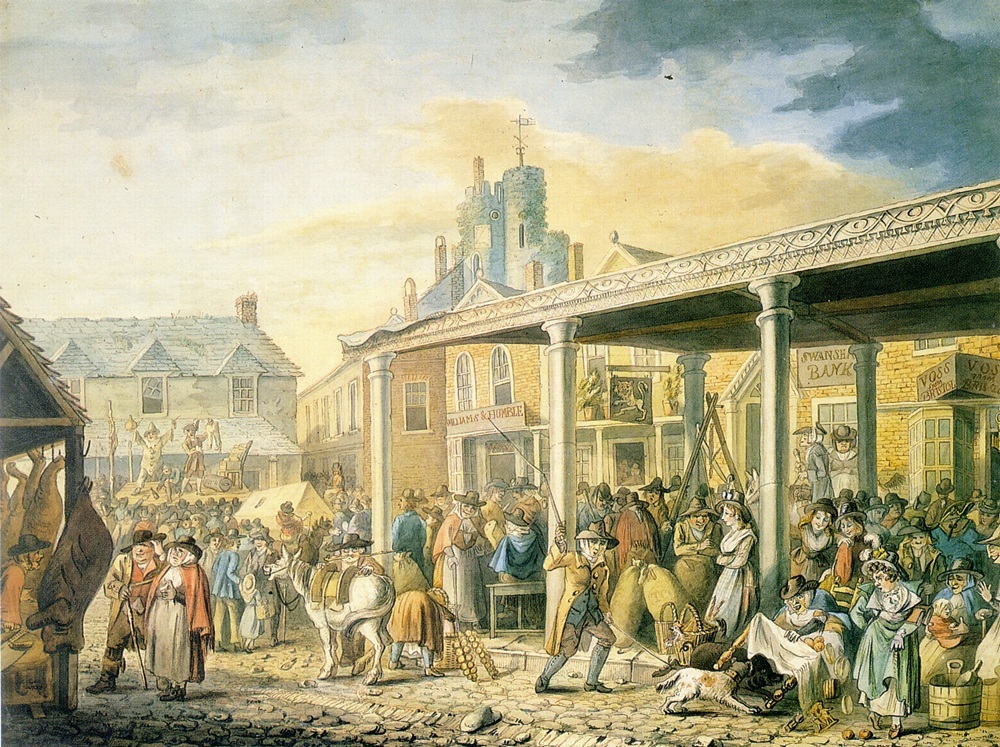
We’ve already suggested that the young actors have been taking part in a kind of rite of passage, a creative pursuit only followed by people in a liminal state between childhood and manhood. They have been performing their play in various fairs, markets and gwyliau mabsaint (parish wakes).
These events might be seen as communal liminal zones; people leave work and the oppression of a hierarchical society in order to drink, dance and enjoy some carnivalesque entertainment.
Members of each community, having seen the anterliwt and enjoyed the few days of their local fair or gwylmabsant, must sober up and go back to work after the celebration’s ‘time out of time’ is over.
However, the young actors have been in effect enjoying one extended gwylmabsant, travelling from parish to parish and taking part in festival after festival throughout the season. But when the touring season comes to an end, they too must sober up.
The poet Huw Jones has taken advantage of his native language’s grammatical resources in order to emphasize this in a way which is both concise and eloquent. Welsh has a number of different kinds of pronouns, including the simple independent pronoun, which, in the case of the first person plural (‘we’), is ni.
At the end of his ballad he uses the conjunctive form of the first person plural pronoun, ninnau. This form of the pronoun is used in a variety of contexts, often to express a contrast with other pronouns (either expressed or implied).
Sober up
He could’ve written sobrwn ni, ‘we will sober up’, but what he has written is sobrwn ninne (Llangwm dialect for sobrwn ninnau). This one simple grammatical choice allows him to say this in effect: ‘all of you other people for whom we have performed during the season have sobered up, and now the season is over and we ourselves have to finally sober up.’
The simple phrase pawb i’w fan is extremely suggestive as well. In saying that ‘each [one of them must now go] to his place’, he is saying that, having left their normal places in society in order to temporarily live the lives of travelling players, each one of them must now go back to his appointed station in life.
This song by Huw Jones provides a memorably suggestive look at what the experience meant to the lads who toured with an anterliwt company. It was a rite of passage, a unique period in their lives and a time out of time.
Further Reading:
Dafydd Glyn Jones, ‘The Interludes’, yn Branwen Jarvis (ed.), A guide to Welsh literature c.1700-1800 (Caerdydd: Gwasg Prifsygol Cymru, 2000), 210-55.
- M. Ashton (ed.), Hunangofiant a Llythyrau Twm o’r Nant(Cardiff 1948)
- G. Millward (ed.), Blodeugerdd Barddas o Farddoniaeth o Gerddi Rhydd y Ddeunawfed Ganrif (Llandybïe, 1991).
Jerry Hunter, ‘Gwerth Oferedd’, Taliesin 50 (Winter 2011).
Support our Nation today
For the price of a cup of coffee a month you can help us create an independent, not-for-profit, national news service for the people of Wales, by the people of Wales.


