


Animal cruelty campaigners demand end to foxhunting legal loopholes
Martin Shipton
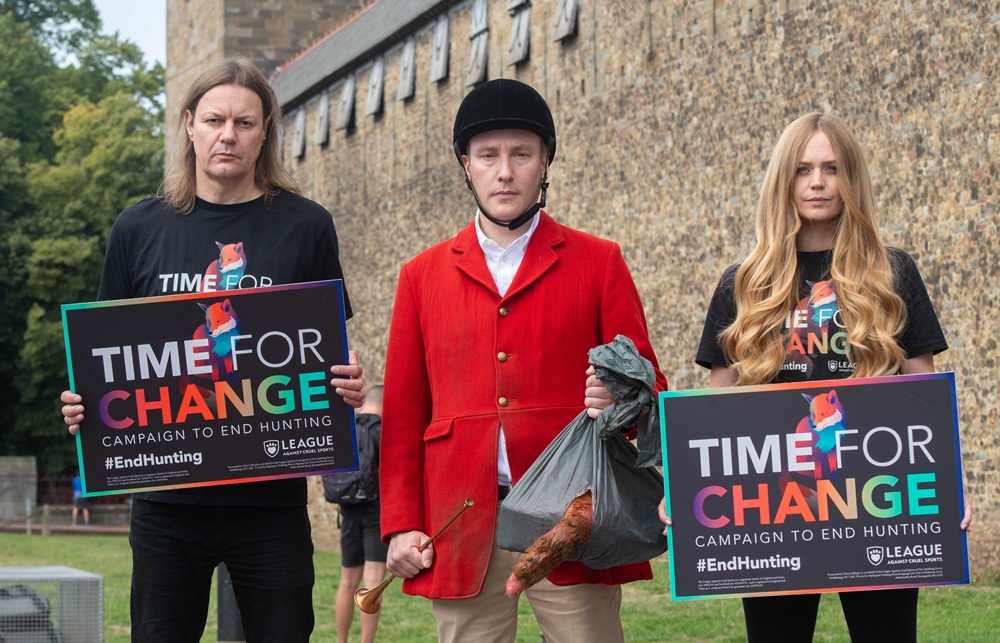
Campaigners from animal welfare charity the League Against Cruel Sports protested in Cardiff to expose the savagery of fox hunting they say is still going on despite the ban.
A League “huntsman” carrying a fake fox covered in blood paraded down Queen Street, and spoke to the Cardiff public about the need for stronger fox hunting laws.
The protest was held in advance of the UK Government’s consultation on fox hunting set to take place this autumn.
‘Havoc’
John Petrie, senior campaigns manager with the League Against Cruel Sports, said: “Fox hunting has been illegal for 20 years and yet this blood sport is still going on across Wales despite the ban. Foxes are still being chased and killed and havoc is being inflicted on rural communities by the hunts.
“The Cardiff public, shocked by the sight of a hunter in red coat and blood-spattered fox, came up to us today to voice their support for stronger fox hunting laws and an end to fox hunting for good.”
Polling commissioned last year by the League and carried out by FindOutNow with further analysis by Electoral Calculus showed more than three quarters (78%) of the Welsh public supported strengthening the Hunting Act.
The League published figures earlier this year from the most recent fox and cub hunting seasons in Wales showing the scale of hunting still taking place.
There were 21 incidents of suspected illegal hunting with 16 foxes seen being pursued, and 81 reports of hunts causing havoc in rural communities.
This havoc was made up of incidents entirely inconsistent with the discredited excuse of trail hunting invented by hunts which purport to follow a scent laid by themselves – hounds running loose on busy roads, trespass, threatening and irresponsible behaviour, and causing harm or distress to other animals such as family pets.
Flint and Denbigh Hunt
The figures revealed that the Flint and Denbigh Hunt, followed by the Sir Watkins Williams-Wynn Hunt (also known as the Wynnstay Hunt) and Sennybridge Farmers Hunt were the three worst offending hunts in Wales.
John added: “It’s time to properly strengthen the Hunting Act and end all hunting with hounds and we urge the Welsh public to pledge to take part in the forthcoming government consultation and demand an end to hunting wildlife with dogs.”
“This is a pivotal moment for animal welfare and together we can see fox hunting finally banned for good in both Wales and England.”
Fox hunting was banned in Wales and England when the Hunting Act came into force on February 18, 2005.

Fox hunting laws in Wales are not devolved and are determined by the UK Government though Members of the Senedd have backed calls to strengthen fox hunting laws.
Find Out Now interviewed 5,379 GB adults online from 26 March-2 April 2024. Data were weighted to be demographically representative of all GB adults by gender, age, social grade, other demographics and past voting patterns.
Trail hunting, the excuse often used by hunts, has been described by temporary assistant chief constable Matt Longman, the League’s national lead on fox hunting crime, as a “smokescreen for illegal fox hunting”. He also described illegal hunting as “prolific”.
Support our Nation today
For the price of a cup of coffee a month you can help us create an independent, not-for-profit, national news service for the people of Wales, by the people of Wales.



There is so much to do and enjoy in the Welsh countryside, why do these barbarians have to hunt foxes with dogs?