


Council spends £6.26 million on bed and breakfast accommodation
Richard Youle, local democracy reporter
A Welsh council has confirmed it spends more than £120,000 a week on bed and breakfast accommodation for people in need of housing.
The eye-watering £6.26 million bill for 2024-25, which works out as £120,384 per week, dwarfs the £2.5 million cost in 2022-23 and the £4.32 million outlay in 2023-24.
The council said the net cost was actually a lot lower as it has been able, for example, to claw back some money from the Welsh Government but its overall share of the expenditure is rising.
The situation in Swansea is far from unique. Councils everywhere are having to spend more to provide people in need of a home with somewhere to live and bed and breakfasts are part of the solution.
Audit Wales
An Audit Wales report this week said the main causes were a lack of housing generally, local housing allowance – the housing benefit entitlement for private tenants on welfare – being well below market rate, cost-of-living pressures more widely, and a shortage of key workers to prevent homelessness. Another factor was a Welsh Government policy during Covid to ensure everyone had access to a place to live.
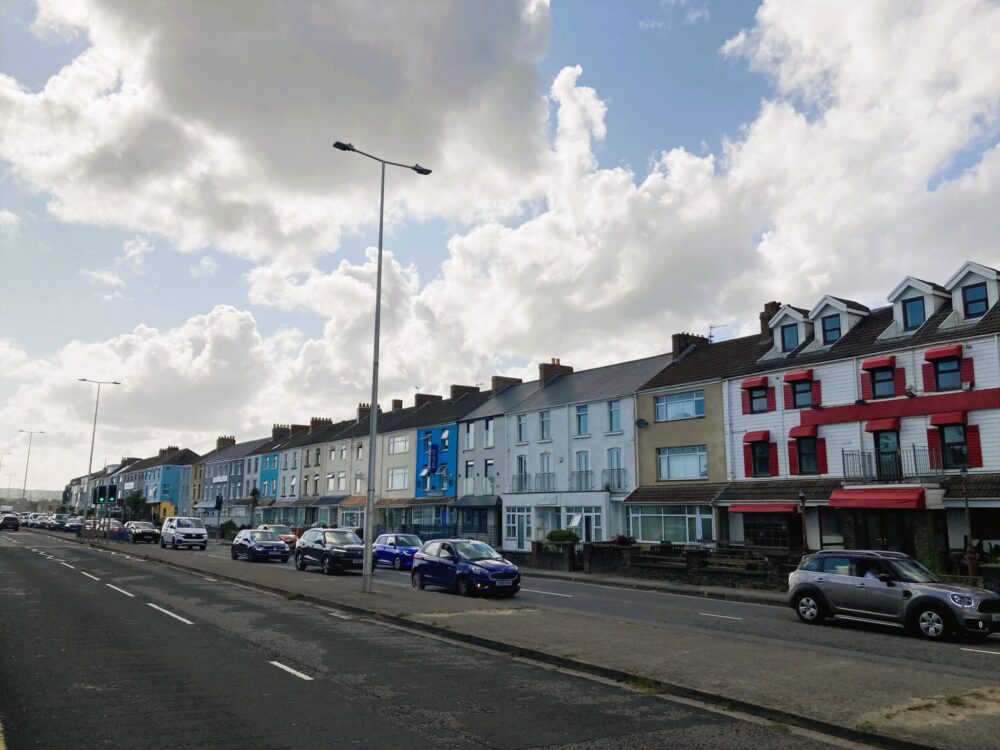
Some bed and breakfasts in Swansea’s Oystermouth Road accommodate people in need of a home, including recently-released prisoners.
One man, sat outside the Oyster Hotel on Oystermouth Road said he’d spent 18 months in jail before being placed last December in a nearby bed and breakfast. Two months ago he was moved to the Oyster Hotel.
“Coming from prison it wasn’t so bad for me – it was a step up,” said the 35-year-old, who asked not to be named. “If I’d be living in a flat it would have been a step down.
“The staff here are better than at the previous place, they are more helpful. And there is a microwave we can use. You get to know some of the other residents. Some are all right but a few are d***heads.”
Farming
The man, who said he used to work in farming in the Neath area, said he’d found a few places in Swansea where he was provided with free meals and that he really wanted to live somewhere where he could cook.
“They (the council) have told me that I’m close to the top of the housing list,” he said. “I can’t wait to get out.”
A few doors up, another man said he’d been in his bed and breakfast since last October having also been released from prison. He said there were no cooking facilities at all and that buying meals was expensive.
He said he often visited his mother and friends and preferred “keeping myself to myself” while at the accommodation.
The 32-year-old, who also asked not to be named, was upbeat though as he said he’d just secured a private studio to rent. “I’ll be there in hopefully two weeks,” he said.
Swansea Council’s bed and breakfast expenditure followed a freedom of information request by the Local Democracy Reporting Service.
Although the costs have risen considerably the number of people in bed and breakfasts was fairly similar – 1,048 last year, 1,374 in 2023-24 and 1,049 the year before that. The council said rising accommodation prices and longer length of stays helped explain why so much more money was being spent.
Asked how long placements in such bed and breakfasts could be, it said the longest was 1,092 nights for an individual and 77 nights for a family.
Temporary accommodation
The council has other temporary accommodation it can use, such as purpose-built pods off Walter Road, Uplands. It is also building affordable homes but demand is considerable with thousands of people on its waiting list.
It is currently converting the former police station on Alexandra Road in the city centre into temporary accommodation. The project, in tandem with housing provider Pobl Group, will provide 68 rooms for single people or couples and eight kitchens.
Cllr Andrea Lewis, whose cabinet brief includes housing, told a cabinet meeting this week that the building, called Llys Glas, should be ready for occupation around autumn time. She said: “We will be able to get some people out of bed and breakfasts because we realise that’s not ideal, and we will continue to work to find some better alternative accommodation.”
The council said it planned to spend more than £250 million over the next five years building homes, modernising its housing stock and redeveloping existing buildings.
“The council has made a commitment to ensure everyone in the city can have a bed and put an end to homelessness in Swansea,” it said in a statement.
“Increases in demand for temporary accommodation, along with a shortage of supply, means we have to use bed and breakfast accommodation from time to time to ensure vulnerable people are safe and have a bed for the night.”
The Audit Wales report said the country’s 22 councils spent £28 million on temporary accommodation in 2019-20 compared to nearly £172 million in 2023-24. Reducing that figure, it said, was important for their financial sustainability.
‘Fire-fighting’
Auditor General Adrian Crompton said: “Councils are currently in ‘fire-fighting’ mode, focused on dealing with high costs and levels of demand. I recognise how challenging it may be to make the shift, but councils need to focus more on prevention and assessing the value for money of temporary accommodation options.”
On Swansea’s Oystermouth Road one businessman claimed that anti-social behaviour and drug use was blighting the seafront strip.
Paul Hooper, the owner of Hooper’s Coffee Shop, said he believed the cause was the concentration of so many homeless people in the bed and breakfasts. “It’s not doing them any favours,” he said.
Mr Hooper said he’d had to defend himself a couple of times with a crowbar and had spoken to police about the situation.
“We used to have holiday-makers in this area, now there are very few,” he said. “The biggest problem is people smoking weed. Residents here in Sandfields want something done.”
South Wales Police said it had received 79 reports of anti-social behaviour on Oystermouth Road since the beginning of 2023, of which 11 related to hotels or anti-social behaviour on the street.
Sergeant Gareth Jennings said: “Records of anti-social behaviour reports on Oystermouth Road show a decline in the number of reports from January until mid-July year-on-year. The local PCSO has also reported no marked uptick in incidents of this nature in the last few years.”
He encouraged the public to report incidents. “We will then place our focus upon any premises where there are repeated and ongoing issues,” he said.
Support our Nation today
For the price of a cup of coffee a month you can help us create an independent, not-for-profit, national news service for the people of Wales, by the people of Wales.



Lets not mince words….the Sandfields area of Swansea – like much of its city centre – is now a crime and drug infested cesspit. And that’s why no one in their right mind goes into Swansea centre these days – either to shop or to socialise. And why businesses opening up there are often closing shortly afterwards. It’s very sad to see but its a consequence of the drug epidemic which is gripping so many british cities. A epidemic which police and politicians of every party have allowed to grow unchecked and which they now show zero interest in tackling… Read more »
But the politicians tell us that they are their people and our problems, which explains that the degradation in out society is matched equally by the degradation in the standard of politicians.
Ah yes all issues that are well known to increase the price of housing 🤣
The prices those accomodations bill councils for are outrageous: for three weeks, a B&B in Ystrad Mynach billed council £1800 per 1 person for a modest room with just a bed and a wardrobe in it. The food was not provided. The bills are massively inflated, and someone profits on all this. Who decides to which hotel place those in temporarily accomodations? Which hotels will have money? There is a lot of shady business going on, payed by taxpayers, while someone gets mega rich. And it is used to spur anti-homeless and anti-immigrant sentiment so that the real culprits can… Read more »
We sold off our obligation to look after people and landed it in the hands of private landlords. What do you expect?
End of the rail line, put your problems on a train, then it’s someone else is problem.