


Plaid Cymru accused of hypocrisy for opposing solar energy farms
Martin Shipton
A farmer has accused Plaid Cymru of hypocrisy for opposing solar energy projects in one of its heartland seats.
Last weekend the party’s leader Rhun ap Iorwerth and MP Llinos Medi joined more than 100 residents when they staged a rally against two applications to build vast solar energy farms on Anglesey.
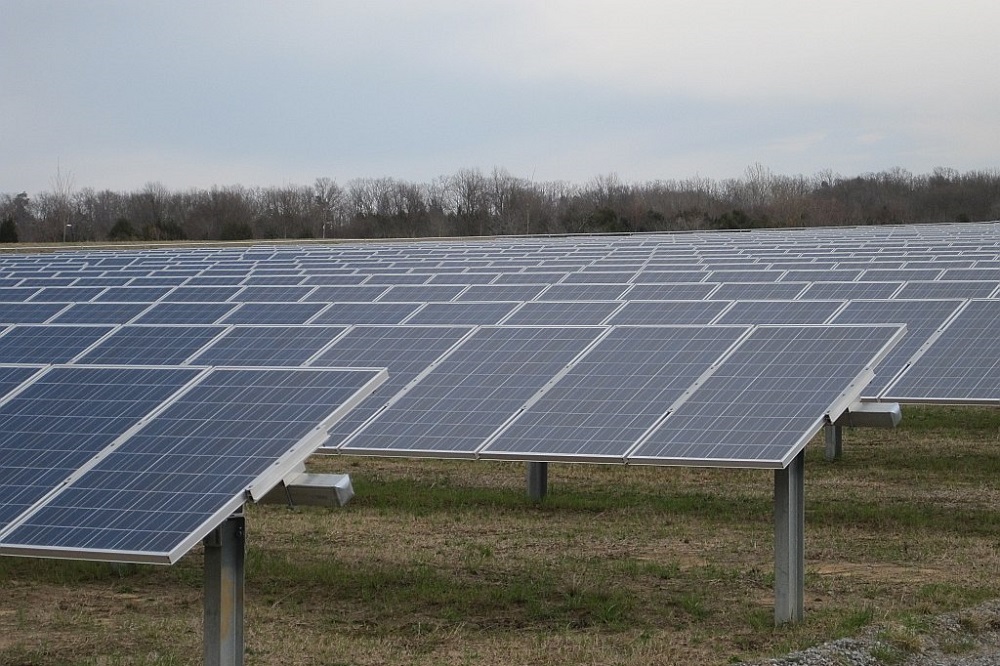
The schemes – known as Alaw Môn and Maen Hir and proposed by Enso Energy and Lightsource BP respectively – would potentially cover up to 3,700 acres of mostly farmland on about two per cent of the island.
Disillusioned
Farmer Carwyn Thomas contacted Nation.Cymeu and stated: “I write to you not only as an Anglesey farmer but as someone who has grown increasingly disillusioned by the short-termism and political posturing that continues to plague the Welsh energy debate, most recently on full display during a public protest in Llangefni, where Rhun ap Iorwerth MS and Llinos Medi MP condemned the very solar developments Plaid Cymru once pledged to deliver.
“The protest seemed pretty poorly attended considering that I have been told first hand that Rhun’s staff were spending their time on Friday phoning Anglesey residents and pleading with them to attend the rally, an excellent use of taxpayers’ money I’m sure.
“Jonathan F Dean is often invited to speak at these rallies as a self proclaimed ‘expert’ who consistently exults the benefits of offshore wind without ever offering a balanced view of either onshore wind or solar. He sugar coats the benefits of offshore wind without ever offering comparative costs, or ultimately the final cost to both the bill payer nor the tax payer, which is, invariably, higher than other renewables. Seeing as Mr Dean is a Trustee of [the countryside charity] CPRW, I feel like he has a vested interest in pushing Plaid Cymru’s narrative towards promoting offshore wind only and in my opinion should not be peddled out as some kind of ‘energy expert’.
“In their 2021 manifesto, Plaid Cymru proudly committed to making Wales ‘100% powered by renewables by 2035.’ A bold vision, yes, but what credibility does that target have if the party now lines up to oppose the very projects that would help meet it? Their recent grandstanding against the Maen Hir and Alaw Môn solar farms and similar proposals is not principled resistance; it is political contradiction at its worst.
“As a relatively young farmer of 37 I can attest that land-based agriculture is increasingly unviable. Having graduated from the University of Oxford with a 2:1 in 2009 I could have pursued any career I wished, but chose to come home to farm out of a sense of duty not only to my forebears but also to future generations who may wish to be custodians of the land.
“Putting part of the farm into a solar scheme will provide a vital source of income as the economic return on capital with traditional farming is currently abysmal, and policies like Rachel Reeves’ proposed IHT reform only add further pressure to asset-rich, cash-poor farmers trying to plan ahead. Solar presents a practical, clean, and economically sustainable option, not just for me, but for Wales.
“It’s galling to see Plaid Cymru, which once championed green energy, now oppose large-scale solar, one of the most cost-effective, low-carbon technologies we have. Let’s be clear:
• Onshore wind and solar cost around £50–£60/MWh, while offshore wind is 30–50% more expensive, often exceeding £90/MWh depending on project conditions.
• The Morlais tidal project, once heralded as a flagship scheme, has already absorbed tens of millions in public funding,and after all that, all we have to show is a substation, in an Area of Outstanding Natural Beauty no less.
• If Wales were to meet its renewable energy targets through offshore-only solutions, it would cost the taxpayer hundreds of millions more each year, a completely unnecessary burden when cheaper, proven land-based technologies are being blocked for purely political gain.
“This kind of fantasy politics will not power Wales. It will only delay delivery, push costs higher for ordinary consumers, and deepen the very rural-urban divide Plaid claims to bridge.
“I have expressed my desire to support the Maen Hir and Alaw Môn solar developments because they align with both climate targets and economic common sense. They will also be a huge boost to many farmers in the area who have signed up to these schemes. It gives them breathing space financially, and is essentially pumping money into the rural economy as these farmers will use this extra income to invest in their farms, improve buildings, machinery and infrastructure and in turn spend the money on other local businesses. The hypocrisy of elected politicians who demand green targets one year and oppose viable green solutions the next needs to be exposed.”
Financial agreement
We asked Mr Thomas whether he had a current or prospective financial agreement with the developers, and if so, what are its terms.
He responded: “Personally I do not have an agreement with any solar developer; however my father has an agreement with Enso Energy to lease a portion of his land for the Alaw Môn scheme.”
A Plaid Cymru spokesperson said: “Plaid Cymru’s support for green energy projects that both align with our climate change responsibilities and deliver meaningful benefits for our communities is well-established. We’ve consistently called for a step change in how renewable energy projects are delivered in Wales. We must move away from extractive models and tailor developments to the needs of the planet and our communities.
“Solar has a vital role to play in our ambitions to reach net-zero, but projects must be delivered in more innovative ways than by consuming large tracts of high-quality agricultural land, with the profits leaving Wales.
“Meanwhile, Plaid Cymru continues to make the case for the transfer of powers over key areas of energy policy and the Crown Estate, better promotion of community ownership opportunities, and continued consultation with local communities to ensure that Wales reaches its full potential when it comes to renewable energy.”
Support our Nation today
For the price of a cup of coffee a month you can help us create an independent, not-for-profit, national news service for the people of Wales, by the people of Wales.



If this farmer is so keen to use solar and continue to use his agricultural land to grow crops, will he use the more expensive solar panels that allow joint use? Most likely the answer will be “no”. Just place panels and that land can longer be used for agriculture and Wales will suffer. Our food will come from abroad, which burns fuel, or our food will be intensively grown in warehouses. Solar panels should only go on roof tops first before anything else. Or if you live on the border of the Sahara desert, go place them in the… Read more »
The farmers who use solar panels tend to do so on land that either is unsuitable for crops, that they don’t use for crops or that they are not an arable farmer. Most typically continue to use said fields for animal grazing typically sheep, but I’ve also seen cows and horses. For farmers, food prices are so cheap at the moment it’s not worth getting out the tractor and collecting the food from the field as it doesn’t bring in much money, if it offsets the costs in the first place. The farmer here is arguing that ‘some’ of the… Read more »
If grass grows , then that soil can be used for agricultural use. Unless it is a desert. If the farmers don’t want to farm, sell the land to someone who will.
Like who?
Another farmer. If the land can only be used for agricultural purposes, only another farmer will buy the land.
Hold up. A few sheep can graze around the panels very little crops or vegetables grown.
It’s a very simple concept that Carwyn Thomas has failed to grasp. Solar panels are best located on roofs that of residential, retail and industrial. Does not include taking out large swathes of agricultural land, despite his admission his own family benefit from subsidies paid through all our electricity bills.
Why haven’t we managed to produce affordable solar panel slates/tiles and have our roofs producing power and then our land can produce food?
It’s more expensive to retrofit on roofs. The cheapest way and most useful for the grid is building solar farms.
In most of Europe, solar farms are built on agricultural land and used for agriculture and power generation simultaneously. You can do both, I think the challenge in the UK is the difference that farmers don’t make as money for growing food in the UK as e.g. Germany
There are other issues around soil erosion and water runoff, highlighted in this WG report.
https://www.gov.wales/sites/default/files/publications/2023-08/impact-solar-photovoltaic-sites-agricultural-soils-land-spep21-22-03-work-package-3.pdf
Absolutely, it’s an issue. But not a killer. There are many ways to reduce. But law in some countries, you have to have a gravel filled trench where there is run off, and particular space in between modules and also the ground. If other countries who have much tighter enviroentmnal laws can manage this, then so can wales
This is agreed with the SAB when you submit the SUDS plan for the development a requirement in Wales since 2019, I completed such a plan for a solar farm I was project managing on behalf of a LA in 2019/20 before I retired. It included gravel trenching, collection and controlled runoff through a series of reed beds and dispersal through a tree planting area and attenuation pond to an existing body of water.
You can only do both using a more expensive method. Even then, the amount of land available for agricultural use is reduced and the crops that can be grown restricted. A better argument would be to improve the deal for farmers to farm. Solar panels are best restricted to already constructed developments. Leave the agricultural land alone.
I suppose the first sentence that’s true. To put some flesh on this, I know of one country’s that has already has close to 1/2 GW of Agri-solar (i..e dual use land). It has legal limits that such solar farms can only be installed if land loss is less than 15%. The cost is roughly the same as a full solar farm. Though obviously around 30% less power output due to lower density of solar panels. Those don’t sound like numbers that are going ruin farming in the UK, but it will certainly make farms more resilient in the future.… Read more »
Farmers could always install wind turbines instead.
They could do, but the UK also needs solar for energy in summer. We’ll building plenty of wind farms already. Wind and solar balance each other seasonably reasonably well
The future of food production lies with vertical farming and lab-grown meat. Economics, climate change and overpopulation will bring this about whether you like it or not. Probably most of the salad you eat now will have been grown indoors. The land is best left to those crops which can’t be grown in this way, such as potatoes and other root crops. Animal agriculture is wasteful and should give way to forest and wildlfe.
The harm that pesticides, fertilisers and intensive farming methods do our bodies is becoming clearer now. The solutions will come from slowing climate change, population control and better distribution of wealth. That is unlikely to happen without intervention from Allah but I will keep praying.
If you grow crops indoors you can eliminate nearly all pesticide use, and massively reduce waste products going into the ecosystem. Intensive animal farming is indeed damaging us, notably by excessive use of antibiotics, leading to antibiotic resistance in humans.
Government incentives and subsidies still cost us something. I’m sure that some sort of farming can be done around solar panels but it must be very limited as it has to be impractical to sow or harvest anything among the shade producing panels so that leaves grass that can’t be made into silage or Hay etc and therefore will need to be grazed. Probably the best animal to graze would be sheep. How many sheep can the market deal with?
In Germany, it’s on average 15 to 20% less farming.
On the other point, UK solar has been subsidy free for many years now. Solar farm and on roofs get zero subsidy
How come I am getting asked it I qualify for a grant to install solar panels and a heat pump?
In Germany there is a planning restriction on solar panels on agricultural land, and often specifies a ‘vertical arrangement’ where they are like a fence along existing hedgerows, or in the example below, a vineyard.
The agricultural scheme is tried in with any solar array, which means any solar farm on such land only qualifies if the land continues to be actively farmed.
I don’t think this is a planning restriction.l per se. They are placed vertically to maximise income as there is negative pricing on PV in Germany during periods of oversupply since last summer (I think). They are arranged like this to maximise income. You can still install tilted angle PVs.
You’re right though, farming activity must continue. But this is easily done. The UK is different as the money made from PV far exceeds what farmers make from agri
I can assure Carwyn that I have no vested interest in any energy scheme, other than owning two shares in National Grid plc, bought to allow me to attend the AGMs and speak to the Chairman directly about pylon projects My role as a trustee of CPRW is entirely voluntary I champion offshore wind as it has least impact in the countryside and it is the most acceptable form of wind generation according to the latest DESNZ surveys The latest regional projections from the National Energy System Operator (see FES2024) show Wales generating over 70 TWh of electricity by 2050… Read more »
The argument that Wales produces more energy that it uses oversimplifies a complex argument. The UK operates a national electricity grid and flows are based on demand and network stability. In fact we are also increasingly reliant on interconnectors with other countries for both Wales and the UK. Energy is produced in Wales and often used in English cities because that’s how the grid has been optimised over the years. Wales benefits from export from England as well; for example grid balancing, backup supply and also subsidies for the generation – those subsidies exists at the UK, not Welsh level.… Read more »
I’m well aware, I was just pointing out that Wales can generate, on an annual basis, far more than it will consume only from offshore wind. The GB mix will use many forms generation, and the integrated GB grid is essential Currently we generate more than we use due to the big gas stations, but all of those will reduce significantly, and Wales isn’t “self sufficient” in renewables yet, but will be But it wouldn’t be optimal for Wales to have a “self contained” grid, just as it isn’t for Northern Ireland (which is part of an integrated island of… Read more »
At the moment, it’s not true to say that Wales can generate 100% of it’s needs 24 hours per day, 365 days per year -that is my key point. Reducing down to an annual number is becoming more and more pointless. If you model grids of the future, all nations in the UK will produce excess electricity for their needs unless seasonal storage issues come sorted.
Your comment on Wales isn’t “self sufficient” in renewables is true, but if it was, or wanted to be in the future, it would result in very high consumer prices
I know Wales could never generate 100% of demand 24/7 365, but it has no need to
If it could generate 100% from renewables on an annual basis there would still be times we exported and imported, and there always will be as long as we are just part (a tiny part) of the GB grid. But that’s the cheapest way of doing it
Wind turbines and solar panels are easy money for farmers.
True, but wind turbines allow 90 to 99% of the agricultural land to still be available for use whereas solar panels screw up the land.
It takes approximately 900 tonnes of concrete to secure a wind turbine to the ground. I would presume that would prevent future use of the land should the turbine be removed. Considering the turbines are built in banks of dozens, in some cases, that’s a lot of lost land.
The 2 farms I run past only have a single turbine each per farm.
It would depend on what you wanted to use the land for afterwards – if you are putting buildings on it, what would be the problem? Anyway, why would you want to remove the turbines, we aren’t going to find a better way to produce power in the foreseeable future.
Not as much concrete as a nuclear power station.
Well done, Carwyn. A bright young man who has returned to his roots and wishes to build a future in Ynys Mon. The exact type of person Plaid should be supporting. Yet what we often see from them are knee jerk reactions and their statement in response to this article is meaningless.
He is right to raise the debate. These things generally never get discussed when policy is being formulated, the time when change can really be effected
These solar energy panels would “cover up to 3,700 acres of mostly farmland on about two per cent of the island!!” So how much farmland would then be left on this farm which is on the island that we know as the breadbasket of Wales? Not very much I fear. Is a farm still a farm when it’s covered in solar panels?
Solar better option for Yns Mon
Than nuclear at Wydfa!
Strange decision by Plaid.
Wind turbines would still allow agricultural use to continue.