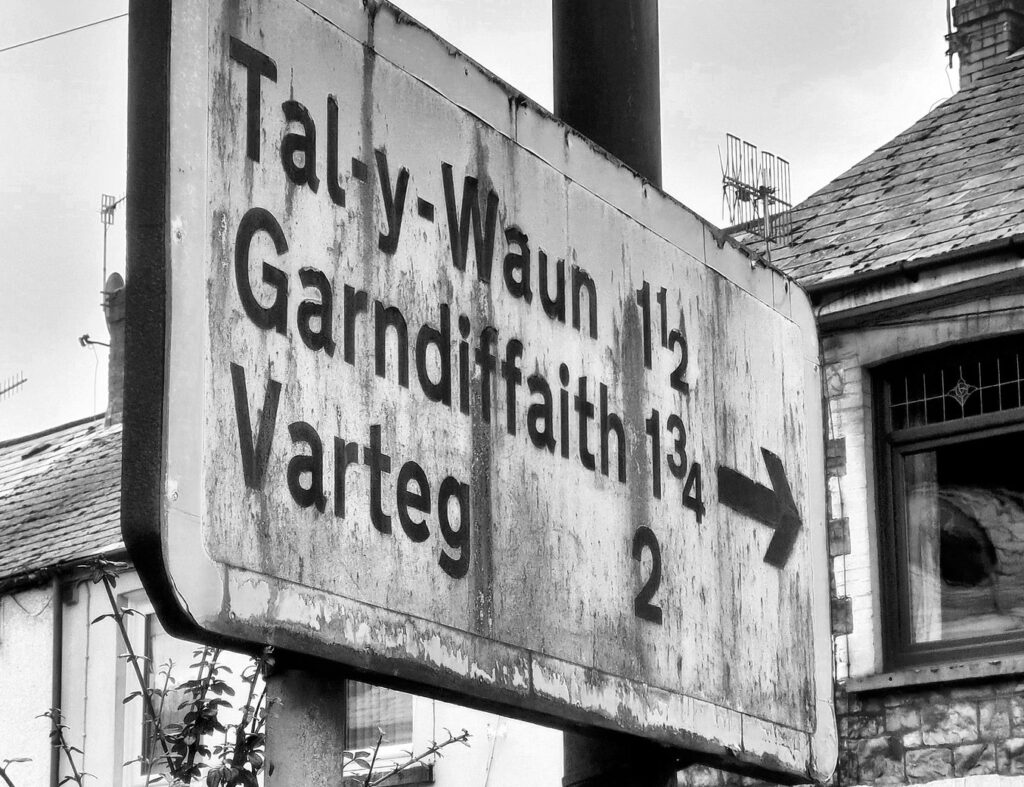
Y Farteg: Varteg’s Empire-approved official name is the wrong one
Stephen Price
In news this week, Torfaen council has officially approved 54 place names across the county, with one name in particular making headlines once again.
Be seated folks, it’s HILARIOUS! (If you’re anti-Cymraeg and/or not so bright).
Thankfully we can all breathe a sigh of relief as the Welsh language will no longer face any ridicule by journalists and a handful of tourists, and the silly idea that a Welsh place name will be spelled correctly is thankfully off the table.
Yes, Varteg will no longer be spelled Fart-Egg.
Even though, of course, it was never going to be spelled that way anyway.
As reported by Twm Owens on Tuesday 13 October, a plan to settle on a formally agreed list of names, in English and Welsh, for towns and villages across Torfaen in 2013 led to a row when residents in Varteg on the outskirts of Pontypool objected to using an F in the Welsh spelling.
They feared they would be ridiculed if Y Farteg was placed on the village road sign, with the F proposed as there is no V in the Welsh alphabet. Following a consultation in 2013 Torfaen Borough Council agreed to continue using the spelling Varteg in both languages.
Though the council had sent its list of approved place names to the Welsh Language Commissioner in 2013 they were never adopted on a national level.
In January last year the commissioner approached the council to look again at the issue and come to a consensus on standardising Torfaen place names.
As a result a list of 54 names to be recognised as the official names in both English and Welsh has been agreed between the council and the commissioner.
The list also confirms Varteg will continue as the official spelling for the village in both languages.
The name for Fairwater will continue to be used in both English and Welsh while Sebastopol, between Cwmbran and Pontypool and named for the siege of that name during the Crimea War, will continue with the same spelling in both languages.
The council’s Welsh language compliance notice has been in place since 2016 with the overarching principle of “treating the Welsh language no less favourably than the English language.”
The list has been approved for use throughout the borough and further afield in a decision taken by the council’s cabinet member for corporate governance, Labour’s Peter Jones, who represents Cwmbran’s Two Locks ward whose officially agreed name in Welsh is ‘Dwy-loc’.
A report by the council’s Welsh language policy-officer Alan Vernon-Jones said the failure to adopt the names on a national level had been causing confusion.
He stated: “Despite sending the Welsh Language Commissioner our approved list of names, these were never adopted on a national level. This has proved problematic in recent years, with the majority of external organisations looking at the commissioner’s website for official Welsh names, rather than consulting with the local authority.”
A revised list was compiled using a combination of the consultation findings from 2013 and expertise from the commissioner’s office.
Mr Vernon-Jones said the process had taken longer than expected, following the approach in January 2025, due to the standardisation panel only meeting at certain times of the year.
Any required changes to bilingual names on signs will only be carried out as a result of replacement or scheduled renewal.
The list will also be distributed to council teams, and staff and managers will be made aware of the agreed standardised list to ensure that staff use the Welsh language names in the course of their work.
It will also be sent to the council’s partner bodies.
Idiot-compliant
Essentially, the decision can be summed up as ‘Council and Commissioner prioritise the juvenile and uneducated over Wales’ native language’.
“Oh that sounds like fart egg – funny ha ha ha”
“No. It doesn’t, it’s an English corruption of a Welsh place name and sounds like ‘Varteg or Var-tairg’ actually – learn the Welsh alphabet and then make your comment – and it’s not in English, for English approval – or shouldn’t have been anyway.”
An imperfect analogy, no doubt, but if I knew a child was being bullied or ‘ridiculed’ for simply being their beautiful innocent and anything-but-harmful self, my solution would not be to tell said child to adapt, to be more like the bullies, to try and fit in. I’d do all I could to empower them to stand up straight, to look their bullies in the eye, and most certainly not change to be lesser, to be harmed.
How many parents have to debate a child’s name because of how it lands in the playground, instead of addressing the unfairness and idiocy of the playground.
I know at least one family who have to spell their boy’s name Iolo with a lowercase i – and they simply shouldn’t. Same for Gruffs becoming Griffs, and Angharads and Geraints no longer being in vogue. It is not Wales’ job to be lesser, to be more Anglicised, to fit in – but for us to be less forgiving of the uneducated and small-minded.
Bending to the sensibilities and the ‘mocking’ of the superpower is admitting that Welsh is secondary. And even though the name itself is Welsh, it’s unthinkable to actually be spelled as it should.
Gwawr Dafydd responding to an article summed up the Varteg/Farteg ‘debate’ in a letter to the Times, sharing: “Sir, After reading your article “Village kicks up a stink over plan for new name” (Sept 25) it seems to me some of the residents of Y Farteg and your reporter have got the wrong end of the stick.
“The village was renamed incorrectly when it was anglicised — as happened with so many other Welsh towns and villages. There is no “V” letter in the Welsh alphabet, therefore Varteg is incorrect.
“The name Y Farteg originally comes from y + march + teg — when translated it means “the most beautiful place” and I am sure the residents are very proud of this name. Hopefully common sense will prevail in Torfaen Council when they decide to use the correct name for this village.”
Common sense. Where did that go?
“Can’t pronounce it? Look it up. Think it’s funny? Why – explain that will you?”
Welsh has been ridiculed and viewed through English eyes for centuries. It’s the reason my forefathers and mothers didn’t pass on the language of this soil, of my blood, and why I have a non-Welsh bunch of forenames and an Anglicised surname. Surely we’re beyond this now?
Shall we cross-reference all Welsh names that might make an English-speaker chuckle while we’re at it? And bear in mind that the rule only works one way – the baffling spellings of English place names that might sound odd or ‘hilarious’ to a Welsh speaker go in the bin too, since the languages have (laughable) equal-footing in the land after all.. But we know that would never wash.
When it’s Welsh, however, it’s all a little silly, a little ‘nice to have’ – it’s performative and virtue signalling even – “let the English proper spelling system override here, we’ll have none of this Welsh malarkey going on!”
“I’d be humiliated every time I told someone my address,” said resident Sioned Jones to the Guardian when the spelling change was first touted. “Everyone will be laughing at us and coming to get photographed next to the street signs.”
Local MP Paul Murphy rightly added: “Varteg is not an English word so translating it is totally unnecessary.
“It’s a name that reflects our rich history and culture in the Eastern Valley, with its Welsh-language and English-language influences.”
Torfaen council has made some strange choices in their list of 54 place names – Griffithstown in Welsh will be… drum roll.. Griffithstown. Cwmoody will remain Cwmoody. Fairwater will remain Fairwater.
For the most part, though, it’s been quite sensible – Cwmafon, Blaenafon and the like.. but in the case of Farteg, a defiant move to say “no, this is a Welsh name and this is how it’s spelled in OUR language” should have been taken.
One commenter wrote on Nation Cymru yesterday: “Y Farteg apparently means a place of fine horses, which, without the y could easily be MARTEG, so what’s the problem? The whole list seems to appease those who cannot accept there are two languages in Wales or that different languages have different names for places. Torfaen should be ashamed. Im just glad I don’t like in TreGruffudd… sori, Griffithstown!”
A friend of mine chimed in on Whatsapp: “Retaining the ‘V’ in ‘Varteg’ is akin to insisting on calling it ‘Caernarvon’. We are also in ‘Llantwit Major’ levels of derision here as ‘Y Farteg’ is only funny in a puerile way which gives the gutter press something to write about.
“A mature and correct approach would be to call it Marteg, but as we know with the Welsh Language Commissioner, common sense isn’t all that common. This is more evidence that this is a toothless organisation.
“You only have to look at nearby Govilon being the nonsense-word Gofilon according to the Welsh Language Commissioner when it was always understood to derive from Gefailion, the Gwentian Welsh dialect word for “forges” or “smithies” – an indication of its industrial and linguistic past – but Cardiff knows best!”
Varteg’s right and proper name being ‘the English way’ is all too telling.
It is meek and cowardly, and will cost Farteg and Torfaen – and the respectability of the council and Welsh Language Commissioner (who is conveniently ignoring similar oversight and idiocy in neighbouring Monmouthshire) – in the long-term.
A decision to be lesser, humble and English-language and idiot-approved is not the one that should have been taken.
Note that the council’s Welsh language compliance notice has an overarching principle of “treating the Welsh language no less favourably than the English language.” I needn’t even comment.
A very sad day for the Welsh language, but I repeat, a very telling day all the same.
The council and the Welsh Language Commissioner are the only thing in need of ridicule here. But what else have we come to expect.
Support our Nation today
For the price of a cup of coffee a month you can help us create an independent, not-for-profit, national news service for the people of Wales, by the people of Wales.
Get more trusted Welsh news
Choose Nation.Cymru as a preferred source in Google News to see more of our journalism.