

A Tribute to Kevin Sinnott (1947 – 2026)
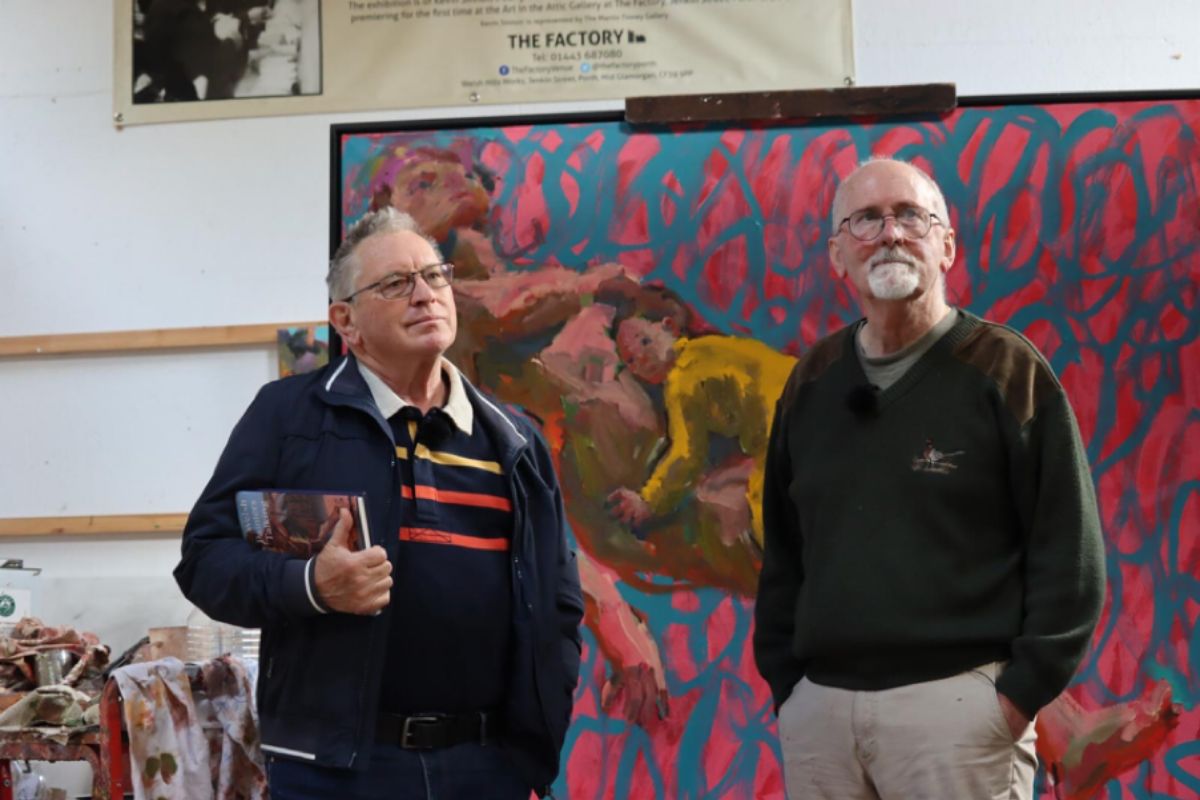
Tony Curtis
Kevin Sinnott died earlier this week. Five days before, on Wednesday the 22nd of July, I visited him in his house to ask him about a drawing we have and to take him some custard slices from our favourite shop. He was very weak, but enjoyed the treat and perked up for the brief time I had with him.
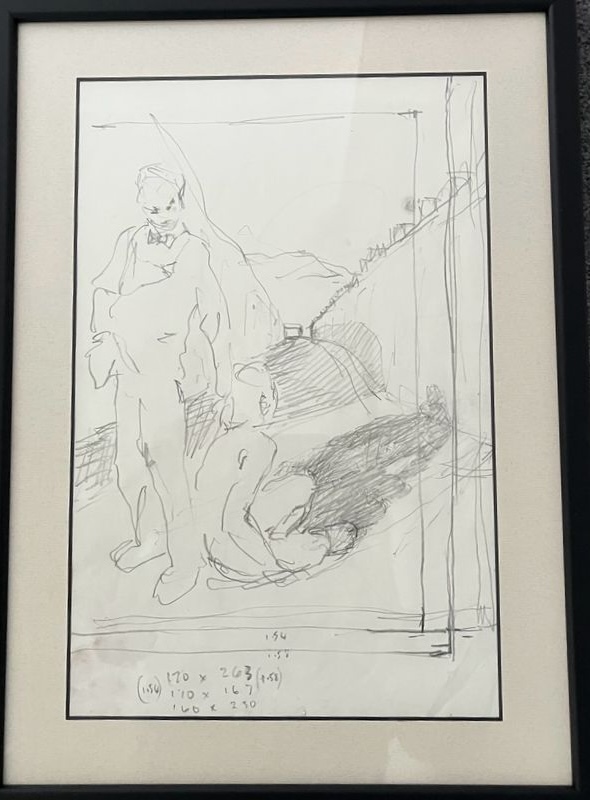
This drawing is one of two hanging in my study: they were gifts from Kevin after I had interviewed him at the Three Streams festival in St Illtyd’s Church in Llanilltud Fawr, three years previously.
Of course, he had been included in my Welsh Painters Talking in 1997 and we had met on many occasions since then – exhibition openings and talks. For the first interview, I visited him in the remarkable Ty’r y Santes Mair near Pont y Rhyl in the Gawr Valley, where he and his wife Sue raised their family upon their return from London. Kevin had converted the disused church into a spacious dwelling, with a large studio in the roof space.
Born near Maesteg, one of a large Irish Catholic family, he had entered Cardiff College of Art and in 1971 was accepted at The Royal College of Art. Like his contemporary, Peter Prendergast, he found London a challenging and stimulating experience. Both artists had some early success and recognition; though both really found themselves and their true subjects when they returned to Wales.
My last visit was short; Kevin was ill and had just returned from a three-week stay in hospital. He was on a settee in the large entrance hall, recumbent beneath an enormous canvas from his “Turkish Baths” series, probably twenty feet by thirty-five. I asked him about the two small drawings and it became clear that the one I’m sharing here was quite a significant study for a large, autobiographical painting.
This is indicated by the dimensions written at the bottom of the paper. Kevin explained that he was the adult figure wearing the bow tie. The successful man was returning to the valley and he touches, or pats the head, of the crouching figure of the boy – his former self. It’s a rough sketch really, but has the gestural energy and juxtaposition of characters that only a very skilled artist can render in a few pencil marks.
Across the narrow valley from his house are the three-level terraced houses which figure in many of the best works. In the late 1990s Margaret and I visited the Flowers East Gallery, driving through a deserted City of London one Sunday morning.
We saw a fox strolling past one of the Banks. That generous exhibition was one of the strongest solo shows I’ve ever seen: dozens of large canvases with figures, couples and families at work or play along the precipitous slopes where they lived. It could only be a south Wales Valley community. It was radiant with a bright sun and their lives seemed blessed there. They were the perfect riposte to the empty City of London.
Kevin was raised as a Catholic and my oldest Llantwit grandson was baptised in the Bridgend Church of St Mary, beneath Kevin’s painting of the crucified Christ behind the altar. There is art in churches, but it may be argued that his faith is also often expressed in the positive images of couples in love and communities pulling through together. Kevin committed himself fully to the Garw Valley, when he returned.
He even opened a gallery of his own in Number 18 Oxford Street, Pontycymmer – “Studio 18 – London, New York, Pontycymmer” was printed on the window. He said it was “A reward for coming home -‘the fatted calf’ even. A reward for the recognition and acknowledgement of my debt to the place in which my particular adventure began.” The gallery showed Kevin’s work alongside others, including Julie Davies, a retired ward manager who had returned to assist as a nurse in the Covid crisis. Also, William Brown was featured in a posthumous retrospective. Kevin was generous to fellow artists.
When one is committed to and immersed in contemporary art it is easy to forget that most people are not. Furthermore, many people find contemporary art intimidating. Probably the only artist from Wales that many people have heard of is Sir Kyffin Williams; their jaws drop at the prices realised for Kyffins in auction and his work reinforces their need to locate themselves in a rugged, rural Wales which probably no longer exists for them.
But the only single painting that is widely recognised is Kevin’s “Running Away with the Hairdresser.” It is nearly always on show in the National Museum in Cardiff and has been reproduced on cards and posters. There are more recent variants of the two figures and the theme of love in the Valleys from Kevin’s studio. He quotes himself, as it were. His version of the Valleys communities fulfils a similar role to that of Kyffin Williams and Peter Prendergast in north Wales. Each artist captures the essence of what remains as our shared identity through memory.
Of course, when it came to choosing a cover image for my book of interviews Welsh Painters Talking in 1997, there could only be one: Mick Felton, the publisher, and I were in agreement. Kevin’s painting had acquired iconic significance. The young man is escaping (eloping?) with the hairdresser; they have to leave the valley town which raised them and begin a new life. It is both illicit and joyous. We cheer them off. Perhaps we wish it were us.
His chapter in Welsh Painters Talking has a photograph in his studio, taken by Bernard Mitchell; just over Kevin’s shoulder is a canvas on an easel of a man pushing a wheel barrow with a dog in it. When Kevin explained this work, I was especially struck: what this painting was capturing was an important moment in their early days in the house. I tried to tell that story in my poem “The Wheelbarrow”
…This winter, just after we’d moved in,
we had a mishap with the dog
they’d left us with this place.
A fine guard dog – named after a German city.
But it got out and mauled some sheep.
In the still-wet painting he is pushing the dead
weight of it up the slope deeper into the trees.
His father-in-law has attached a rope to the barrow
and puts his weight into the pull…
That rainy winter night
I see them spading down the covering
of earth, needles and leaf-mulch.
Then one of them, or both of them, sings,
or cries. Or it might be the rain
in the trees and in their eyes.
In a video interview which I did with Kevin in 2023 he said, “Sometimes I think my painting subject matter was driven by art: when I got back to Wales it started to be driven more by life.” The little drawing he gifted me shows the return of the prodigal, successful son; he comes back to celebrate the changes in his life and to touch his boyhood roots. As Kevin said last week when he saw it again, “It is autobiographical.”
Kevin Sinnott found early success with the Bernard Jacobson Gallery in London and in America. His return to south Wales gave him renewed energy and what, perhaps, was always going to be his true subject. Lovers gaze across and down from the valley slopes at the terraced houses snaking along the winding valleys. There is a rugby pitch; clothes lines are hung with clean sheets and clothes.
Balls are kicked into the sky, dogs run free. Couples cwtch under the low skies. He celebrates love, praise and poetry in the everyday lives of his neighbours, his people. That’s a legacy many of us would wish to aspire to.
Support our Nation today
For the price of a cup of coffee a month you can help us create an independent, not-for-profit, national news service for the people of Wales, by the people of Wales.
Get more trusted Welsh news
Choose Nation.Cymru as a preferred source in Google News to see more of our journalism.


