

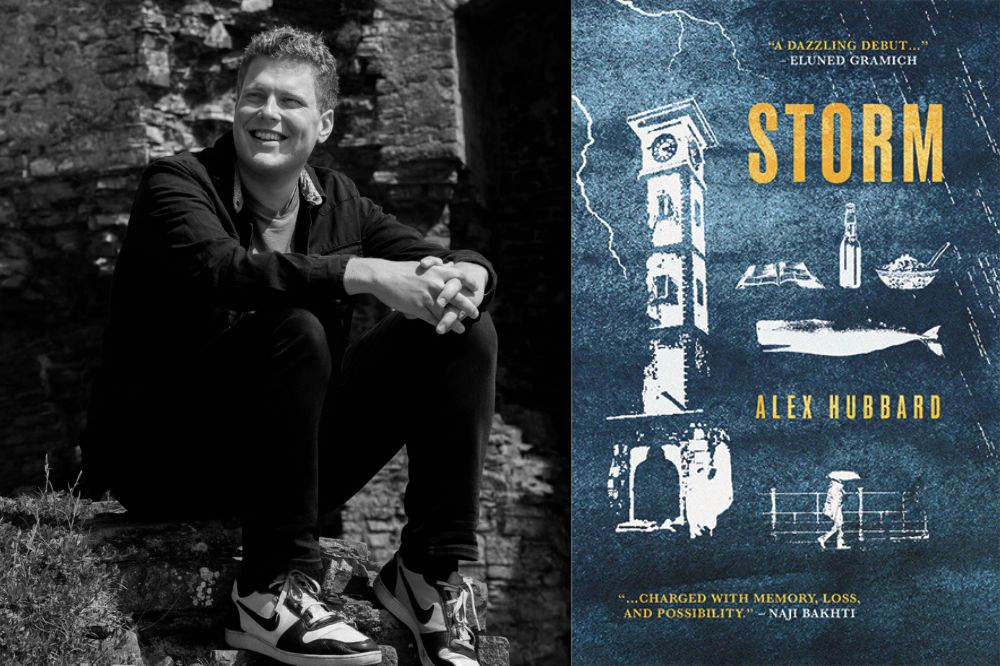
Alex Hubbard on his debut novel Storm
Imogen Davies
Alex Hubbard’s scintillating debut novel is an intriguing story about love, friendship, and our links with the past – a contemporary Gothic masterpiece which will leave you nostalgic for your small-town uni days.
Josephine is already haunted. At university in Aberystwyth, she is grateful to be away from home, and further everyday from the past. When she kisses Glynn on a night out, it could be the start of a love story. Awkward, earnest and polite, he isn’t like the other people she knows. But the town is in the midst of a violent storm and strange things keep happening. Josephine wishes it would all go away. But the past is intent on coming for her.
What inspired you to write Storm?
While wrapped up in rain, booze and ectoplasm, Storm is, in its essence, a love letter to Aberystwyth.
The cast of characters was initially put together during my undergraduate, from 2015 to 2018, heavily inspired by my motley-crew of friends, acquaintances and undesirables. However, when I came to taking this loose assemblage of character sketches into a narrative, the effect was a poor imitation of something between Niall Griffiths’ Grits and Sally Rooney’s Normal People. I’d been reading W.J. Lewis’ wonderfully heterogeneous Born on a Perilous Rock, which offers a comprehensive history of the town; everything from council disputes to washed-up whales.
I always wanted the novel to ask students, particularly those who, like me, came to Aberystwyth and Wales from England: what do you not know about this place? Initially, this was to be communicated quite didactically, with characters having nuanced conversations about what it means to live in a place. But I felt there was a real opportunity to evoke those histories in distinct, unusual ways. This was the driving force for what became Storm’s magical realism.
In ‘Storm’, you mention writers such as Melville, Murakami, and Griffiths, are there any writers in particular that inspired this novel or your writing style?
Lots, to the point where, in some ways, Storm feels a bit like an amalgamation of all the different stuff I like. However, the chief influences are probably James Joyce’s Ulysess and Brigid Brophy’s In Transit. Joyce got me thinking about how much space style offers to play with reader and character perceptions. Brophy gave me permission to throw mimetic conventions out of the pram, before delicately picking them back up again. American surrealism – Infinite Jest, and the television shows Twin Peaks and Atlanta, primarily – also influenced me a lot.
The TV series, Hinterland, is a noir crime drama also set in Aberystwyth and the surrounding area. Why do you think Aberystwyth is an ideal setting for a moody, dark, atmospheric novel or series? As ‘Storm’ is equally populated by troubled characters haunted by their personal and communal past…
In the winter, Ceredigion can be a difficult and beautiful place to live. The winds are high and hard, the nights are dark, and the trains often break down. Aberystwyth sometimes feels quite entrapping.
Hinterland represented such a moment of confidence in Welsh culture. I love the show very dearly, particularly for its attention to the Aberystwyth psychosphere. It’s a shame more hasn’t been built from the momentum it gathered.
I think Aberystwyth is a place of almosts. It doesn’t have the seafaring tradition of a Bristol, for instance, but it could have. Its historic, but that history is fragmented, polyphonic and therefore doesn’t conform neatly to conventional narratives.
All of this makes the place philosophically, aesthetically, innately gothic. For what is the gothic if not falling into a place you cannot quite understand?
What is the most surprising thing you learned about Aberystwyth in researching and writing this novel?
I’m still reeling from W.J. Lewis’ claim that a whale washed up on tan-y-bwlch. There was also a conspiracy theory I came across, which suggested the National Library of Wales continues to play a part in covering up a rather significant royal scandal. I’d better steer clear of giving anything further away…
Have you ever been in Aberystwyth during a storm? Did anything strange or out of the ordinary happen?
Plenty of times. Of course, the responsible thing to do is stay inside and wait for the weather warnings to end. However, while writing Storm, I generally ventured out into them to get a feel for the conditions. Late one night, I came across a bunch of kids in cars, getting ready to race. There’s nothing quite like headlights in the rain.
What do you think Owain Glyndwr, among the other Welsh historical figures you allude to in the novel, would think of Aberystwyth today?
Pleased but, given the number of royal pardons he ignored, probably ultimately a bit disappointed. Regarding Wales more generally, maybe a little gutted at where the Senedd ended up.
I think the most interesting thing is how we see him, and that’s what I wanted to capture. Never captured, never killed, he’s a symbol of what could’ve been. I’m quite keen to watch Owain & Henry with Michael Sheen because it’ll likely build on these themes in a way I couldn’t. The surrendering of Aberystwyth Castle in 1412 was in many ways the end of Glyndŵr’s potential as a serious political threat, so perhaps there’s even a sequel for them to think about.
Part of the reason it was so easy to write the Preacher as a quasi-antagonist was that his inspiration, Reverend John Williams, was so obviously resisting the kind of place Aberystwyth has now become. Generally, I was very hesitant to put words in the mouths of the dead.
Given that the sea is central to ‘Storm’ and life in Aberystwyth, and that your current project is a book about rising sea levels and lost places, would you say the sea is of great interest and inspiration to you?
Since I first moved to the seaside, I’ve found myself often ruminating about water. It sustains, kills, and erases us. Even when I briefly moved back to London, I would watch the Thames flow with a kind of obsession.
It might be tides, specifically, which interest me. Katherena Vermette, the Canadian poet, writes very movingly about this in ‘indians’, where she imagines the Red River giving back the many drowned bodies it has taken away. Alice Oswald’s Dart explores spectres, industries and peoples living alongside the rushing waters of the River Dart.
Tide and light are the parameters with which we built time. If we don’t act soon, it’ll be tides that get us, in the end.
What do you hope readers will take away from this novel?
That places are large, people are strange, life is beautiful, and novels are fun. That whimsy can be profound.
Alex Hubbard is a writer from London, living in Wales. He first came to Aberystwyth in 2015 and, like so many, fell in love with it. His creative work has appeared in Nawr, Cerasus, The Forge, Abergavenny Small Press Literary Journal, Prole, Bandit Fiction, and in the two anthologies by Think.Material Press, among others. He is currently writing a novel about rising sea levels and lost places.
Imogen Davies is a writer and creative from Aberystwyth, currently undertaking a masters in modernist literature at the University of Edinburgh. Named as one of sixty New Welsh Poets ‘to watch’ by Poetry Wales, her first collection, DISTANCES appeared in 2024.
Storm is available on the 8th of October, published by Seren Books.
Support our Nation today
For the price of a cup of coffee a month you can help us create an independent, not-for-profit, national news service for the people of Wales, by the people of Wales.
Get more trusted Welsh news
Choose Nation.Cymru as a preferred source in Google News to see more of our journalism.


