

Angela Graham on Documentary Poetry
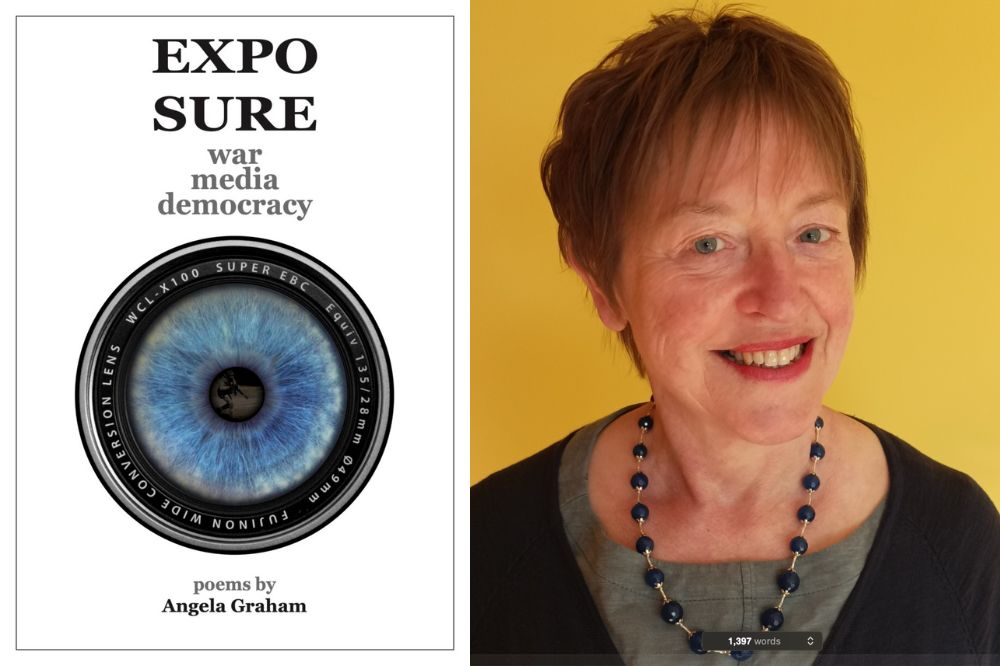
Angela Graham considers the influence of her career as a documentary-maker on her poetry collection Exposure: war, media, democracy from Culture and Democracy Press.
My new collection of poetry, Exposure: war, media, democracy began from my response to a photograph of a dead Russian soldier on the outskirts of Kharkiv. It was taken on the invasion’s third day, but he had died on its first afternoon.
As I saw more and more photographic coverage of this one death, there before me was evidence of how the choices made by the photographers were emphasising particular aspects of the scene. Changes in the weather were powerful influences – snow loomed, arrived, dominated, melted; as were changes in access – front line crisis, aftermath, stasis. Each variable was likely to touch one rather than another emotional chord in the viewer. Every image was ‘true’ but many images considered in relation to one another revealed the complexity in the circumstances, making them more challenging to decipher – the truth deepened; or the truth undermined?
Truth is notoriously both absolute and subjective. Shift the point of view and a situation presents fresh facets. Re-interpretation ensues. Where has the simple truth gone?
The earliest photograph, taken shortly after the death, is laden with a sense of banality and futility. It’s a raw February close-of-day. The soldier lies on gritty tarmac alongside his crippled armoured vehicle. He wears a beanie hat, not a helmet. The casual. The catastrophic.
In contrast, photographs taken from the following morning on, are captured in the diffused, almost artificial, aura brought by the snow that arrived at eight o’clock. Veiled in white, the disparate elements lose their idiosyncrasies. The scene is monumentalised as though in some medium of stone. When the thaw begins, slush, photographers’ wet footprints, emergent details create images that display tracks of the process of shooting and thereby draw attention to the manufacture of meaning. It is less easy to believe that the photographer has simply captured the truth of the scene.
The first section of the collection consists of twelve poems prompted by these photographs, considering the interplay of subjectivity and objectivity and the resulting ‘reality’ rendered. The thirteenth poem, Exposure, asserts:
the photograph, unmoving,
moves us
– viscerally –
to implicate ourselves,
to feel
as a stranger felt,
to be
beyond ourselves.
The type of photo-journalistic photographs I am considering work, to some degree, as an icon does. They hold reality present so that we can contemplate it.
But I spent decades, not as a photographer, but as a documentary film-maker. In writing this collection I became aware of the influence of that medium on my writing practice. The next section of poems is entitled, ‘I Imagine Being’ and these five poems are in the first person. Three of them are prompted by the BBC 2 documentary, Ukraine: Enemy In The Woods which won Hoyo Films the BAFTA Award for Best Single Documentary, 2025.
Documentary film makes big claims to communicate truth. Real people speak unscripted words in actual settings. The root of the word is in the Latin documentum which comes from the word for teaching and learning and became attached to the tangible evidence used in legal proceedings. In documentary film you will encounter evidence, especially proof derived from experience. Though we will immediately think of documentary genres such as docu-drama or docu-spoof which harness artifice, the claim will nonetheless be made that the manufactured elements work in the service of attaining truth.
Documentary’s trump card is its I-was-there, eye-witness quality. I made many films in which my role was to enable people to represent themselves on screen as accurately as possible. I don’t say as truthfully because maybe they were sometimes lying, but then, that would be the truth of their position.
The central figure in this Ukraine documentary is Vovan, a unit commander in the defence of Kharkiv. To use a theatrical term, he is the protagonist, the protos agonistes; literally the frontline sufferer. He and members of his unit were supplied with bodycams and therefore the viewer sees something very close to what they were seeing during combat. This is certainly being brought close to the action, to its sudden lulls and eerie silences among the slender trunks, more like stems, of pale-barked trees in an endless forest infused with snow.
We are, of course, brought close to the soldiers and their feelings. The immediacy prized by documentary is certainly achieved. We hold in a creative tension our knowledge that film is orchestrated reality (it has a rhythm created to represent reality while maintaining a hold on the viewer’s attention) and our willing assent to accept it, on its terms, as reality. A poorly made film can’t sustain this tension.
It’s a tribute to this film’s calibre that, when writing poetry prompted by it, I instinctively took a further step into identification with the people in it. In these poems I include words spoken in the film (words truly said and in a setting rendered faithfully) but I also speak as Vovan; both giving words said by him and giving him words. In putting words into his mouth, I intend to express what the film as a whole gave me to understand about him. Each poem is footnoted to state that words in italics are from the film.
I IMAGINE BEING VOVAN, UNIT COMMANDER IN THE DEFENCE OF KHARKHIV
November/December 2023
When I made it back home, Mama cried out,
My golden boy! My little fish!,
bending my head down to hers,
kissing my hair, eyes, forehead,
and I swam in the dam-burst of love
that swept through our apartment,
all of them hugging, stroking,
holding onto me as though amazed
I was flesh and blood, not a ghost
returned from that savage borderland.
I say, and I don’t say, what I did there.
The next poem goes further into identification with Vovan in that I create ‘a scene’ and details which are not in the film, but which draw on what the film communicates of combat and how he felt about it.
I IMAGINE BEING VOVAN, ON FURLOUGH
At night I watch the lights from traffic at the intersection
chase each other across the ceiling
– shadows writing …
They swing in urgent arcs, or float and fade
– such anxious angels.
Or maybe the roof is perforated, letting strange lights through.
I can’t get a fix on what’s outside, or in.
I lose perspective and proportion.
I lost myself today among the supermarket aisles.
Sleep is a shallow dug-out where I dream a cathedral
of so many pillars there’s no room to pray,
and they refuse to form a line, no aisles:
move and these trees move with you.
Between slender saplings I am a bottom-feeder,
darting over an ocean floor of snow, chasing shadows
and never any sky or sunlight, just dawn/day/twilight/night …
I wake, and, overhead, angels and drones …
I have a feeling that the forest will never leave me.
In March 2025 I learned of Vovan’s death.
MAKING CONTACT, MARCH 2025
During a Russian tank attack ten months ago
Vovan was suddenly let through.
He is where I am not – yet –
Time will deliver me.
The dead are reticent. No need to cajole
or threaten us. We will arrive.
Time will deliver us
– each of us suddenly let through.
Here, via sound and shadow in a film,
something of Vovan entered me, to stay.
There, he and I will be suddenly let through
to one another … suddenly let through
In writing this I stumbled on the realisation of a major theme in the collection, that of the desire to be ‘let through’ into another life. The documentary had allowed me access to Vovan’s life. Only a version of it, I realise, but still very precious access. I-had-been-there with him, to the extent that the medium of documentary can achieve.
All media are means of access to one another or they are spurious and compromised. Through the medium of poetry, I have tried to provide access to what this documentary offered me. I was drawn to documentary-filmmaking because of its potential to let people speak, to let them represent themselves. I try to remain aware of the influence of artifice in this process. Perhaps my poems are documentaries of a kind.
EXPOSURE: war media democracy by Angela Graham is available from Culture and Democracy Press.
Support our Nation today
For the price of a cup of coffee a month you can help us create an independent, not-for-profit, national news service for the people of Wales, by the people of Wales.


