
Artes Mundi 11 brings major international art to Welsh venues
Six international artists will exhibit new and major works across Wales next year as part of the eleventh edition of the UK’s leading contemporary art prize, Artes Mundi.
Artes Mundi 11, presented in partnership with the Bagri Foundation, will run from 24 October 2025 to 1 March 2026, featuring exhibitions at five venues nationwide with Aberystwyth Arts Centre joining for the first time.
The £40,000 Artes Mundi Prize, the UK’s largest contemporary art award, will be announced at a ceremony at the National Museum Cardiff on 15 January 2026.
Themes
All six artists will be represented in a group exhibition at National Museum Cardiff, the central hub of AM11, showcasing ambitious new productions and key museum loans that explore themes of loss, memory, migration and environmental cost.
These will be complemented by in-depth solo exhibitions across Wales, offering audiences multiple ways to experience the artists’ work.
The solo presentation locations for AM11 are: Anawana Haloba and Sawangwongse Yawnghwe at Aberystwyth Arts Centre, Aberystwyth; Sancintya Mohini Simpson at Chapter, Cardiff; Kameelah Janan Rasheed at Glynn Vivian Art Gallery, Swansea; and Jumana Emil Abboud and Antonio Paucar at Mostyn, Llandudno.
As a vital platform of cultural exchange between the UK and global artistic communities centred on the ongoing examination of the ‘human condition’, Artes Mundi brings together a significant biennial exhibition of contemporary art from impactful international artists.
Features
Anwana Haloba at Aberystwyth Arts Centre and National Museum Cardiff
Anawana Haloba (b.1978, Livingstone, Zambia; lives and works in Oslo and Livingstone) explores how societies position themselves within shifting political, social and cultural contexts, rooted in Zambia’s post-independence experience.
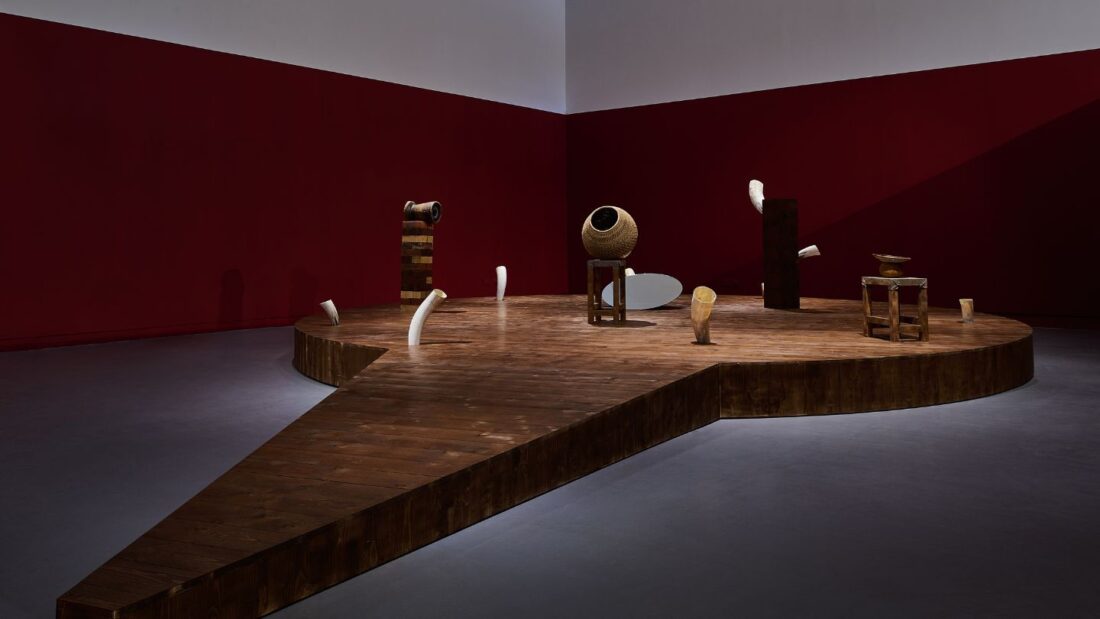
At Aberystwyth Arts Centre, Haloba will present a new version of a large-scale installation that functions as an hourly opera, combining spoken word and song from objects arranged on stage. The work unfolds as a dialogue between characters reflecting on the rise of nationalism and migration.
At National Museum Cardiff, she will exhibit an interactive sound sculpture inviting visitors to listen to whispered fragments of text, music and ambient recordings emerging from ceramic forms that explore trauma and healing.
Sawangwongse Yawnghwe at Aberystwyth Arts Centre and National Museum Cardiff
Sawangwongse Yawnghwe (b.1971, Shan State, Burma; lives and works in Zutphen, the Netherlands) was born into the Yawnghwe royal family, his grandfather Sao Shwe Thaik serving as Burma’s first president after independence in 1948. Following the 1962 military coup, his family went into exile, first to Thailand and later to Canada, where he grew up.
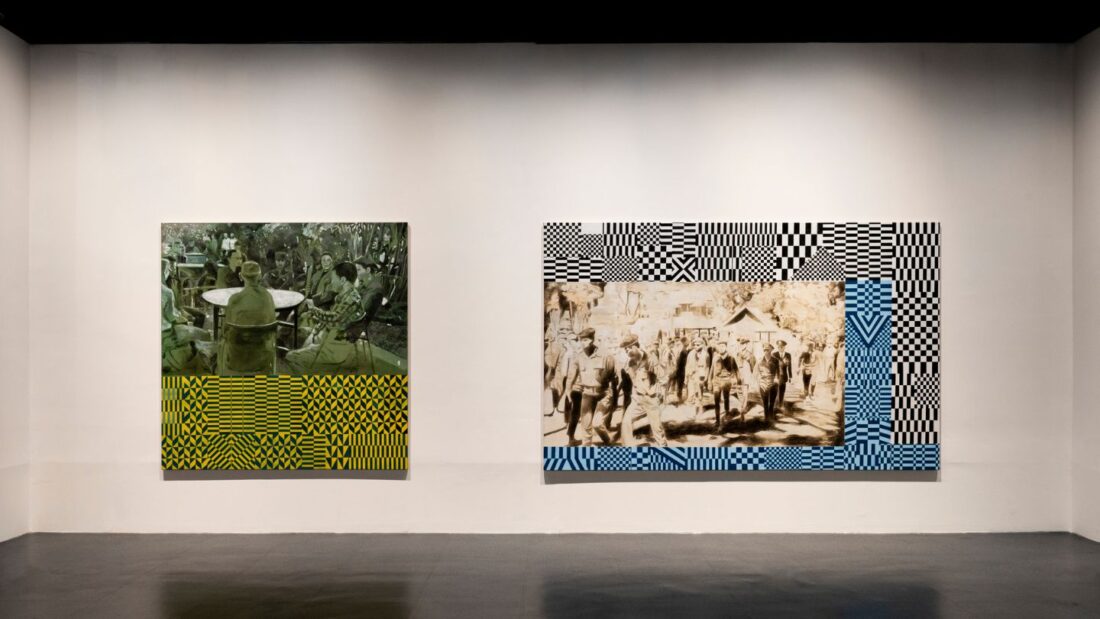
Yawnghwe’s paintings draw on his family history and Myanmar’s turbulent politics, addressing conflicts related to drugs, revolutionary armies and state violence, aiming to clarify a complex political landscape. At Aberystwyth Arts Centre and National Museum Cardiff, he will show a series of new three-metre paintings combining family photographs with abstract, optically patterned panels, questioning how archives and images shape national identity and truth.
At Aberystwyth, he will also present impastoed still-life paintings of opium poppies, referencing Myanmar’s historic and ongoing opium trade and its entanglement with rebellion and Western influence.
Sancintya Mohini Simpson at Chapter and National Museum Cardiff
Sancintya Mohini Simpson (b.1991, Brisbane; lives and works in Meeanjin/Brisbane, Australia) is a descendant of indentured labourers sent from India to work on colonial sugar plantations in South Africa. Her multidisciplinary practice spans painting, video, poetry and performance, exploring migration, memory and trauma, reflecting on her maternal lineage through narratives and rituals.

At National Museum Cardiff, Simpson will present a large-scale watercolour and gouache work referencing Indian miniature painting and aerial landscape traditions common in Indigenous Australian art. This will be shown alongside Sugar Vessels, three black clay forms fired in sugar cane mulch that evoke the body, water and boat, symbolising oceanic migration and the legacy of the sugar industry.
At Chapter, she will debut new and recent works using sugar cane as pigment, including scroll-like pieces with handwritten text and a large sculptural sound installation activated by a live performance on opening night. Her video Dhuwa (“smoke” in Bhojpuri, one of the terms used by indentured labourers in Natal, South Africa) will also feature, infusing the space with the scent that inspired its title.
Kameelah Janan Rasheed at Glynn Vivian, Swansea and National Museum Cardiff
Kameelah Janan Rasheed (b.1985, East Palo Alto; lives and works in Brooklyn, NY, USA) explores the poetics, politics and pleasures of communication through a multidisciplinary practice that probes the relationships between written language, loss and fugitive meaning.
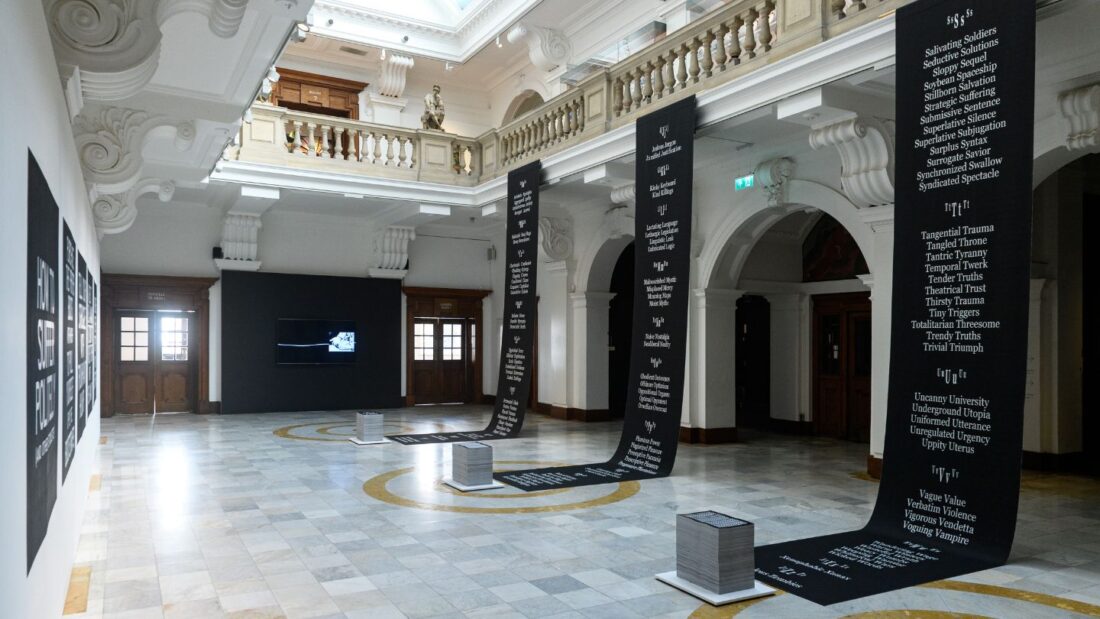
At Glynn Vivian Art Gallery, Rasheed will transform the atrium into an immersive graphic environment of prints, drawings, banners, photographs and video that evoke the energy of the street. Combining text and image through collage, humour and wordplay, the installation reflects on the fluidity of communication. Describing herself as a learner, Rasheed will also lead workshops and tours for schools, communities and families as part of the public programme.
At National Museum Cardiff, she presents a related installation linking both spaces through Rasheed’s response to the particularities and idiosyncrasies of the building’s architectures in relation to her intervention. These fragmented compositions function as visual “footnotes” to a large-scale wall text that anchors the display.
Jumana Emil Abboud at Mostyn, Llandudno and National Museum Cardiff
Jumana Emil Abboud (b.1971, Shefa’amer; lives and works in London and Jerusalem) draws on folklore, myth and storytelling to explore heritage and the shared connections between people and place. Working across drawing, sculpture, video and performance, her ongoing Water Divining project investigates how local tales endure through changes in land use, occupation and displacement centred on water sources.
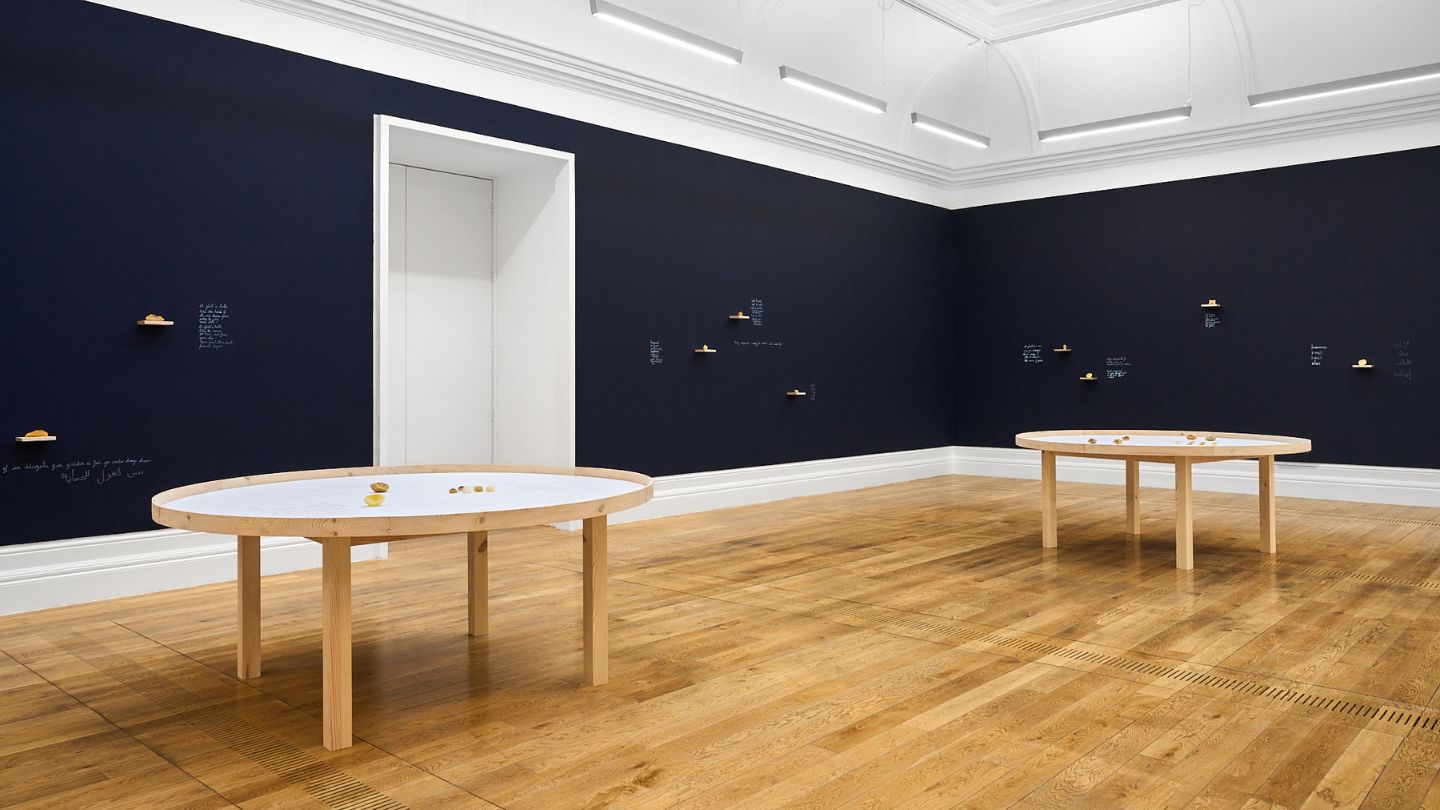
For Artes Mundi 11, Abboud will lead a series of workshops and walks in the north Wales landscape, collaborating with communities around Llandudno to uncover stories surrounding nearby freshwater springs. These gatherings will inform new embroideries, drawings, writing and cast wax votive forms, presented at Mostyn alongside selections from earlier iterations of Water Divining in Palestine and elsewhere.
National Museum Cardiff will exhibit further drawings and objects inscribed with charms and spells, while Mostyn will also debut a new installation of mirrored glass bowls, handmade with artisans in Marseille, which will be incorporated into the performance on the opening night. Referencing black mirrors, the work reflects on how stories and images reveal and distort the negative aspects of our collective selves.
Antonio Paucar at Mostyn, Llandudno and National Museum, Cardiff
Antonio Paucar (b.1973, Huancayo, Peru; lives and works in Berlin and Huancayo) creates a poetic visual language through performance, sculpture and video, drawing on his Indigenous Andean heritage to explore contemporary conflicts faced by indigenous peoples and the ensuing environmental threats to place and home.
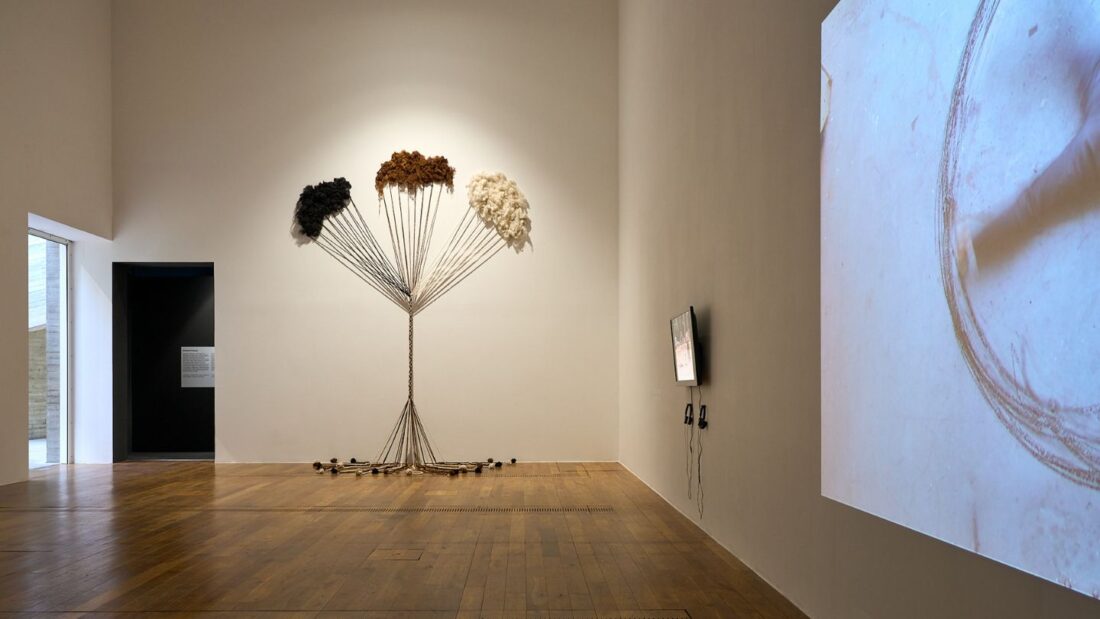
At Mostyn, Paucar will exhibit a series of handwoven alpaca wool sculptures and performance videos reflective of rituals and interventions that document their making, including Illapa (2021) and Suspendido en la Quenua (2014). He will also stage a new site-specific performance inspired by north Wales, leaving behind a clay imprint of a handstand against the gallery wall alongside a film of the act.
At National Museum Cardiff, Paucar presents La Energía Espiral del AYNI II, a newly expanded work combining video performance with a spiralling black-and-white alpaca wool sculpture. His film El Corazón de la Montaña (2018–19) reflects on ecological and spiritual loss in Peru’s Huaytapallana mountain range, where the artist inscribes a sentence in his native wanka lima (Quechua wanka), “The heart of the sacred mountains is weeping blood,” using his own blood.
Support our Nation today
For the price of a cup of coffee a month you can help us create an independent, not-for-profit, national news service for the people of Wales, by the people of Wales.


