


Arts interview: Elizabeth Haines

Jon Gower meets the painter and philosopher Elizabeth Haines as her new show, Thin Places, opens in Fishguard.
In the Celtic mind, thin places were places where the veil or curtain between this world and another world were a bit thin. Elizabeth Haines has taken that idea as the title for her latest show: ‘It is said that the ancient Celts believed that heaven and earth were only three feet apart and places where the connection between this and other worlds can be navigated more easily can be called thin places. It struck me that a painting can also be a thin place. If you can relinquish the chatter, the conscious mind, and listen to what you are looking at, colour and form can then be part of the alchemy. And in doing so, that can invite you to travel beyond the everyday towards your own other place. So that’s what I’m saying a painting can be.’
Miraculous glances
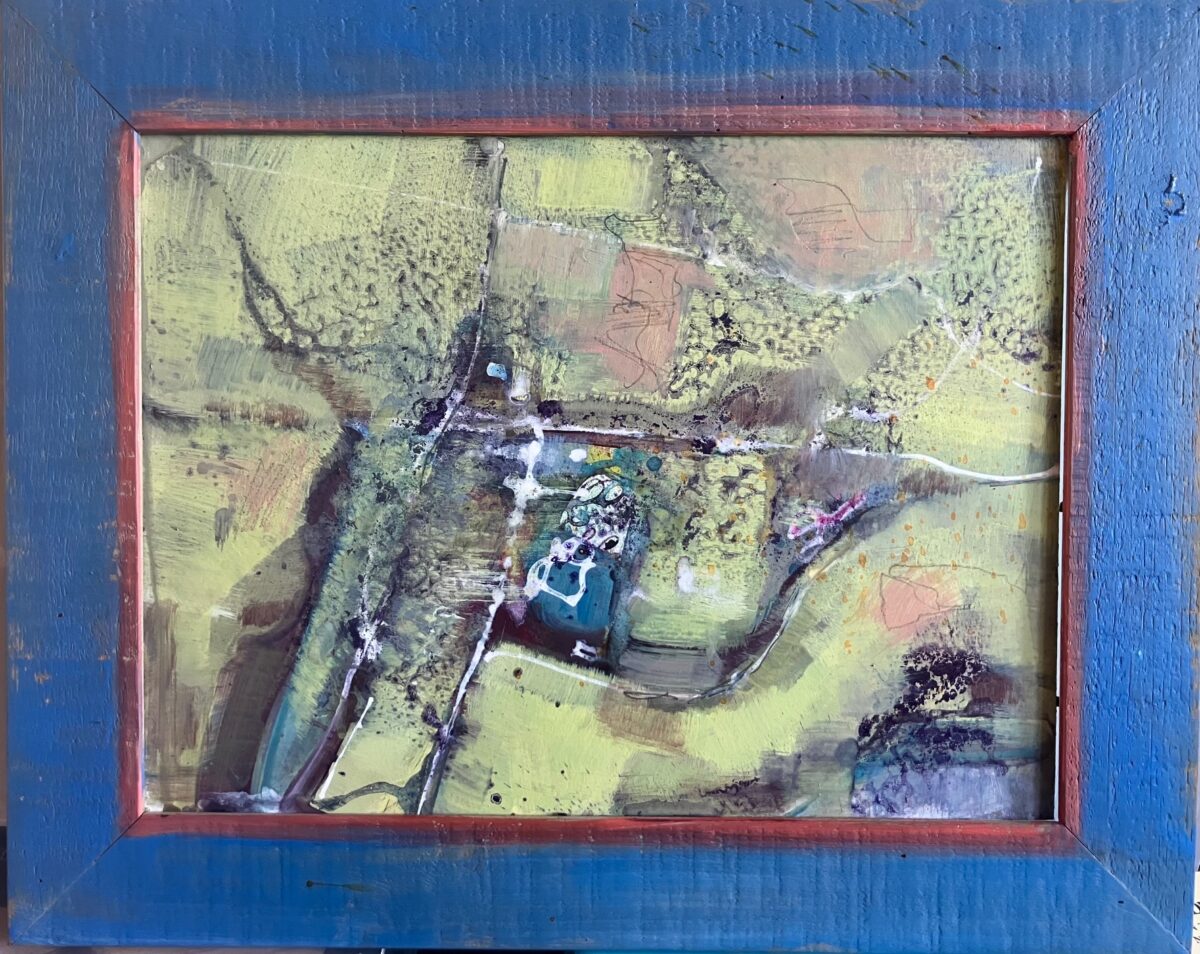
Haines lives in Rhosfach in Pembrokeshire, having moved to Wales in 1968 after training as an illustrator at Brighton College of Art. She describes some of her recent work being ‘settled in a precarious hinterland between representation and abstraction, where information gained from years of drawing from nature has blended with the imagination. Nevertheless, my work in the studio is always reinforced by drawing from life; for only when I come to draw do I see that what I thought I saw is even more exciting and miraculous than it was at first glance.’
Mad bobsleigh ride
Haines is a very energetic artist: she finds the act of painting entirely invigorating but massively demanding at one and the same time. ‘I work at a sort of very high energy. It’s like a mad bobsleigh ride. I can’t do that every day. So you go down a cog and you start looking at them. I can’t work in a considered sort of way, except perhaps the next day, after a big session. If I’ve managed to stop myself from tinkering with things, I do look at them in the light of recollection, if not tranquillity. It’s tiring, but it’s exciting so I just feel extremely lucky to still be able to do it.’
Earliest memories
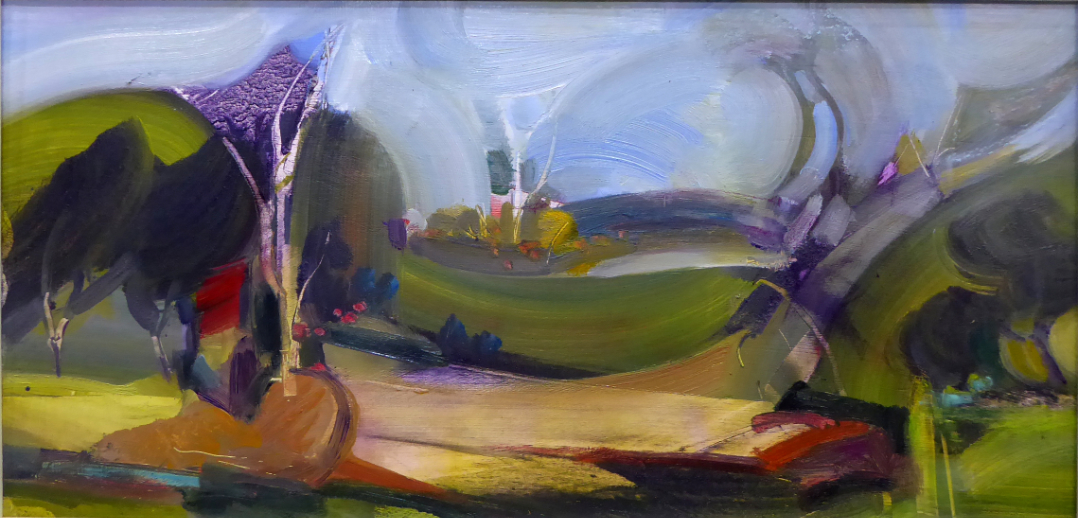
One of the first things you notice about the works is the difference between the various surfaces of paint: some are smooth, some are stippled. ‘The stipply thing is to do with my tendency since childhood – since my very earliest memory of being a three-year old drawing on the wall – to draw, it’s to articulate things, to make lines. You know, if I had to be somewhere without a pencil and paper, well, I might as well be dead. You know, it would be just terrible.’
Despite the satisfying and absorbing range of the colours she employs in her work, Haines doesn’t see herself as a natural colourist. ‘I had to learn colour and I learned it by looking at Johannes Itten, who lectured in colour at the Bauhaus until it was shut down by the Nazis. I spent ages doing his endless books of wonderful exercises about complementary colours and the meaning between them and the saturations of different hues, working, you know, taking yellow from light to dark, taking red, taking blue and looking at the very subtle complementary relationships.’
Art that sings
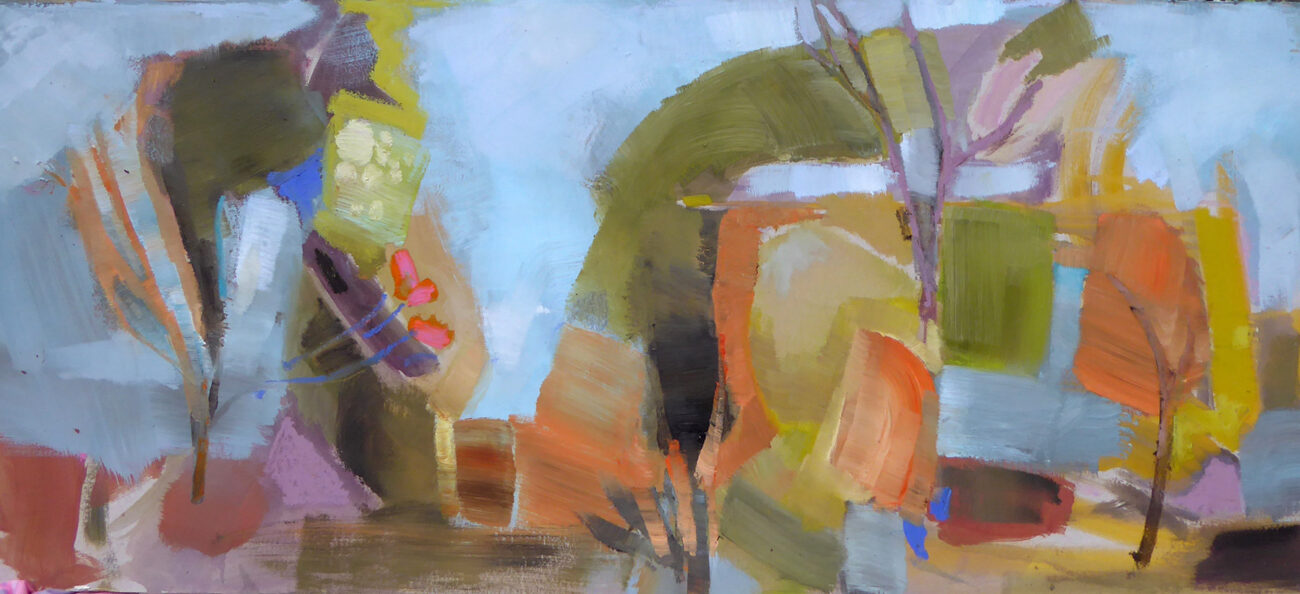
Haines’ works are quietly colourful but they are also musical, they sing quietly and often beautifully, as if Haines is both humming and hymning the land. ‘My work has been influenced over the years by an interest in the relationship between painting, poetry and music. It has also been affected by a temporary injury which forced me to paint with the left hand, a practice I now continue when necessary. Painting with the left hand (and so, we are told, with the right side of the brain) has enabled me to work more freely from memory and imagination.’
The music whisperer
‘I went to a most wonderful workshop at the Royal Academy of Music. I used to tootle up there to draw people such as Ilya Musin. He was 90, from the Academy of St. Petersburg. He wasn’t world famous, but he was famous as a teacher. There were all manner of eminent conductors who had come to see Musin. And the only way I can compare it is that my late husband was a shepherd, and he trained sheepdogs. He was what you might call a dog whisperer, he could control a dog that nobody else could. Ilya Musin was the musician whisperer. He was teaching all the students how to conduct Rimsky-Korsakov’s Scheherazade. This little old man goes up to the podium as if to say, I’ll show you how to do it. And he scarcely lifted his baton when he looked round. And the music that came out from them, it was beyond anything.’
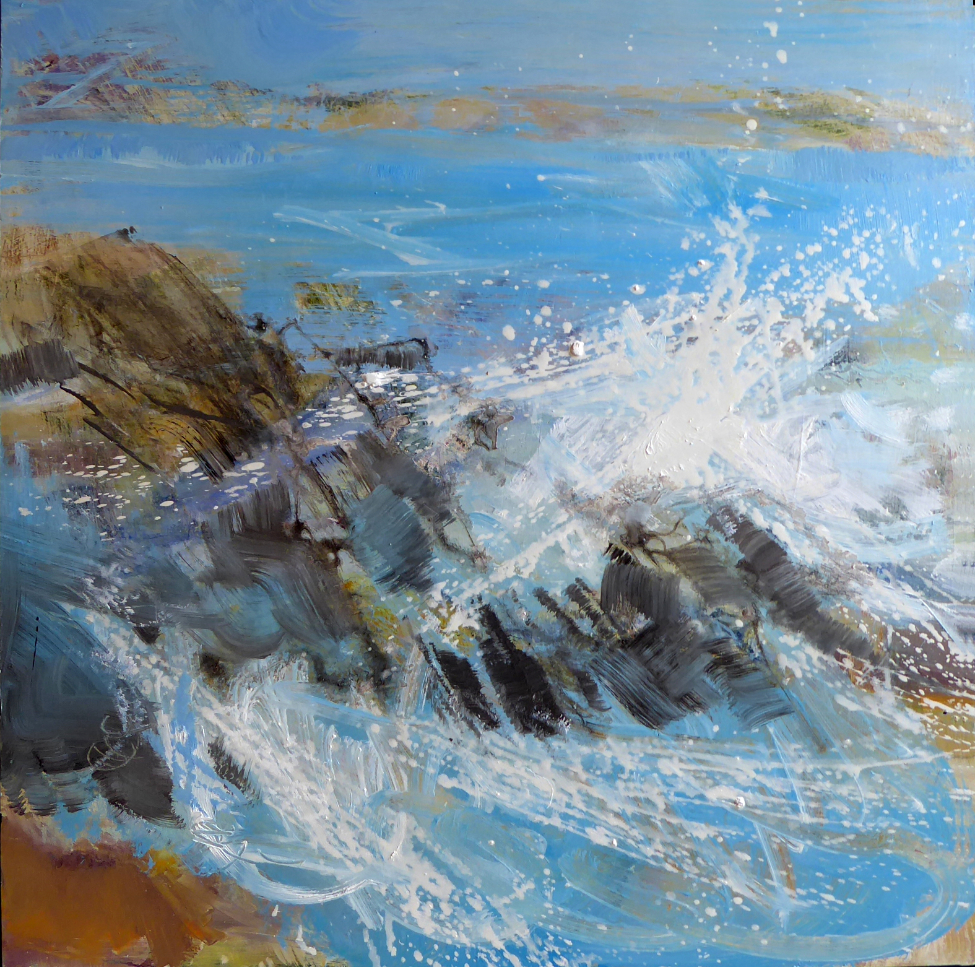
Elizabeth Haines sees her paintings as journeys. ‘They’re always journeys, like that poem by Antonio Machado, ‘Wanderer, there is no road/The path is made by walking.’ And walking, you make the path and then it goes on to the end. There’s only, as you look back, a wake of stars. You can only see where you’ve been.’
Thin Places runs at the West Wales Arts Centre, Fishguard between the 14th July and the 29th August, 10am-4pm Tues to Fri and 10am-3pm on Saturdays.
Support our Nation today
For the price of a cup of coffee a month you can help us create an independent, not-for-profit, national news service for the people of Wales, by the people of Wales.
Get more trusted Welsh news
Choose Nation.Cymru as a preferred source in Google News to see more of our journalism.


