


At the bright hem of Wales: Twenty years of change in Radnorshire
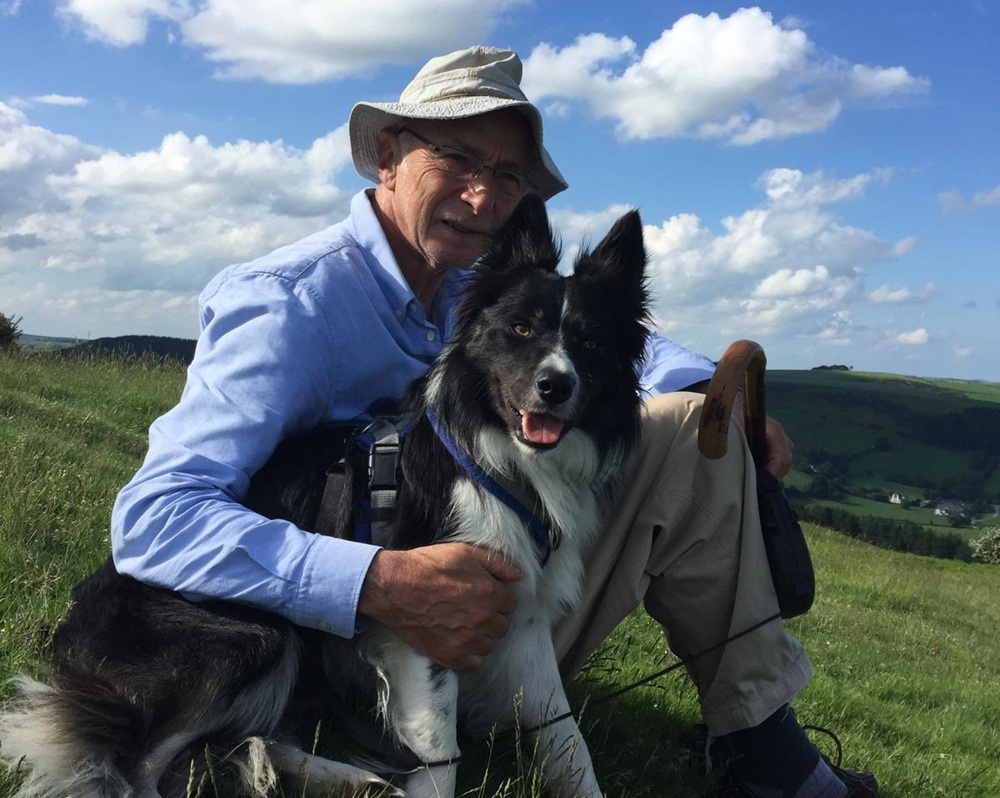
Twenty years after writing a book celebrating Radnorshire and exploring its place in Welsh history, Peter J Conradi returns to the landscape, literature and people that inspired it – and considers what has changed.
Twenty years ago I wrote At the Bright Hem of God, a book that grew out of my desire to celebrate Radnorshire while learning about the history of Wales itself.
Four years of research led to strange discoveries. The most striking concerned the five hundred years of sovereignty of the Marcher lords, who conferred a proud and radical sense of local autonomy that arguably survives today. The Welshness of Radnorshire before the Act of Union and the local discovery of ley-lines were others.
Looking back, I see that I have celebrated the reclusiveness of this little-known and under-populated region, and have tried to honour those who – over the centuries – fell in love with it.
This love was sometimes directed more towards the landscape than its citizenry. Shelley, who longed to live in the Elan Valley, was capable of decrying Welsh society as “all aristocrats and saints”. As for the Welsh gentry they had “all the ferocity and despotism of the ancient barons without their dignity”.
Then Wordsworth, who visited the Hindwell Farm in Walton in Radnorshire a dozen times and thought of moving here permanently, in 1791 found himself quarrelling about the respective virtues of the Welsh and English languages with a Welsh pastor, who drew a knife on him.
Such conflicts make the diarist Francis Kilvert’s responses to Radnorshire during the 1870s all the more remarkable: he not only admired the landscape but also loved his parishioners with an affection they amply returned. He is deservedly remembered as Radnorshire’s supreme ambassador.
If Kilvert was Radnorshire’s great literary ambassador of the 19th century, the writer Tom Bullough may deserve that title today.
He is that rare phenomenon, a writer born and bred in Radnorshire, not an incomer. He has published – among other work – remarkable and distinguished novels about his native realm: The Claude-Glass (2007) and Addlands (2016).
The first concerns the improbable friendship between two small boys growing up in the 1980s on the Welsh borders: Robin, eldest son of hippy sheep farmers, and Andrew, so neglected by his impoverished parents that he is left almost mute; his father feeds him scraps under the table with the farm dogs who console him.
Bullough has an exact and startling recall of a child’s eye view of the world that is unexpected and enriching.
Andrew discovers the “Claude glass” in the mouldering rooms of his family’s farmhouse: a small 18th-century convex mirror, designed to reflect a picturesque, enhanced impression of a landscape. For such local colour Bullough travelled, inter alia, to Grasmere to read Dorothy Wordsworth’s unpublished 1826 Radnorshire journals.
Tradition
Bullough wants Welsh Border literature to find its own unique sense of place, landscape, language and tradition.
It dismays him that Bruce Chatwin should depict characters in On The Black Hill from each side of the border abusing one another (“Taffy” / “Dirty Saxon”).
“This would not happen and insults the people whom his novel should serve.”
Similarly, much as he admires R. S. Thomas’s poetry, he finds his depictions of hill farmers close to Romantic primitivism – “prototypes”, as Thomas acknowledges, not human beings.
Bullough’s Addlands (2016) does not, by contrast, contain any of the following words: “Wales”, “Welsh”, “England”, “English” or even “border”.
Instead it uses dialect terms freely: the language of its characters. The glossary of dialect words Bullough’s website provides is many pages long. It opens:
Addlands (i.e. headlands): the border of plough land which is ploughed last of all
All about in one’s head: become light-headed
Annoy (the road etc.): obstruct
Awlman: cobbler &tc.
Borders
Incomers like to focus on the border, but Bullough observes that for native Radnorshire folk “the border – straddled and complicated by families, by farms and by towns – carries minimal significance… The area cannot be defined simply in terms of the larger, more dominant cultures to either side. And unless you raise the subject yourself, the border rarely comes up in conversation”.
True, devolution since 1998 has raised consciousness, yet Radnorshire has for simple reasons of history and geography probably been as often tied imaginatively together with Herefordshire – as did Daniel Defoe – as it has been twinned with either Montgomeryshire or Breconshire, with whom the county of Powys was invented in 1974.
Addlands takes place over seventy years, from 1941 until 2011, on a farm called the Funnon, an Anglicising of Welsh ffynnon, meaning “spring”.
Even for its time this is a backwards place – of horses, candles and bread ovens – because of its situation, and because the owner is a Great World War survivor who has turned his back on the modern world.
Here Etty’s son Oliver is born, winner-to-be of pub fights, a man around whom legends will cluster and huge social changes may be explored: mechanisation, rural depopulation, the demise of religion and local dialect, the changing roles of men and women, and their relationship with the natural world.
Bullough explores the links between language, history and landscape and his novels are wonderful “wholes”, satisfying emotional journeys.
A so-called “Writer’s Writer”, his books reward close reading, their visionary intensity often thrilling.
Bullough is interested in what is to happen to the Sacred once church and chapel have gone; his answer is an ecological one.
In 2024 his Sarn Helen – the chronicle of a walk across Wales, and at the same time a meditation on climate change and psychogeography – won the Wales Book of the Year award.
It re-visions the whole genre of pastoral in the light of our environmental crisis; thus, instead of seeming backward looking, his version of pastoral belongs to and enriches our anxious discussions about a sustainable future.
A landscape under pressure
Climate change nowadays is close to home.
During February 2020 – hot on the heels of Storm Ciara – Storm Dennis arrived. I spent ten hours trying to drive from London to mid-Wales.
But westerly roads were all transformed into rivers, with cars floating down them like boats. So I ended that day back in London, frustrated, fearful and forced to await a change in the weather.
Then in November 2024 my collie and I had to be rescued from deep floodwaters by friends with a tractor, and to abandon our car overnight outside Leominster.
Carwyn Graves in his brilliant and seminal Tir: The Story of the Welsh Landscape (2024) points out that conflict between conservationists and traditional farmers has often been more bitter in Wales than elsewhere in the UK.
We were nonetheless soon persuaded by our local Wildlife Trust to cede parts of a flat field adjoining the Cascob brook, a tributary of the Lugg, to the creation of a sequence of new ponds and “scrapes”, that would when full retain – we were assured – over one million litres of water.
This idea of helping – even in very modest measure – to mitigate the now regular and disastrous flooding of West Midlands towns appealed.
Climate change forcibly reveals both our human interdependence and our vulnerability.
And the frailty of borders.
The wildlife detected by cameras stationed on the new ponds soon included otter and kingfisher.
Peter J Conradi is the author of At the Bright Hem of God. He is indebted to Tom Bullough for providing a detailed critique and also draws on his own chapter, “Radnorshire Literature in English”, in the forthcoming Radnorshire County History, due for publication by the University of Wales Press in 2030.
Support our Nation today
For the price of a cup of coffee a month you can help us create an independent, not-for-profit, national news service for the people of Wales, by the people of Wales.
Get more trusted Welsh news
Choose Nation.Cymru as a preferred source in Google News to see more of our journalism.


