

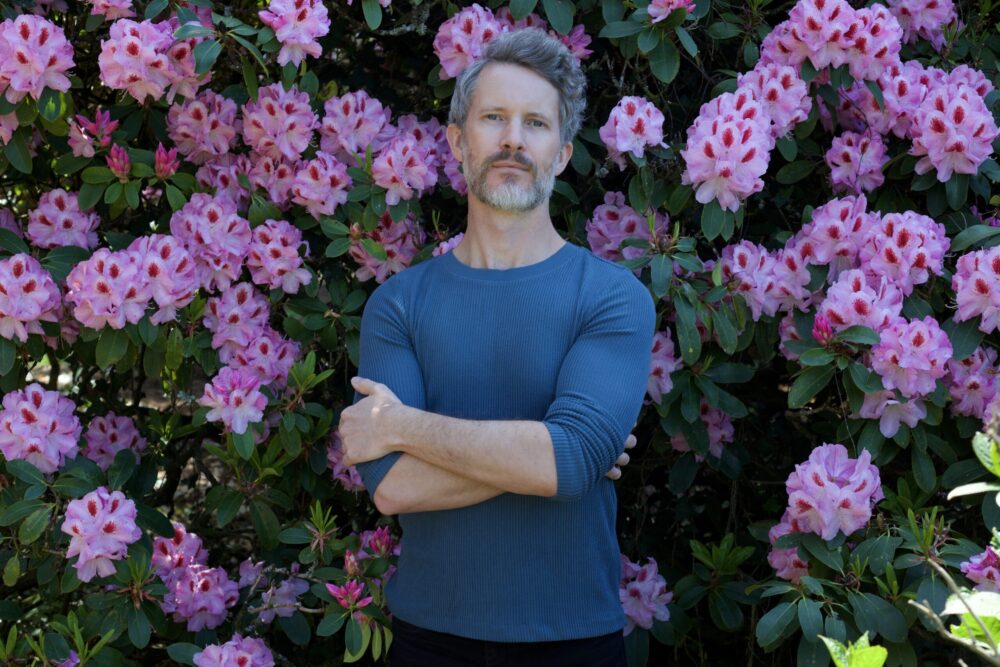
Ben Rhys Palmer on his poetry collection Breakfast with the Scavengers
Imogen Davies
In Ben Rhys Palmer’s joyful debut collection, Breakfast with the Scavengers, discombobulated robots rub shoulders with philosophising hyenas, orangutan brides, Mesopotamian fish gods, and a psychotherapist from outer space.
A Welsh poet based in Mexico, his poems about Mexico capture the magic and vibrancy of a country André Breton once described as ‘the most surrealist in the world.’ Other poems pay homage to Welsh cult heroes John Cale and Adrian Street, and Ben’s plucky ancestor, Rebecca Howells, who emigrated to Patagonia after her husband was killed in a mining explosion at Blaengwawr Colliery.
At once funny, tender, and beautifully bizarre, Breakfast with the Scavengers explores love, loss, loneliness, our never-ending quest for connection, and those blink-and-you-miss-them moments of transcendence that can light up our lives.
What inspired you to write Breakfast with the Scavengers?
The poems in the book came together over several years and across three different countries, so the inspirations are all over the place – from Neanderthals to axolotls, lucha libre to the apocalypse. But to attempt to be a little more profound about it, what drives me to write is an urge to play with words and images, to explore characters and strange scenarios, and to entertain and surprise. Ideally, I surprise myself first, and then (with luck) the reader too.
What was the creative process of writing Breakfast with the Scavengers?
The collection came together in fragments over time, more like a collage than a carefully mapped journey. A line, an image, or a voice would take hold, and I’d follow it to see where it led. Often the trail fizzled out, but sometimes it grew into something that worked as a poem. It was a process of chasing curiosities and stitching them together into a world that ended up feeling bizarre but strangely familiar.
The collection reads like an outlandish dreamscape, poems such as ‘To Celebrate Our Engagement’, in which the speaker and their partner ‘parachute onto the rim of a volcanic crater for a picnic.’ requires a playful imagination, were you equally as imaginative as a child?
More so. I was one of those children that adults like to describe as having their head in the clouds. On long car journeys I’d spend hours inventing fantasy worlds full of monsters, heroes, and adventures. I also enjoyed creating my own superheroes. My favourite was ‘Amalga-Man’, who had a mix of different powers he could combine in improbable ways. Looking back, it’s clear I already had a poet’s weakness for dodgy wordplay and slightly silly ideas. I probably had a far richer imagination then than I do now, though like most children I lacked the patience to do much with it.
Your poetry spans a variety of cultures and countries, from celebrating Jay Fai, the legendary Thai street food chef in Bangkok, to Blaina in Wales, Germany, Mexico, and even Y Wladfa, the Welsh settlement in Patagonia, are these places you have travelled or hope to visit some day?
I live in Mexico and I’m from Wales, so those two nations naturally weave their way in. Other places are there because of a character or a story that caught my attention, like that of the pfeilstorch – the unfortunate stork which flew all the way from Africa to Germany with a spear piercing its neck (thereby providing irrefutable proof of avian migration), only to be promptly shot and stuffed on arrival in Mecklenburg.
The poem ‘Rebecca Williams, Y Wladfa, circa 1890’ is a tribute to your great-great great grandmother who emigrated to Patagonia in 1875 after her first husband was killed in a mining explosion at Blaengwawr Colliery in 1861. How important is your Welsh heritage and identity to you? Especially since you were born in Cardiff and now live in Guadalajara, Mexico.
It’s important, though not in an overly self-conscious way. I’m proud of my Welsh heritage, but in a low-key and hopefully good-humoured way. Living in Mexico, I often have to explain where (and what) Wales is. Most people have vaguely heard of it but think it’s in England or Scotland. Or possibly has something to do with hobbits.
What drew me to the Welsh figures in the book – Adrian Street, John Cale, and my ancestor, Rebecca Williams – was the fact that each of them, in their own way, broke free of the expectations of their background and took a radically different path. In a small way, I’ve done something similar, leaving Wales to live in Latin America. That sense of forging your own route resonates with me.
I’d also say that some traces of Welsh literary tradition creep into my work. I studied poetry with Nigel Jenkins at Swansea University, where we dabbled in Welsh strict metre, or ‘Welsh S&M’ as Nigel liked to joke. I’m not someone who writes out of love for fiendish complexity, but I do enjoy the musicality cynghanedd can bring, and faint echoes sometimes surface in my poems. I’m also a fan of The Mabinogion. I love how playful, surreal, even proto-magical realist it is. I think that spirit has influenced my work, whether I meant it to or not.
The collection makes numerous references to different elements of pop culture, from artists such as Frida Kahlo, to actors like Chuck Norris, as well as referencing emojis, Superman, Downton Abbey and even the song ‘Don’t You Want Me’ by The Human League. How significant is the influence of pop culture in your writing?
Like most people of my generation, I’ve been steeped in pop culture, so it seeps into the poems. I wouldn’t call it a major driving force, but it’s definitely part of the fabric. Songs, films, emojis, even Superman – they’re part of the shared language we live in. Sometimes a pop culture moment provides just the right jolt of humour or recognition to sit alongside something stranger or more serious.
As well as writing in traditional poetic forms such as the sonnet for ‘Adrian Street and His Father’, the poem ‘Herring Gull’, by contrast, is very creative and playful with form, is experimenting with poetic form something you hope to achieve in your poetry? If so, why?
Yes, though not in an abstract, technical sense. I don’t experiment for the sake of it, I do it when a poem demands it. Some pieces want the tightness of a sonnet; others feel better served by something looser, wilder, even playful on the page. I think of form as part of the poem’s costume: it needs to fit the role.
The poems in this collection entangle human life and the natural world, whether it be animals behaving in a human way, such as a table-mannered yeti who covers ‘his mouth when he burps’ in ‘Yeti’, or the threat of our modern humanity to nature, as ‘Eden’s calls to the emergency services had gone unanswered’ in ‘Eden the Robot Gardener’. What impact do you hope to have by blurring the boundaries of the human and the natural world in your poetry?
I like the way you put that: ‘entangle human life and the natural world’. I think that’s very true. We are entangled in a messy, complicated way, though we like to imagine ourselves hovering above nature like gods.
We are animals, whether we like it or not, and I think the division we insist on – human here, ‘nature’ over there – is artificial. Spend time with animals and you see they have personalities, emotions, quirks. I write about animals because I love them and find them endlessly fascinating. But I also use them as a way of writing about ourselves, they help me think and feel. Sometimes a yeti with good table manners or a tenacious tardigrade can reveal something about loneliness or resilience in a way a human speaker couldn’t.
What do you hope readers will take away from this collection?
I hope readers find it entertaining as well as moving. If it makes them laugh in places, ache a little in others, and maybe see the world with fresh eyes, I’ll be happy.
And if readers finish the book feeling they’ve been on a bit of an adventure, and perhaps a little more in love with the world, even with all its chaos and violence, then I’ll feel I’ve done something worthwhile.
Ben Rhys Palmer is a poet, translator, editor, and musician born in Cardiff, Wales and now based in Guadalajara, Mexico. His poetry has been published in The London Magazine; Poetry Wales; New Welsh Review; Forklift, Ohio, and Under the Radar. Winner of the Verve Poetry Competition 2022, Ben was shortlisted for the Bridport Prize 2023 and highly commended in the Winchester Poetry Prize, the Kent & Sussex Poetry Competition, The Interpreter’s House Poetry Competition and the Welshpool Poetry Festival Competition. Breakfast with the Scavengers is his debut collection.
Imogen Davies is a writer and creative from Aberystwyth, currently undertaking a masters in modernist literature at the University of Edinburgh. Named as one of sixty New Welsh Poets ‘to watch’ by Poetry Wales, her first collection, DISTANCES, appeared in 2024.
Breakfast with the Scavengers is available now, published by Parthian Books.
Support our Nation today
For the price of a cup of coffee a month you can help us create an independent, not-for-profit, national news service for the people of Wales, by the people of Wales.
Get more trusted Welsh news
Choose Nation.Cymru as a preferred source in Google News to see more of our journalism.



