


Book Extract: Lone Wolves, Steve Blandford – Part 1
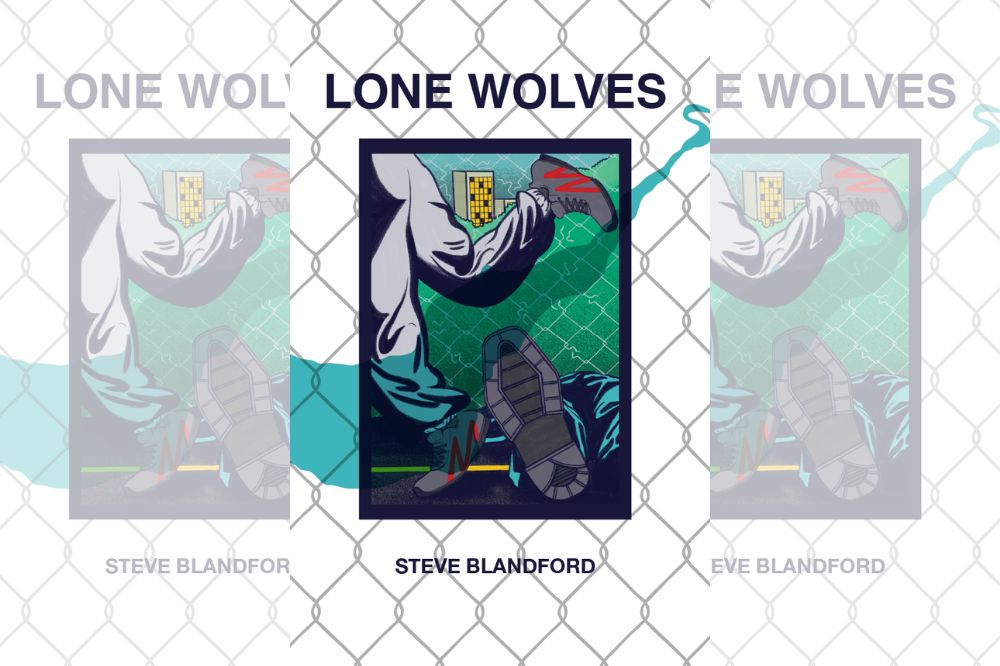
This is the first of three extracts from Steve Blandford’s new novel Lone Wolves, which will be published on Nation.Cymru over the coming weeks.
Author’s Note
This is a story set in Wales in the period after the shock of the Brexit result in 2016, but before the mutation of UKIP, first into the Brexit Party and then into Reform UK.
The novel happily leaves it to others to concentrate on the machinations of those closely involved in right wing political parties. However, UKIP’s electoral success in Wales in 2016 and Reform UK’s subsequent rise in the opinion polls in Wales do form an important backdrop to the fictional events of the story.
David
Chapter 1
David had always thought that the hospital looked more like a prison. This effect was exaggerated by the fact that it had been built on the edge of the park. It wasn’t the most beautiful park in the world, but it provided some woodland on the edge of the city. Woodland that made him run, or at least stumble, the 5k twice a week that helped to compensate for eating and drinking too much.
To help forget the prison-like effect of the hospital, David planned his route through the woods so that he was mostly facing away from the gigantic huddle of buildings, more like a small town than a place that would encourage the idea of healing.
He had been running just far enough for the awful lung-busting effect at the start to wear off, but these days David was more worried about his dodgy joints and vulnerable muscles. He never warmed up properly, so there was always the possibility of a tight calf muscle or a twisted ankle.
At one point the woods gave the illusion of being quite dense, though there was always a clear path running through them. It was mid-November, so most of the trees had started to look as miserable as David felt that morning, allowing the thick tangle of brambles to dominate the landscape. There was a slight downhill stretch at this point, giving him the feeling of sudden acceleration. This happened quite quickly, and David took advantage of it, nearly tripping at one point as he cursed another isolated rubbish bin that had overflowed.
‘If it’s full, take the sodding rubbish home with you, dickheads,’ he muttered to himself. He was, on the other hand, conscious that his self-righteousness hadn’t extended to carrying a bag so that he could pick up his share of humanity’s carelessness and deal with it himself.
The golden rule of his slow stumble around the park was, of course, that he never stopped. Not even when he had obviously tweaked something. Stopping was an admission that even his fingertip-hold onto an actual physical existence was weakening and likely to be finished soon. There had to be exceptions, of course, even to a pathetic, self-imposed golden rule like this. One, he discovered abruptly, was seeing a person’s feet sticking out from the undergrowth a few feet from the rough path.
It certainly hadn’t been the weather for drinking in the park. It had been a period of grey drizzly rain, interrupted only by heavy downpours, for at least two weeks. The idea that someone had fallen asleep and keeled over after downing a bottle of vodka seemed implausible, but as he approached the feet, David found himself fervently hoping that this just could have been the case. There was a rough bench less than a hundred yards further down the track. Someone just might have collapsed there for a while and then staggered into the mess of weeds and brambles.
As he got closer, David could see that the person was lying face downwards. This was not a great sign, especially in these conditions. David looked around; it was still early, but people who used the park as a shortcut, mainly to get to the hospital, were starting to appear in the distance, as shadows through the trees and bushes on the crisscross network of paths through the woodland. David wondered whether to call out to someone, mainly for moral support, but he told himself that this was stupid. Why ruin the start of someone else’s day? His shift didn’t start until lunchtime. He had plenty of time to help here. This didn’t seem to be a situation where he was in any danger, at least.
He approached the feet which now he could see were clad in a pair of regulation black Doc Martens. Regulation that is for someone who had to spend a lot of time on their feet but who still needed to look presentable. The shoes were in good condition and recently cleaned. The couple of streaks of brown mud were at odds with the rest, which had been recently covered in Dubbin. He didn’t wear them anymore, but David had been a great fan of DMs and knew what was needed to keep them looking presentable.
The soles were quite new too. Just a little wear on each heel. Someone who walked around a lot and turned their feet in just ever so slightly. David’s flat feet had given him a newfound expertise by way of his podiatrist. He wondered if the person lying in front of him had the same-shaped inserts inside his shoes. DMs were one of the few brands that inserts fitted into without any trouble. These were not the feet of someone who routinely fell asleep in parks after drinking too much.
David couldn’t see what else to do except give one of the feet a nudge with his own foot. The way that the person was lying meant that anything else would mean him scrambling into the bushes. If he could avoid that, he would like to. More mud to deal with in his laundry was something he could do without.
The nudge produced no results. The foot just flopped back into its original place. A strong sinking feeling was now starting to replace the mild annoyance David had felt at interrupting his run. One more time, he thought. Ridiculously, he wondered if he should try the other foot to see if it made a difference. Obviously, it didn’t and it became clear to David that scrambling further into the bushes to investigate was his only option. He wasn’t the kind of doctor that, mercifully, had to deal with much trauma. At least not of this kind. But, like most reasonably sensible human beings, he knew enough not to try and tug on a leg without really knowing who was at the end of it.
David unstrapped his phone from the contraption that held it to his arm. He hated the thing actually and would have much preferred to run unencumbered, especially by something that actually measured the pathetic distances that he managed to cover, but one of his daughters had bought it for his birthday to encourage his attempts at exercise and he felt obliged to strap it on each time he set off.
He had hardly ever used the torch before and was surprised at how powerful it was. The first unpleasant surprise he received was that, underneath a winter coat, the man was dressed in light blue. Shit! A doctor or a nurse. As the torch beam moved through the tangled brambles towards the head, a terrible feeling came over him, and he could not help himself; he cried out aloud. This was perhaps the first time he could remember doing this since he was a child. He jumped backwards and was soon himself flailing around in the undergrowth, small spikes embedding themselves in the naked flesh between his socks and his shorts.
There was, he was almost certain, no head attached to the body. He had moved the beam slowly upwards over the open coat until he reached the neck and he saw nothing but blood. He hadn’t lingered, or at least his instincts had prevented him from lingering.
Just for a moment David felt unable to get up. Not so much because of the shock but simply the inability of a forty-plus man to rise from a prone position without some leverage. For a second he thought he should stay down and call for help from where he was but even in this situation some desire for a bit of dignity prevailed and he eventually got to his feet, his arms scratched and bleeding from the thorns.
Trying to get the 999 operator to feel the sense of urgency that he felt without being alarmist or melodramatic was a strange challenge that he hoped he would never have to repeat.
‘Which service, please?’
He wanted to just scream ‘all of them’ down the line, but the need for a fire engine seemed ridiculous. He simply described that he had found what appeared to be a corpse in the park adjacent to the hospital. Thanks to GPS, he didn’t have to provide ridiculously complicated directions involving small footpaths and ‘just past the tennis courts’.
It felt quite a long time before he heard sirens and David even began to wonder if he should have been just a little more explicit in his description of what had been found. Eventually two uniformed police officers appeared in the distance down the path. Curiously, he expected they might break into a run, but of course they didn’t. David had been sitting on the bench and was, by now, freezing cold. As they came down the path, he broke into a trot towards them, which seemed to startle them somewhat.
‘It’s ok. I was the one who called it in.’ David said.
“Called it in?” he thought to himself. Jesus, too much television.
‘Can you show us where you found the body, sir?’
Both officers looked quite young, though of course that was the oldest one in the book, wasn’t it? The woman gave him a half-smile, probably to try and establish some level of trust, David thought. He found himself worrying about them. He wasn’t the kind of doctor that possessed a cast-iron stomach himself, but even a radiologist couldn’t entirely avoid being exposed to some of the less romantic details of the human condition, at least in the early part of his life. These were two beat coppers (did anybody walk a beat anymore?) who probably had to deal with all sorts in the city centre most weekends. But vomit, broken heads and human excrement were still not in the same league as a decapitated body.
Just before they got back to the spot, David decided he had to warn them.
‘Erm, I’m sorry, but I need to tell you something.’
‘Yes, sir?’ said the woman whose badge said that her name was Anna Dodds.
‘The body. I’m afraid that I think it’s decapitated.’
‘Jesus, what?’ said PC Mike Leeworthy, involuntarily it seemed to David.
‘I obviously didn’t want to go into the undergrowth and mess about with evidence, but from what I can tell with my torch, it does seem that there is no head on the torso.’
‘Have you seen the head, sir?’ asked Anna Dodds.
‘No, no, I haven’t,’ David replied, realising for the first time that he hadn’t looked.
‘That’s ok, sir.’
They had reached the spot where David had first seen the legs. The light had increased a little over the last hour and most of the legs and body were now clearly visible. Strangely, it was still not immediately apparent that there was no head.
It seemed to occur to both the young officers for the first time that it was a possibility, even if it was a remote one, that David had something to do with this person lying in the undergrowth.
‘I’m going to have to ask you to stand back here with me, sir,’ said Mike. ‘Is that ok with you, Anna? Will you shine your torch in there and just check he’s dead?’
‘Yes, yes, sure.’
David stood with Mike some yards down the path. Anna first repeated what David had done nearly an hour ago now and lifted one of the legs. Getting the same response, or lack of it, she took a huge powerful torch from her belt and illuminated what seemed like half the wood.
‘Oh my God, Mike.’
‘What?’
‘It’s just as he said; there’s no head.’
‘What’s your name, sir?’
This seemed to David a bit late in the sequence of events to ask this, but that wasn’t a helpful thought, so he just told him,
‘My name’s David, Dr David Kelston.’
Lone Wolves – Steve Blandford May 2026, Cambria Publishing. Available at: www.cambriabooks.co.uk
Support our Nation today
For the price of a cup of coffee a month you can help us create an independent, not-for-profit, national news service for the people of Wales, by the people of Wales.
Get more trusted Welsh news
Choose Nation.Cymru as a preferred source in Google News to see more of our journalism.


