


Book extract: Some Miraculous Promised Land
Richard Gwyn
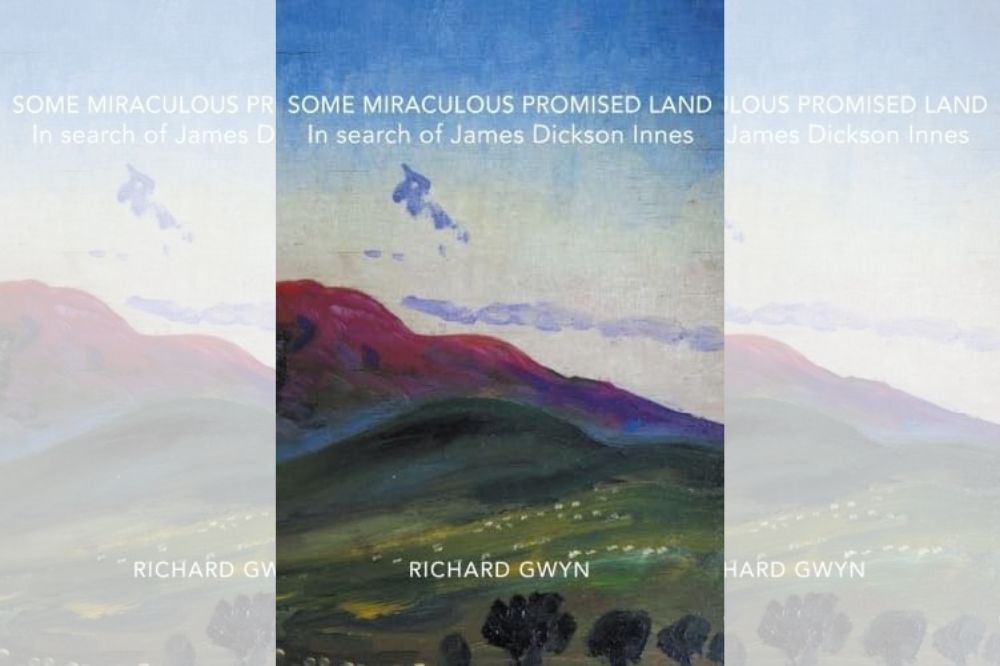
In this extract from Some Miraculous Promised Land, I describe my first outing to climb Arenig Fawr, the mountain that obsessed James Dickson Innes, and I reflect on how the immediate environment of the mountain might differ today from the one painted repeatedly by the artist during the years 1911-13.
From the slopes of the mountain, the hamlet of Capel Celyn would have been clearly visible — but it was drowned, wiped out, in 1965, its sixty-seven inhabitants forced to move elsewhere. Likewise, the decommissioned nuclear power station at Trawsfynydd would not have been there, nor the patches of coniferous forest, planted in recent decades, and soon to be replaced. Another major difference was the railway line, which used to run from Bala to Ffestiniog; its track is now gone, but the ghost of it remains, a trail of luminescent green, running in a straight line through a landscape of enfolding curves. Beyond the phantom railway track lies the main road from Bala to Trawsfynydd, its sporadic stream of traffic soundless from the summit . . .
On my way down the mountain I passed through the ruins of farm buildings at Amnodd Wen, which has not been occupied for almost a century, and just beyond it, the path became a watershed, the mountain’s manganese shale and porphyry copper deposits lending the stream a rusty colouring. A miniature cliff appeared to the right of me, like a doubling or a fractal of the formation made by Y Castell and Simdde ddu, that I had passed earlier in the day. I was amazed by this pervasive duplication, or repetition in nature; it seemed infinite, a constant process of recursion, of mountains within mountains, worlds within worlds, a never-ending pattern that replicates itself in an ongoing loop; and I drifted into a fantasy in which I reached for the top right hand corner of the page before me — the page of the visible world — and peeled it back, revealing what lay beneath; another landscape, another world, seemingly the same as the one it had replaced, but with minute differences, so that once the page was turned an apparently identical image appeared before me, on the next page, and the next, and I began to turn the pages, slowly at first, and then faster, each page seemingly identical to the last and yet different in some small detail, every tiny difference representing another world that lay behind and beyond the last world, an impossible number of worlds superimposed one upon the other, into infinity — and we inhabit only one of them, as contingency dictates; we are granted one life, and there comes to us eventually the knowledge that we will one day leave it behind. And while there is sorrow at departure, there is also joy in the world’s unfathomable beauty. The transience of it all. Yet I feel a wave of sadness when I think of James Dickson Innes, of his passion for this mountain, and of all he might have achieved had he lived, perhaps, to my own age.
Dick Innes paints and re-paints the same image of Arenig, whereas I, one hundred and ten years later, on the same mountain (but now a slightly different mountain) in the same small country (which remains a small, almost accidental country) take a photograph on my iPhone, and am offered the chance to edit, so that I may, if I wish, enhance certain features, while eliminating others, and it occurs to me that this is precisely what Innes is doing with Arenig, finding multiple versions, multiple edits of the same image, and enhancing it, over and over again, except he doesn’t have an iPhone but instead has small wooden boards and oil paints.
Or to put it another way: in Gertrude Stein’s famous line, ‘a rose is a rose is a rose’, the second rose differs slightly from the first and the third rose differs slightly from its two predecessors. Although the words are the same, they carry a slightly different semantic charge. This is the poetry of minute differences, which can be likened to Marcel Duchamp’s concept of inframince (which might be translated as infrathin) to indicate those fine and barely perceptible nuances that differentiate near-identical experiences and subtly alter their meanings. Paul Matisse referred to inframince as a quality that evinces ‘the very last lastness of things . . . the frail and final minimum before reality disappears,’ to which we might add the brief pause taken between one breath and the next. When applied to time, the concept of inframince implies that the world subtly shifts with the passing of every microsecond. The idea is linked, in my mind, to the Celtic notion of ‘thin places’, which mark the confluence between the world of everyday reality and the mythical otherworld, known in Welsh as Annwn. In such places the boundary between the worlds is most fragile, and the chances of tipping into a contiguous one most likely. Coming down off the mountain, it felt as though Arenig itself were a vast nexus of thin places, host to many such points of confluence.
Dick paints the mountain, trying to record it in a way that seems most apt in that moment, but with each rendition, each layering of the paint, the configuration of the visible world changes: that cloud has moved a fraction, a leaf has fallen from one of those rapidly painted trees, the bird has flown to another branch . . . a fly buzzes past, halts for a moment on the sleeve of the artist’s coat. He looks down at the fly and reality dissolves, which is to say the world stands still for as long as it takes for the fly to clean itself, rubbing its tiny hands together; and then everything starts up again, but this time it is all marginally different.
Some Miraculous Promised Land by Richard Gwyn is published by The Hmm Foundation and is available to buy from bookshops.
Support our Nation today
For the price of a cup of coffee a month you can help us create an independent, not-for-profit, national news service for the people of Wales, by the people of Wales.


