

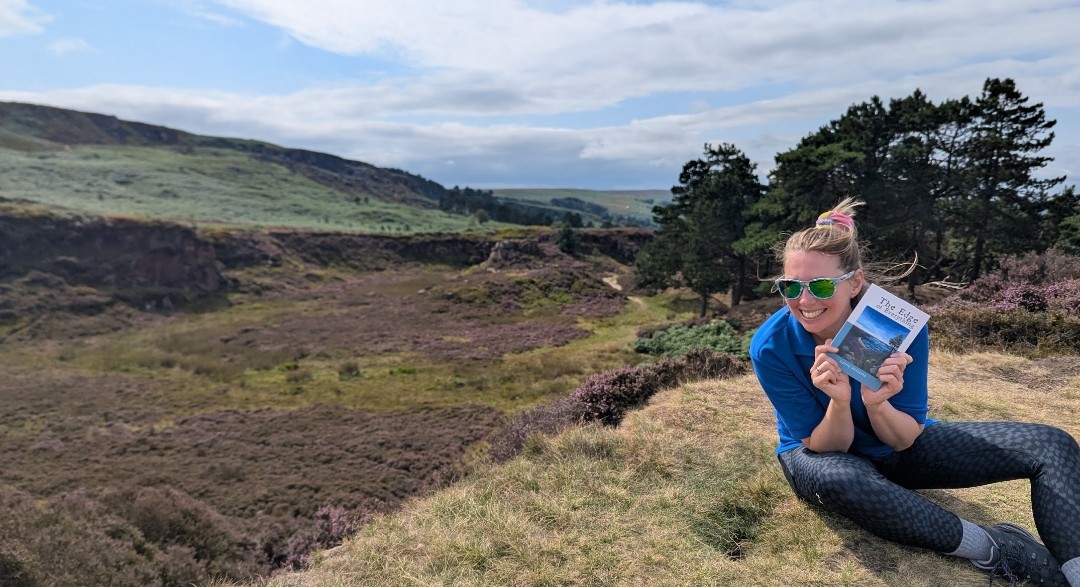
Book extract: The Edge of Everything by Lottie Williams
Finding the Tywi
I am crouched in the bottom of a shallow valley at just over 300m above sea level in the heart of the Cambrian Mountains. Around me, the terrain is a mixture of blanket bog, upland heath and conifer plantation. By my feet, the young Tywi burbles along, singing a carefree song that has emerged into the light only a few miles upstream from where I am now. Despite the rugged lines of this Welsh heartland, a tranquility hangs in the sky above me, over the land and in the water. There is a softness to the air even with the fresh edge it carries. I close my eyes for a moment and breathe deeply in, then, quietly, I bend down and slip my fingers into the cool flow of the river. It’s tea stained in colour from the peat of the surrounding land where rushes, rowan and rosebay willowherb line the banks.
I know that if my children were here, they would be drawn to the lure of stones and rocks which gravel the bottom and sides of the river. My two older boys would seek out the largest and most irregularly shaped stones, the ones which make the biggest splashes. They like to disturb, to create noise and movement where there is none, and to feel the energies and effects of their actions. My two girls would hesitate, scan their eyes in as meticulous a fashion as young children can manage, and look carefully for colour and shape over size and impact. This is a place where young flesh comes face to face with the tangible reality of history.
These stones and rocks have been fingered into position over millennia by the shifting hands of ice. Twelve thousand years ago, as the most recent chill retreated and Earth warmed once more, the rocks found rest and felt the flow of the fledgling river, though by the very nature of water, especially in this steeper upland valley, the riverbed will never really be still. Boulders have become rocks, have become pebbles, have meandered on a course through the floodplains where the river has, so many times, altered its choice of path, slipping into new grooves in the land without stopping to ask permission. There is nothing and no one to ask. It doesn’t have to, and lives and thrives as it does with its own perceptions of time and distance in its evolution. This river is old. These rocks are older, and here I am, brand new.
Diamonds
Up here, the water runs both bronze and clear, welcoming the sun onto its surface like tiny diamonds cruising a highway. It is a miracle, and has fed the stories and throats of people and places for far too many generations to count. I dip my hand into the river again, and this time I bring my hand up to my mouth. It is refreshingly cold but the Tywi has no taste, which I find both surprising and disappointing. I thought there would be something; a gentle musk perhaps, or an earthy tang given the dark peat it has risen within.
I pick up a stone from the riverbank and run my fingers over its smooth grey surface. I have become fascinated by time, or at least the stretch of it, trying to comprehend how long it has taken for Earth to find such a delicate balance to flourish, and how close recent history remains. The rock I am holding is a time machine, folded, faulted and formed during the Paleozoic era, over five hundred to four hundred million years ago, in which the first fish, corals and land plants evolved. Immortalised within the layers beneath my feet and in the rise of the hills above, marine fossils tell the story of an underwater past, of curious creatures living in long displaced oceans, where sand, silt and pebbles collected and settled, crushing together the pages that would become an encyclopaedia of rock, each layer of sediment telling an incredible tale.
I push the stone into my face and hold it there, my cheek a soft interruption between teeth and rock. It is cool at first but it doesn’t take long for my flesh to warm the surface, connecting me to Earth’s deep history through a shared transfer of heat.
Humbling
I find it both astonishing and humbling how these rocks were created under pressure and have since survived so much. This stone in my hand has witnessed the near-apocalyptic period known as The Great Dying, two hundred and fifty million years ago, when extreme heat and poisoned air choked almost all living plants and animals. Earth’s crust heated so much that tree roots caught fire in the scorching soil, sending flames to lick up the trunks of the prehistoric conifers. Carbon dioxide, chlorine and bromine hissed through magma cracks in Earth’s surface, turning the air toxic and magnifying the sun’s UV. As acid poisoned the sea and algae blooms flourished, sea creatures died from a lack of oxygen and food. Even so, through all of this, my stone survived.
Evidence of how life almost entirely collapsed is squished into the rich coal seams that lock up the clues of what was once a lush and vibrant home before The Great Dying. Above this seam, geologists have found a section of rock almost void of fossilised life, lacking the pre-historic animal and plant remains usually present. During this time, Earth had become barren and lifeless. Microscopic pollen grains that have been found are mutated and sterile, misshapen perhaps by the changes in climate and atmosphere. Nine out of ten species are said to have died. Yet from this meagre ten percent survival rate, life was able to slowly haul itself back up and evolve once more into the vastly complex ecosystems that enrich the
planet today.
Recovery from The Great Dying took a huge amount of time but it was worth it. This blue-green jewel of a planet is by far the most beautiful and precious thing in our known universe, and I ache lovingly at the thought of its diversity and abundance. Only recently have I begun to realise that everything I have or know today is owed to what has come before me, to what has been sacrificed in the dying of an ancient time and to what has then been able to re-grow and flourish once more. Without these conditions, I (and everything else I know and love) would simply not exist. I find that quite extraordinary.
Support our Nation today
For the price of a cup of coffee a month you can help us create an independent, not-for-profit, national news service for the people of Wales, by the people of Wales.



There have been at least five major mass extinctions that piece of rock has witnessed, all with varying degrees of life lost with it all locked up in the rocks around us. Indeed, it a wonder we are here at all!