


Book extract: The Edge of Everything by Lottie Williams
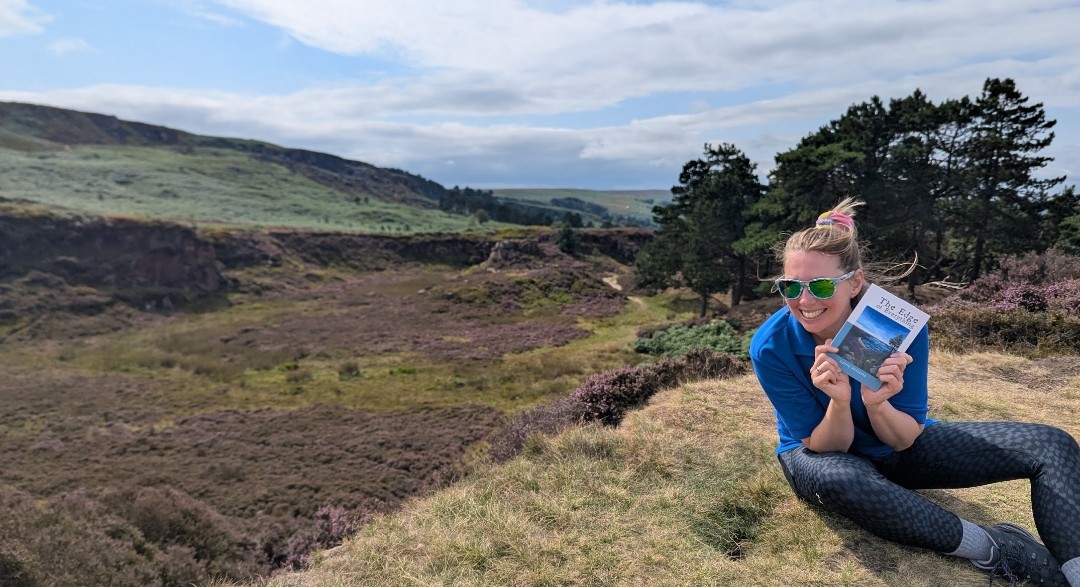
Lottie Williams
Pendine, Carmarthenshire
September 2024
No sand this morning, just waves against the sea wall. The beach gradient is so shallow it allows for seven crests to roll in at any one time, one after the other. In between the crests, foam strings each wave together and forms one mat of tide.
With one hand on the metal bannister, I climb the steep steps above the beach on the coastal path which continues west around the headland. The smell of fried breakfast wafts up from Point cafe, still open for the early Autumn day trade. My mouth waters – ooh, this is a smell I only like if I’m hungry, and the small-ish banana I ate a couple of hours ago is long gone.
Hash browns, mushrooms, fried egg and beans. I keep walking to escape the lure below.
At the top of the steps, the coastal path levels out. The climb has warmed me, so I stop to catch my breath and take off my hat. Here the brambles are high and act as a shield, my ears no longer throbbing from the south-westerlies below which hiss indecipherable tales from distant lands. Behind me on the prom, the Welsh flag is at the top of the mast, the dragon wind-ironed in mist.
Across the channel, the Gower hides behind a shimmering wall of muted bright. I can’t see the sun, but I know it’s there. I look over the stretch of sea. What was it like, between here and the Gower, when there was a wide expanse of land? Before the rising sea level flooded the valley floor at the end of the last Ice Age? Not far from here, remains of tree stumps from submerged woodland at Amroth can still be seen at low tide.
Gorse
Now the path is surrounded by gorse and a smattering of acid yellow flowers. Leftover magenta heather shivers close to the ground by the side of the path. Most of it has already browned, already dried. The sun intermittently breaks through the mist, then disappears again behind the veil. My shadow, long in this early morning light, joins me, leaves me, joins again. My boots slip on the mud and the dew-wet grass. I sidestep slugs.
Soon, the path rolls down the other side of Gilman Point and into the open palms of a small beach. Morfa Bychan, along with several other beaches along this stretch of coast including Amroth, Wiseman’s Bridge and Saundersfoot, were used for ‘Operation Jantzen’, a series of secret practice landings for Allied vessels incoming from Tenby, Swansea and Port Talbot during the summer of 1943.
The remains of a sea wall still poke jaggedly out of the beach in what once was a simulation of the sea defences similar to those which would be encountered on the Normandy beaches in the D-day landings. The operational practice included breaking holes in walls to allow for tanks and troops to pass through. Just past a barricade of brambles, there’s an inner wall still more or less intact, though scarred. In places, the surface has been blasted away, revealing a cobbled stone interior and a warped metal structure now red raw with rust.
Butchers’ hooks
Unnervingly, they remind me of butchers’ hooks silently illustrating a horror that once was. In places, white mineral deposits have seeped out of the wall in glacial rivers moving too slowly for the human eye. The ridges across their pearly surfaces are like the tide today, or satellite images of mountain ranges, or canyons eroded by rivers. Green and yellow lichens add to the topography. There is life in this inanimate object.
I continue up the other side of Morfa Bychan towards Ragwen Point. It’s steep. Occasionally, devil’s bit scabious and yellow potentilla poke through the edge of the path, tiny and cheerful like nursery children let outside to play after the rain. I’m here with the promise of Neolithic Chambered Cairns, written in an ‘oldey worldey’ font on my OS map, so I’ve come to search for them on the side of this cliff. It’s tricky though. The gorse is still so high I feel entombed within a tunnel vision of vegetation, the coastal path my only way up or down, in or out. I can no longer see the sea, or the scree slopes and boulders, let alone get access to them.
Eventually I see a point where the path begins curling around the coast and decide that when I reach it, I’ll turn back. But as I come to that point there is suddenly space and air to my left, and I can once more see and hear the sea, like someone has thrust a huge shell to my ear, and the gorse subsides and the cliff opens up to the scree and the boulders and everything feels excitingly exposed.
I can get to the edge of the rocks.
I clamber through and begin looking for obvious chambers, for flat roofs, diagonal or vertical rocks, little caves or small hidey-holes, but my eyes lack the nuances of historical knowledge. Keep looking, keep looking. I’ve heard there are four chambers here. I wonder – if I were choosing a spot, which would I choose? I’m a confident and surefooted walker, but even so I’m finding it tricky to navigate across these rocks. Some are stable but many are not, and you can’t tell until you place your foot on top which one it’ll be.
Tetris blocks
The rocks resemble ill-shapen Tetris blocks, not quite fitting together but having a really good go. There are pillars stacked like Mayan temples. Some large. Some small. The vegetation is deceiving, deeper than what I expect it to be, so I can’t place my weight in between the rocks for fear of a void beneath. There is heather, star moss, sphagnum moss. Is that reindeer moss? I wonder what the landscape below would have looked like when the chambers were built. Lichens paint old fashioned maps of territories and land boundaries, of seas in between clusters of raised green land.
About half way along the cliff, I reluctantly and carefully make my way back up from the scree and onto firmer land. I don’t want to risk a twisted ankle, or worse. I am alone, and yet to see another walker on the coastal path this morning. I’m not sure my cries would be easily identified as a distressed human between the high pitched gulls and the rolling sea. I feel exposed, but, despite not being able to find what I have come for, I also feel calm.
On the grass ledge at the top, I stop and look out over the rock field I have just been wading through. This is a thin place, connecting me to long ago human activity, connecting me to the sea, the sun, the sky, the edge.
Does it matter that I can’t find the burial cairns? Just being here, in this place, isn’t that enough?
Lottie Williams is the winner of the Nigel Jenkins Literary Award 2023 and a Pushcart Prize Nominee. He work has been published in Nation.Cymru, Modron, Firewords and Red Door. She holds a Masters in Creative Writing from Swansea University, and was a member of Literature Wales’s Sgwennu Well programme in which she developed a nature-based writing for wellbeing programme for young people.
Support our Nation today
For the price of a cup of coffee a month you can help us create an independent, not-for-profit, national news service for the people of Wales, by the people of Wales.
Get more trusted Welsh news
Choose Nation.Cymru as a preferred source in Google News to see more of our journalism.



That’s a beautiful read.
Diolch, John. That’s very kind of you to say 🙂