


Book extract: Weights and Measures by Jane Fraser
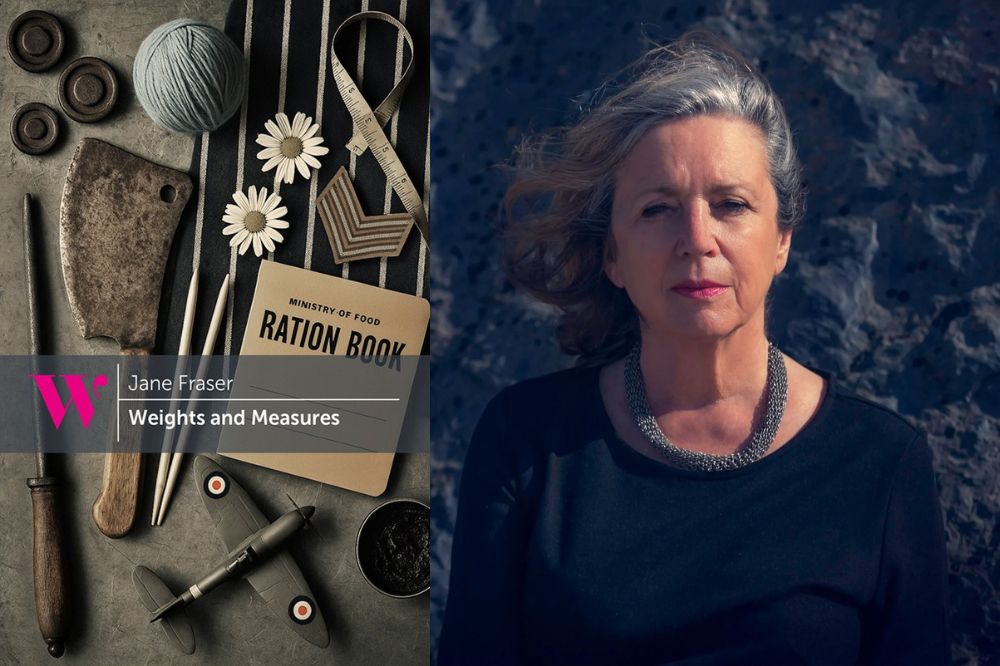
Jane Fraser
Jim belched as he entered the shop, walking across the wooden floor boards sprinkling them with sawdust. Then he stood next to the white, marble slabs inside the shop window, reaching above him and beginning his daily task of unpicking the individual sheets of greaseproof paper hanging from the hooks. One by one, he took each sheet down, placing the papers in a pile and the hooks in a tin, ready to be used again later, when it was time to lock-up.
As each paper was unhooked, it revealed more and more of the queue that was already forming outside. All women. They all seemed to look the same: drab coloured, tightly-belted coats; headscarves tied around their hair, knotted under the chin; familiar shopping bags at the ready. Jim tried not to make contact with those eyes of theirs, imploring him to open up. Putting him under the pressure of a performance he didn’t want.
Rushed
He looked at the walnut clock that hung over the doorway to the passage. Five to nine. He wouldn’t be rushed. He placed the ashtray on a stand next to the shop door, adjusted his tie, turned the sign that hung on a piece of string from CLOSED to OPEN and then finally, unbolted the door, top and bottom. He cleared his throat ready to get into role. He was conscious he did this. Mary had told him he had a shop voice that he could switch on and off, telling him there was no need for affectation. He hadn’t known what affectation meant, but he assumed it was something like pretending. He didn’t want to ask: it would only drive home how different she was from him in so many ways.
“Morning, Ladies. How are we today?” he said, as, in an orderly fashion, the women filled the space on the other side of the counter with the smell of stale cigarette smoke, and dampness. With them came the bite of the October morning. This weather was better for trade.
“No need to close the door, Mrs Squires,” he instructed. “Nice and fresh this morning. Now, who’s head of the queue here?… Mrs. Brooks, usual, is it?”
Every Tuesday was neck of lamb day for Mrs. Brooks. He’d never make a fortune out of her from 140. She could make a stew that would last all week for her and Mr Brooks out of this cheap cut. Mean buggers.
“I heard you sorted Mrs Weidenbach out earlier, Mr Froom? You know she’s German, don’t you?” she said.
“I did indeed. Was more than happy to. And she’s not German by the way – as if that makes any difference.”
“Well, she was married to one. And it will make a difference, Mr Froom. Make a difference to us all.”
He tried not to rise to the goad. Of course, it would make a bloody difference. But Mrs Brooks was a bigoted bitch.
“This alright for you, Mrs Brooks?” he said, holding up the meat, wishing it were Mrs Brooks who he’d taken the cleaver to, and was now hanging limp in his hand.
“Lovely, Mr Froom.”
He walked to the Avery scales and placed the neck on a sheet of greaseproof paper to weigh.
“Sixpence halfpenny? Is that too much for you?”
“It’ll do fine,” she said. “Don’t want to go spoiling anyone.”
Memories
Mrs Brooks handed over the exact amount and he placed the sixpenny-bit in the sixpenny-bit compartment and the halfpenny in the halfpenny compartment and tried to regain his composure as she went out of the shop. He knew if he told everyone who came into his shop what he really thought about the world – and them – he’d have less of a business than he did now. Everything was such a ruddy compromise, and he hated himself for it.
He looked deep into the till, to the wooden compartments at the back which didn’t hold money, just tucked-up memories: a curl from Dora’s red, childhood hair, the first milk tooth he’d pulled out from Teddy with a cotton thread, one of Rhoda’s early attempts at writing her name on a scrap of paper, a fading sepia image of William on the rocking horse, a signed photograph of Mary which she’d sent to him when he was at camp in Bulford, and even a picture of himself in uniform soon after he’d been made a sergeant. He closed the drawer of the till quickly when he looked at the image of himself in uniform with the three stripes, stifling another burp, and quickly returned to the next customer.
Jane Fraser lives, works and writes fiction in a house facing the sea in the Gower peninsula. She is the author of the novel, Advent, winner of the Society of Authors’ Paul Torday Memorial Prize 2022, and two collections of short stories, The South Westerlies and Connective Tissue. Her short fiction has been broadcast by BBC Radio 4 as part of its Short Works series. Jane is a Hay Festival Writer at Work and has an MA and a PhD in Creative Writing from Swansea University. Weights and Measures is her second novel, to be published by Watermark Press on 31 October 2025.
Support our Nation today
For the price of a cup of coffee a month you can help us create an independent, not-for-profit, national news service for the people of Wales, by the people of Wales.


