Book review: Alfred Janes – Maker of Pictures by Ceri Thomas
Tony Curtis
This is the second significant book on Welsh art to be published by Parthian in a matter of weeks, and they are to be congratulated.
I reviewed Peter Wakelin’s William Brown: Pursued by Bears recently on this website. This book on Alfred Janes is also very worthwhile: Janes was of the generation of Swansea writers and artists which included Dylan Thomas, Dan Jones, Vernon Watkins and Mervyn Levy, all of whom Janes painted.
On the eve of the Second World War, Alfred Janes was the outstanding young artist in Wales, with extraordinary gifts in terms of his use of colour and the organisation of the canvas.
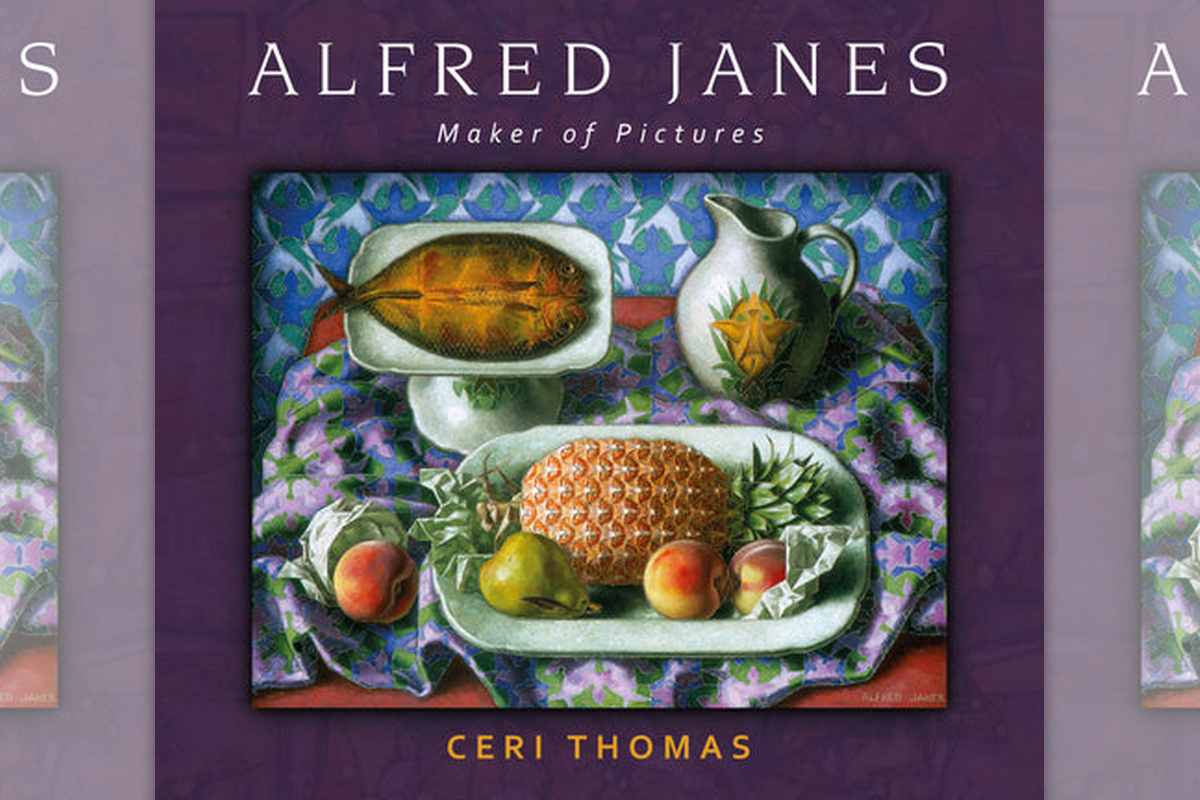
The cover of this book uses his “Kipper and Pineapple” from 1937, which is a fine example of this period. It is a work which acknowledges the European tradition of the still life, while subverting and extending it.
Kippers and pineapples are unusual subjects to be displayed on the same table. But their colours chime well and are set against an enveloping cloth which has the astonishing complexity of this artist’s use of textile at this time.
The rich colours of the fruit satisfy the promise of taste which the genre always delivers, but the arrangement of the dishes and their decoration set up other delights. The water jug has a modernist fish and the base of the dish on which the kipper sits has an echo of the cloth and background.
Is that a matching wallpaper, a hanging tapestry or cloth? The perspective is flattened and the whole piece is an arrangement which is unreal, dreamlike. The artist said, “I noticed the attitude largely about my Kipper and Pineapple painting. Was it because I’d put a most lowly fish in company with extremely aristocratic fruits?”
The bowl and water jug match and resonate with the predominant greens and blues of the background. The folds of the cloth are a ruckling and disturbance that is unsettling. The wrapping paper for the fruit is strangely green; this is the 1930s, in Swansea.
Ceri Thomas includes some preliminary drawings which confirm the lengths to which Alfred Janes had gone to determine the exact geometry of the patterning. Throughout this book, Thomas, himself an artist, is insightful and eloquent in his analysis of featured paintings.
In a radio programme in 1949, Vernon Watkins said, “I like Swansea because it has three kinds of fish, whereas all other ports have only two. Swansea has sea-water fish, fresh-water fish and Janes fish.”
Both Swansea poets were close to this artist: Janes had the dubious pleasure of sharing digs in London with Dylan Thomas. When I interviewed him for my book Welsh Artists Talking in his home in Dulwich in 1998, the year before he died, he told me that when his flatmate sat for his portrait, “Dylan was in and out like a cat in a tripe shop.”
It was Fred who had taken Ceri Richards down to the Boathouse in Laugharne to visit Dylan. Their planned collaboration did not come to pass, as Dylan left within days for his final, fateful trip to America. Alfred Janes was a steady point around whom wilder men circled.
The war took him away from Swansea into service in the RAF and as far afield as Egypt, where he ran a POW camp for captured Italians.
While the war and its challenges opened up new opportunities for some writers and artists – John Piper, Henry Moore, Ray Howard Jones, John Nash – for others, it was an unwelcome break from normality and their predicted progress and careers.
Fred Janes finished a few drawings, including a sensitive celebration of his wife, Mary, from 1942, and some portrait drawings of fellow soldiers. He returned to Swansea and painted one of the notable Blitz works from the destruction of that town which he and the other Kardomah Café boys had left years before.
“Castle Street Swansea (after the Blitz)”, from 1949, is a powerful and poignant work. A young child stares up to the sky past the ruined shells of the houses and store-fronts. I remember bidding for this work in an auction many years ago: it fetched a price beyond me, and went to a good home in south Wales.
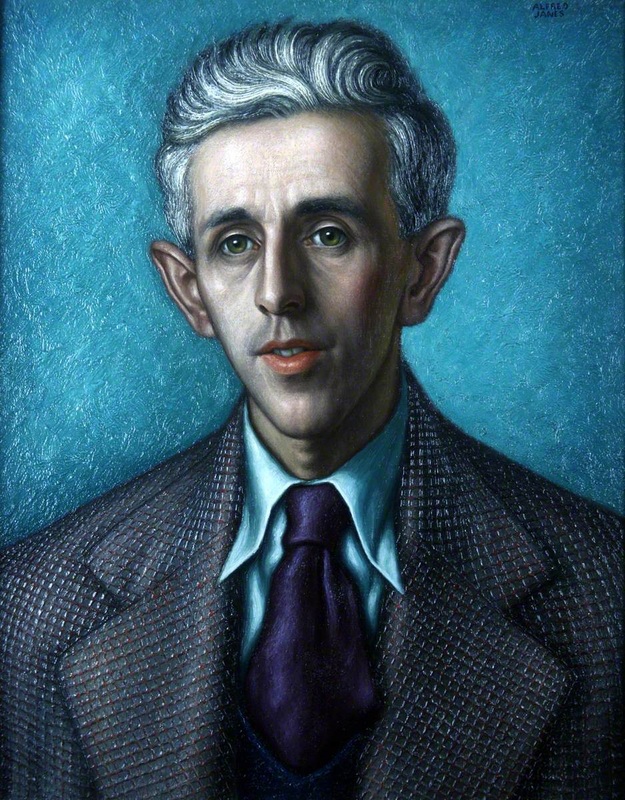
In the immediate post-war years, Fred Janes completed a fine oil of Mary Janes and notable portraits of his friends, the composer Daniel Jones and the poet Vernon Watkins, in 1947: I had tutorials with Vernon Watkins as an undergraduate at Swansea University some twenty years later; he was in his sixties and would die in America later that year, but he retained the visionary glow and vulnerability which the portrait captures.
Over the next few years, Alfred Janes moved his family to Gower, taught at Swansea College of Art and produced several large figures, including “The Point is..”, “Boys with a Crab Cancer and Gemini”, “Breakfast” and “Bank Holiday (Happy Family)”, in which the characters confront each other and the viewer in a direct, questioning way.
The “happy family” is turning into a fairground monstrosity, the mother holding a stick of rock with the artist’s name and date running through it. These works pull us into their world and challenge us to make sense of them and their place in it; they are unsettling.
Then, in the late Fifties, the work becomes more fractured and experimental. And the sense of experiment is very evident over the next two decades when Alfred Janes works in a variety of media – Perspex, collage, photo-collage, windscreen glass, marbles, PVA, sand and glue.
The works are not just paintings, they are assemblages, constructions. He had moved with his family away from Swansea in 1963, to teach in Croydon. American Abstract Expressionism was the new wave, followed by Op Art, performance, Pop Art. London welcomed things that Swansea was not ready for.
It could be argued that of the leading artists of Wales, only Ceri Richards successfully absorbed Abstract Expressionism and moved on unscathed. His “Cathédrale Engloutie” series was outstanding.
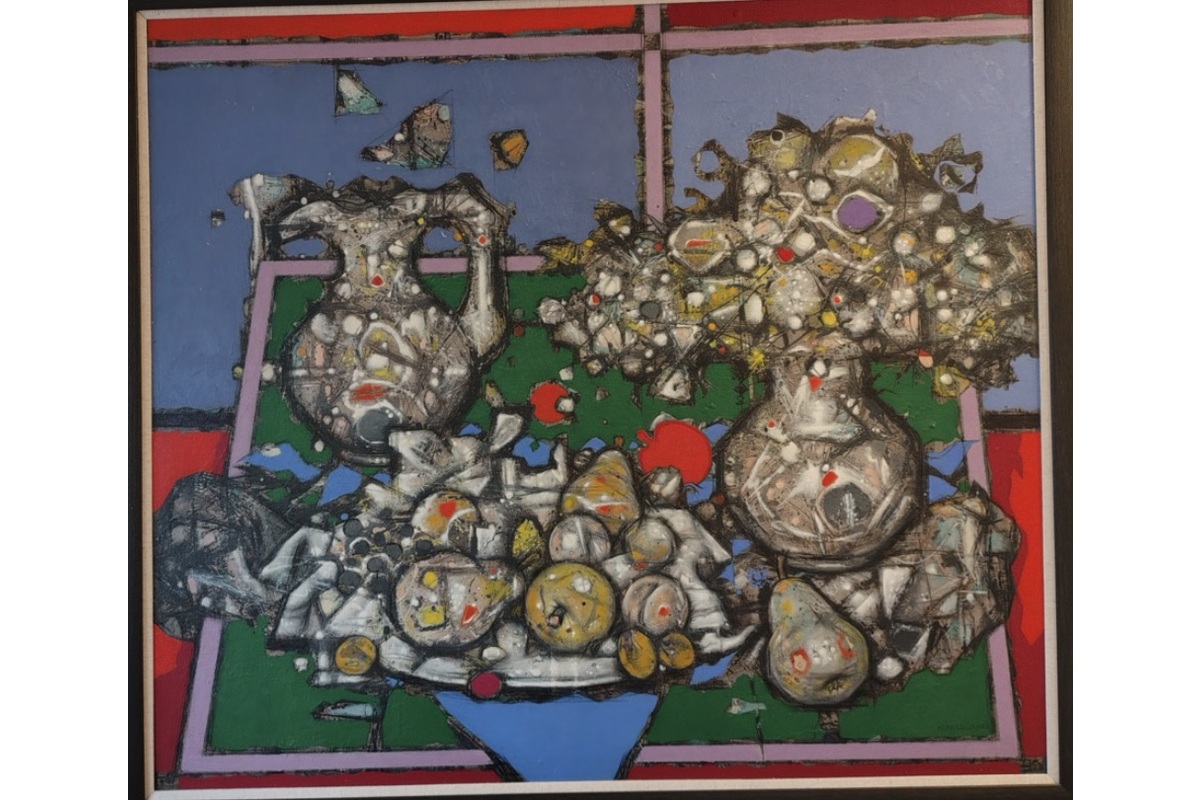
Fred retired from teaching in 1982, having worked until he was seventy-one. Retrospective exhibitions followed, including in Swansea and Cardiff. Later works such as “Somewhere Between” and “Festival” revisit and reimagine the still life subjects on a table, but now there are blocks of colour and a bleeding of the flower images which seem to dissolve before us.
Ceri Thomas is particularly good at critiquing these later works. Of “Red Apple”, a revisiting of a Sixties painting called “Still Life with Glass Jug”, he says:
The sensation of hidden physical forces is enhanced by all the other objects in the picture – the jug, the plate under the fruit, the vase of would-be flowers and the cloth under them – all of which are windows into Fred’s earlier picture. These older parts seem to suggest that we are looking at an equivalent of bubbling, coalescing and fragmenting (would-be or molecular or cosmic) structures. The overall gallimaufry is yet another manifestation of his pure enjoyment of painting as an end in itself.
This is a book about an artist who always had a “pure enjoyment of painting”, written by a critic who is adept at applauding that.
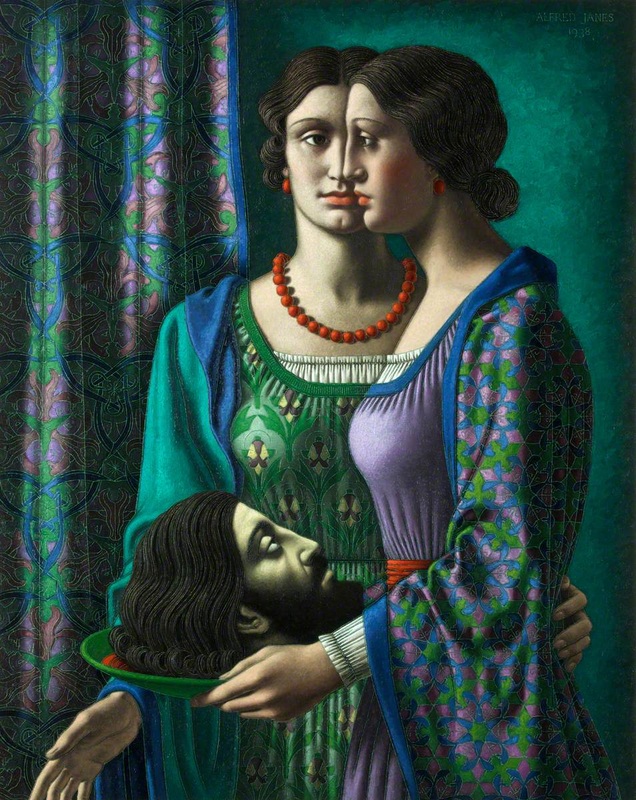
Most of the later, more fractured works, such as “Red Apple” and “Somewhere Between”, are in private collections. However, I would encourage you to visit the collection at the Cyfarthfa Castle Museum and Art Gallery in Merthyr Tydfil, for there in a room which has significant works by Cedric Morris, Kyffin Williams and others you will see Fred Janes’s tour de force from 1938 – “Salome”. Its formal structure, rich colouring and drama – the sheer bravado of the work – still have the power to shock, impress and move us.
It has the complex patterning we would expect; it has a sculptural weight and an ethereal presence. The two figures are overlaid and conjoined, their form and stature enhanced by the red sash, their lips and the necklace – all resonating with the spilled blood of the severed head. He has sacrificed himself to their beauty. It is a beautiful, vengeful triumph.
Could anyone else in these islands have painted such a work in 1938?
Support our Nation today
For the price of a cup of coffee a month you can help us create an independent, not-for-profit, national news service for the people of Wales, by the people of Wales.
Get more trusted Welsh news
Choose Nation.Cymru as a preferred source in Google News to see more of our journalism.