

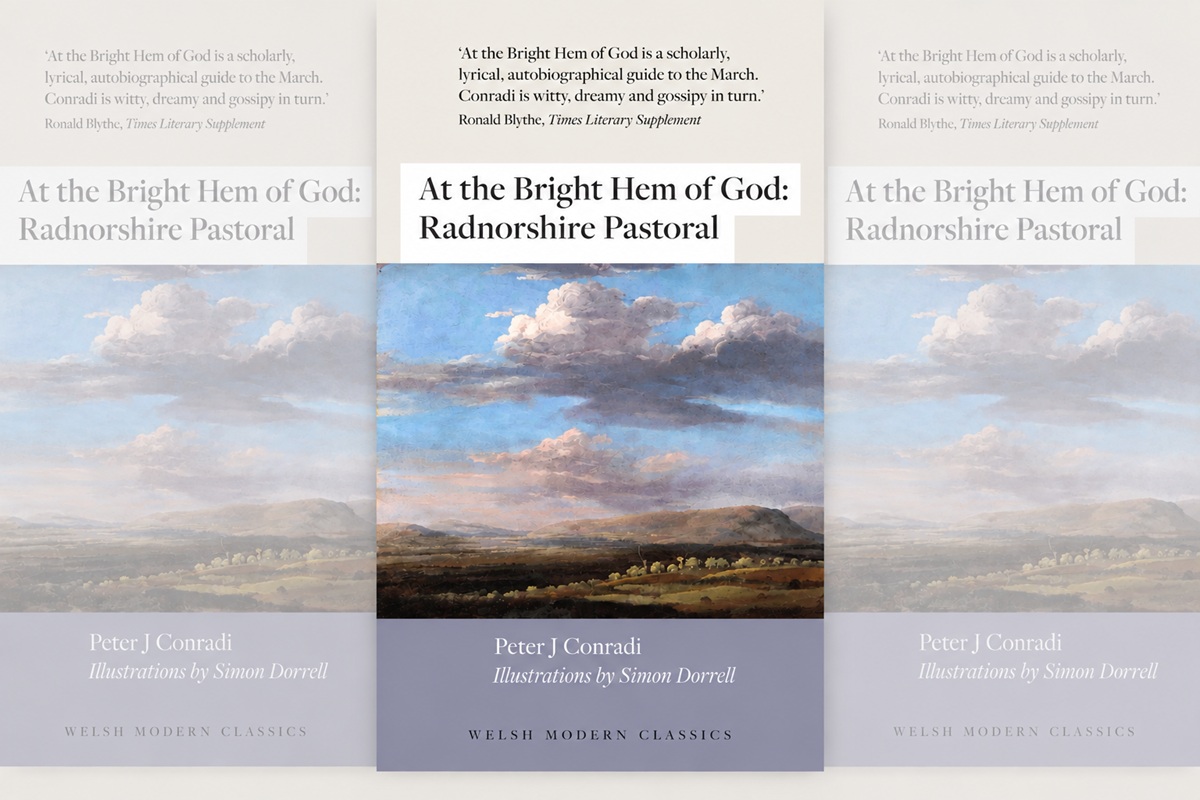
Book review: At the Bright Hem of God: Radnorshire Pastoral by Peter J Conradi
Desmond Clifford
This book was first published seventeen years ago and is now republished as a Modern Welsh Classic.
Radnorshire is perhaps Wales’ most elusive and hard-to-pin-down region. I wonder if it’s what Shakespeare meant when he described Welsh chatter as “a deal of skimble-skamble stuff” – imprecise, defiant of firm definition. On the east, it’s bordered by Offa’s Dyke, a border which is itself ambiguous, no one entirely certain whether it was built to keep in or to keep out. To the west, the impenetrable Cambrian Mountains, and to the north and south a large green empty quarter, the Green Desert.
The centre of Wales is depopulated; most Welsh people these days live along the M4 or the A55 at the country’s extremities. Unlike other regions, Radnorshire has no real centre of gravity. Llandrindod Wells is the regional administrative centre, but this Victorian confection is no capital of hearts.
Presteigne, Rhayader and Knighton all have charms but none of them exert much magnetic pull. Instead, they seem to float without orbit. Radnorshire was prime Marcher territory and one reason the Normans conquered it so easily – while other areas were so hard – was because no central authority compelled resistance. Then as now the land lies open and offers little resistance beyond its obscurity and solitude. The land belongs to those who will live there, among whom sits Peter J Conradi.
Wales has always struggled for a full sense of cohesion. People can make too much of it, but the geographical awkwardness of the country is real. Taking any route you like, the journey from north to south winds through large empty quarters, thinly distributed populations and uncertain identities. Before industry, Radnorshire was not so different from other parts of Wales.
Absorption into England rendered practically the whole country marginal and without centrifugal energy. Once copper, coal and iron were exploitable, the money men became interested and the areas without those resources languished. Nowhere languished better than Radnor – it is a space built for languishing and stasis. Its population today is almost identical to a hundred years ago.
Conradi is exceptionally skilled in conveying the peculiarities and eccentricities of the area. He writes well on the brilliant but small output of WG Sebald, the German author who over a decade published a compelling, mysterious collection of books helping give birth to the genre of “psychogeography”.
The genre is very well suited to a country where geography and the personality of Wales form such an insistent aspect of the national literature. Conradi makes his own contribution to the genre. The area has been nobly served by writers, with Francis Kilvert and Bruce Chatwin perhaps the best known, but is not so frequently written about as to feel hackneyed or jaded. Some parts of Wales, in contrast, feel over-exposed.
Radnorshire as a unit of local government kept going till near the end of the twentieth century when political bureaucrats wiped it away. Wales is different in this respect from Ireland where county borders have long provenance and intense loyalties built largely on Gaelic sports. In contrast, the Welsh experience is of casual county reorganisations with barely a murmur from the hills and hamlets.
At any rate, Radnorshire is no longer confined as a unit with administrative boundaries. Today, and in keeping with the concept of psychogeography, it is a Radnorshire-of-the-mind, a place of imagination and history, governed by the spirits of writers rather than perplexed county councillors convening to make sense of it.
Gerald of Wales
Conradi considers Radnorshire through some of its residents and visitors. Had news operations existed in the late 1100s, the cameras would have flocked to New Radnor and scrambled for camera vantage points. Lord Rhys, Prince of Deheubarth, travelled to the eastern extent of his lands to welcome the Archbishop of Canterbury, Baldwin, about to commence a recruitment drive around Wales for the Third Crusade. Baldwin was accompanied by Gerald of Wales, Gerallt Cymro, who recorded the journey in the first ever book written about Wales.
It was a diplomatically delicate mission. The Normans already occupied large chunks of Wales, the Marcher lands, and the question of conquest lay heavy in the air. Lord Rhys was a gifted fighter but a politician too and he successfully constructed a pragmatic relationship with England’s king. Gerald – three parts Norman, one part Welsh and all parts Apparatchik Extraordinaire – was a close adviser to the king. He was extraordinarily capable and high-achieving in the royal service but he coveted the archbishopric of St David’s which he wanted on the basis of independence from, and equal status to, Canterbury.
He devoted years of his life and energies to this cause, at home and in Rome, but without ultimate success. You could say, and people always have, that Gerald ran with the hares and hunted with the hounds. Conradi sums up this ambiguity elegantly, “It is somehow typical of Gerald both that he was the first man to take the Cross at New Radnor, and also that he never left for the Crusade.”
Gerald is a proxy for the complications, contradictions and compromises sometimes inherent in the Welsh identity, then as now. He is in every sense a modern figure. On their tour, Baldwin and Gerald preached at Llandaff Cathedral and exhorted some of my neighbourhood forebears to take the Cross and head for Acre and Jerusalem. I imagine some of them did. It’s unfortunate there’s no local memorial to this stirring occasion.
Glyndŵr
For all its relative obscurity today, the ghosts of history hang in the Radnorshire air. Llewelyn, the Last Prince, is buried at Cwm-hir. Glyndŵr himself traversed these lands with his court, and the poets, and the full, condemned colour of Welsh civilisation. Famously there is no record of Glyndŵr’s death, a prime reason for his enduring energy, but it was from these borders that he melted into history, an enduring and truculent eye alert still.
Herbert, Traherne and Vaughan all lived in proximity around Greater Radnorshire. Even then, Wales had begun its journey from endless warfare, castles on every brow and promontory, towards the picturesque and romantic – and the slightly suffocating lens through which English sensibility is still inclined to see Wales. A long list of England’s poets, artists and luminaries tramped the hills determined to avoid daily lived experience in pursuit of the ethereal.
The Victorian vicar, Francis Kilvert, resident of Clyro, is the best-known chronicler of the area. His outlook is romantic too; the slow rhythms of the area were what brought him peace, but his experience of life was authentic. Vicars in those days got down and dirty with the parish, there was no welfare state and parishioners’ problems were, in some measure, the vicar’s problems too.
Inspired
Conradi sees Radnorshire largely through the eyes of writers. He explores Edward Thomas, Bruce Chatwin, Ruth Bidgood, Roland Mathias, RS Thomas and others as commentators and creators inspired by the area. This literary preoccupation is hardly surprising. Among other things, Conradi is the biographer of Iris Murdoch. He knew her well and his “A Life” is an excellent book. She herself was a visitor to the area though sadly (so far as I know) wrote nothing about it.
The title, “At the Bright Hem of God”, comes from RS Thomas. For a couple of years in succession, many decades ago now, I ran across Hergest Ridge as part of a race which straddled the border. There is no point higher as far as the eye can see, and with the effect of endorphins swilling around the body, it’s easy enough to believe the ethereal is nearby.
This is an excellent book, so enjoyable to read, and it’s pleasing that the Welsh Modern Classics series is giving it another lease of life.
Support our Nation today
For the price of a cup of coffee a month you can help us create an independent, not-for-profit, national news service for the people of Wales, by the people of Wales.
Get more trusted Welsh news
Choose Nation.Cymru as a preferred source in Google News to see more of our journalism.


