


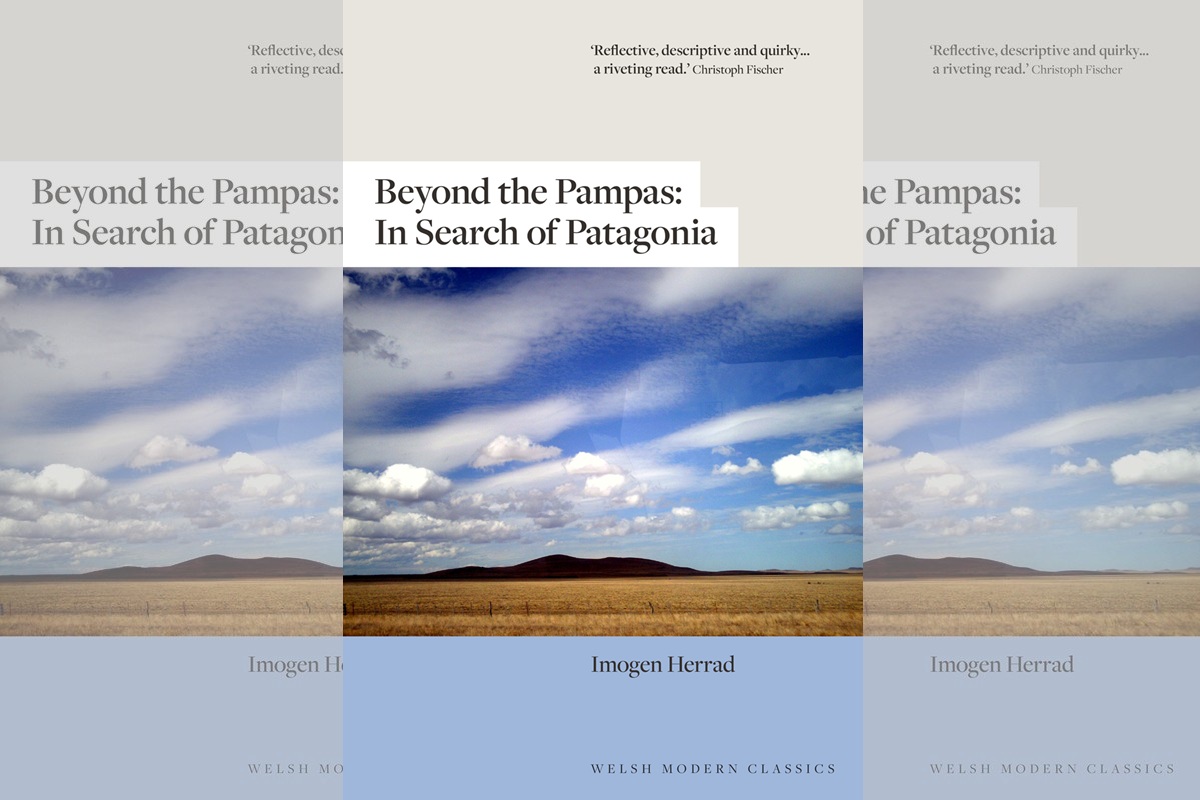
Book review: Beyond the Pampas: In Search of Patagonia by Imogen Herrad
Desmond Clifford
Patagonia has long exercised a fascination for writers and has amassed a substantial literature in three languages; English, Spanish and Welsh.
Writers are drawn by the astonishing story of Welsh colonists departing height-of-empire Wales in search of economic and cultural autonomy. Remarkably, and with some caveats, the adventurers achieved at least elements of what they were looking for on the other side of the world.
Imogen Herrad brings an interesting perspective as an insider-outsider. She is German but proficient (over time and to different degrees) in English, Spanish and Welsh. Professionally she is a translator and academic (British based for long periods but driven to Bonn by Brexit) and writes English with native fluency.
Her relationship with Wales began in Aberystwyth in 1980 (we might have passed on the street!) and has been maintained since. Her relationship with Patagonia is not based on a single visit but a series of visits stretching over many years. It’s a relationship she has invested in.
It’s worth recalling the bald facts of the story. In 1865 a boatload of Welsh colonists left Liverpool, under the influence of Michael D Jones, an early nationalist preacher, who conceived of a Welsh land free from the dominance of England and English.
Around 150 settlers left Liverpool on the ship Mimosa. Patagonia was one of few available locations identified as seemingly empty. It was remote arid land, and the Argentine government encouraged the enterprise, keen to attract European settlers to entrench their still uncertain claim and to fend off claims from Chile.
As Imogen Herrad records, the settlement succeeded more than it failed. The first settlers faced hunger and drought. They landed in a desert, and their first task was to build an effective irrigation system before they could farm at scale. They then had floods which they had to learn how to cope with.
In the meantime, representations to the Argentine government in Buenos Aires for food were successful and it was a combination of Argentine support, tenacity, immense hard work, vision and good luck which held the colony together during its formative years.
Today we only see the successes but there was a long history of failed European migration to the Americas. Apparently, of three million European migrants to Argentina in the latter nineteenth and early twentieth centuries, around half eventually returned home. The odds were against the Welsh Patagonians, and their relative success was an incredible chapter in history.
The author befriends Lisa, a descendant of John Morgan James, from Ponterwyd (Aberystwyth) who joined the colony in 1886 after concluding he had little hope of earning a decent living at home. His granddaughter gave the author a tour in Welsh, including sight of “Capel Bethesda 1904”.
As well as Lisa she meets a Bethan and a Gwilym and they converse in mixtures of Welsh and Spanish. Someone describes the multi-lingual author as “un bicho raro”, a rare beast.
As part of their support for the colonists the Argentine authorities had negotiated a deal with the tribes of native Indians to leave them in peace in return for food and other supplies. Colonies elsewhere across America had encountered repeated violence from native peoples. In Patagonia the Welsh settlers had the advantage of owning guns, unlike the natives, but even so, it’s not clear they would have been well-placed in the event of serious trouble.
As it was, the first encounters between the natives and Welsh colonists were peaceful and when the Argentine state turned aggressive towards the Indians, the Welsh colonies remained largely apart from the violence.
Estranged
Herrad gives notably sympathetic accounts of the Indian peoples and, as a translator, shows sensitivity to their languages. Some of the Tehuelche Indians learned Welsh to help them adapt to the new neighbours. What emerges through the book is that Imogen Herrad was mistreated by her parents during childhood and, as an adult, is estranged from them. This, combined with her consciousness of German history, gives her some feeling for the underdog.
The author is very clear in her judgement, “Without the help of the Indians, the Welsh colony would have never survived.”
Farming took a time to get going as the colonists learned to adapt to new terrain. Only a minority came from farming backgrounds in any case so many had to learn completely new skills. In the meantime, it was trade with the Indians which kept them alive.
The Indians especially loved colourful feathers, which the settlers were able to import from home, and in return they received meat hunted by the tribes.
Trading houses were developed along the Chubut Valley and, in the long run, the colony took root and eventually prospered through a combination of farming with commerce.
Grim
Tragically, the growing demands of Argentine statehood led the central government to supress the tribes and appropriate their lands and animals, eventually confining them to small reservations in Patagonia and elsewhere. The story is less well-known than its USA equivalent but is equally grim.
The Welsh part of the Patagonia story is well-known and widely told. The Indian side of the story is much less known and the author, to her credit, burrows into this world.
She travels and speaks to people to try and understand their cultural and economic anxieties. While official Argentina has been broadly benevolent towards Patagonia’s Welsh identity, viewing it positively as an aspect of European identity, its attitude to the native Indian community is considerably less positive.
She hears from a young Mapuche, “We’re beginning to throw off the shame. We’re learning the language again”.
In general, the author feels warmth and affection from the Patagonian Welsh and, because she speaks Welsh, she feels easily “at home”. Only on 28 July, the “national day”, the annual celebration of the Mimosa’s arrival does she feel shut out by the character of private family celebrations.
Tensions
The longer she spends in Patagonia the more she becomes aware of tensions beneath the surface, largely invisible to the casual tourist. Even non-Welsh Argentinians can feel alienated by what some see as an insular Welsh vibe in Gaiman, the principal town; one person tells her, “They don’t want people from the outside who do new things”.
The question isn’t baldly stated but is implied: were the Welsh colonists the same, fundamentally, as other colonists? Was the Mimosa different in principle from the Mayflower? Colonists everywhere – then as now – generally escape difficult lives in search of better ones.
Some found it, some didn’t. Either way, natives who already inhabited the lands paid a price. It’s not an original view but it acts as a counter to an over-sentimental view of the Welsh colony.
The original colonists may have felt they were fleeing lives of servitude but even oppression has its own gloomy hierarchy. Acknowledgement of the native culture is perhaps a starting point for redress and fuller recognition of their share in the story.
Patagonia has inspired a significant library of books for a reason. It is a compelling story and a rare example – unique really – of Welsh people leaving Wales to begin again elsewhere while retaining a sense of being culturally Welsh.
It’s remarkable that the language survives still after nearly two hundred years and it is encouraging to note that the “Welsh vibe” is broadly popular and supported.
Imogen Herrad writes well and there is no hint of this being written in an acquired language. She is curious and clear-sighted. Her strong nous impels her to look beyond the surface and the kitsch.
She manages to acquire a broader and critical perspective on the Welsh Patagonia experience without becoming alienated from what drew her interest in the first place.
The Welsh language worldview is impenetrable to most non-Welsh people and it is valuable to have this perspective from “outside”. If she writes again about a Welsh topic, I would be keen to read it.
Beyond the Pampas is published by Parthian and can be purchased here and at all good bookshops.
Support our Nation today
For the price of a cup of coffee a month you can help us create an independent, not-for-profit, national news service for the people of Wales, by the people of Wales.
Get more trusted Welsh news
Choose Nation.Cymru as a preferred source in Google News to see more of our journalism.


