

Book review: Dogs in a Storm by Brennig Davies
Niall Griffiths
At age fifteen, Brennig Davies won the BBC Young Writers Award for his story ‘Skinning’; check it out on the BBC website being declaimed mellifluously (of course) by Ian McKellen. It’s a thematically callow piece – ‘God help the beast in me’, kind of thing (thanks, Johnny Cash) – which is perhaps only to be expected from such a young writer, but it’s also astonishingly, extraordinarily accomplished in tone and style and structure and is evidence of a large and nascent talent. It gives the sensation of a greyhound in a trap, slavering and straining to be unleashed on the mechanical hare; here is a drive and a compulsion dying to be born. ‘What fun is control?’, asks the narrator, as well he might; there are wonders and marvels and horrors swarming below the thin scrim of civilisation.
So, eleven years on, in this debut collection, is that early promise fulfilled and honoured? It must have weighed heavy on the writer’s noggin. The bumf on the back of my review copy announces that the target audience is ‘literary fiction fans who also happen to be freaks’, which is ugh (but, well, demographic appeal and all that), and lists a few of the influences (George Saunders, Julia Armfield etc) which suggests that the reader might be in for some performative quirkiness, some self-indulgent ‘aren’t-I-wacky’ banner waving, but don’t be repelled: this is a fine collection. It contains a multitude of great excitements. To be sure, it wears its influences in a somewhat conspicuous fashion but it’s a paradoxical truism that all distinctive voices bear within them echoes of other, prior distinctive voices. Davies, I feel, needs to assimilate those voices further and allow them to be moulded and dyed by his own experience and personality but there’s no doubt he’ll do this; on this evidence, he’s too talented a writer not to. I’m intrigued to see what he’ll do next.
The opener, ‘Pityparty’, looks back to the incarceral period of the Covid epidemic, when our screens were full of people entertaining themselves in their homes; here, our narrator, in a brilliant conceit, recalls weeping for paying customers online, ‘not only crying but also. . . wailing, howling, sobbing, snivelling, whimpering, grizzling, sighing, bawling, and even lamenting’. The voice (female) is completely convincing, utterly absorbing. The ‘job’ comes easy to her initially, she’s good at it, but then she finds a measure of happiness in her life and the ability to cry on demand leaves her, and so she loses her position. There is a disappointed and devastated stalker situation. She resurrects the hibernating capacity for laughter and that is characteristic of this collection – there is a lot of redemptive release for one so steeped in loss and grief. A life mediated through pixels need not be a terminal, irredeemable situation, and the individual persists through the appalling levelling of a virus that doesn’t discern, that kills both junkie and judge (notwithstanding the fact that it disproportionately hits the disadvantaged).
‘The Boys on the Bridge’ has that quality (which writers like George Saunders possess) of provoking laughter in what is essentially a scenario of heartbreak; here are the limbo’d souls of a suicide cluster (echoes of Bridgend; south Wales as a location features strongly in the collection), gathered on the bridge from which they leapt. There are no full stops here (of course); they observe the absurd traffic (including their own funerals) of the physical world they have left, their still-living acquaintances going on dates, to university, also contemplating suicide themselves, ‘And we can feel it all again, all of us How desperate it is How achingly, nibblingly lonely It’s too much, Too Much, but we know it’. It’s a terribly sad story, undoubtedly, but the facility and skill and empathy with which it is told tempts a grin of admiration. Davies slightly develops this story in the acknowledgements, in an address to his friends: ‘these stories are washed in loneliness’, he writes, ‘but it’s thanks to you that they get to be fiction’. Sweet.
And it’s an eclectic skill on display, here. ‘The Pomegranates’ has a perfect opening few paragraphs which deliver backstory, prolepsis, mystery, typographical innovation. It is a skill equally at home in the contemporary vernacular of ‘Tonto’ to the epistolary Victorian horror of ‘The Brothers Riseborough’ (a winding, breath-stealing stomach punch of a story). There’s an anticipatory excitement; where will the next story take you? Where will you go? It’s thrilling. It doesn’t always succeed: ‘The Ground Has Moved’, despite some fine writing and skilful use of repetition, feels a tad trite, thematically, and ‘Thunder Road’ recalls Stephen King at his most mawkish, but ‘Tunnelling’ (another lockdown tale) has a flawless structure that well encapsulates the desperate and frenzied need to escape an intolerability and the closing section of ‘A/B’ is a slap to the face and the heart (this is writing that often has a somatic effect, even as it engages the intellect). It can be pithy – ‘all the emails and bin days and too-fast years all rushing by’ is a precise summation of quotidian ennui – and it can be startlingly descriptive: Rhossili Bay ‘was still beautiful: a slap of soft, butterscotch sand; waves folding over themselves, like napkins in a fancy restaurant. Inland, a cling of grassy hills, all rolling shoulders and gorse’.
Leitmotifs move between specific south Walian geographies, Bruce Springsteen, Europe, unlikely parallels, loss (which has its peak in ‘The Department of Losses’, almost unbearably poignant), and, especially, the chthonic; underworlds and tunnels as symbols recur, as does the sense of an attunement to and with a neighbouring actuality (this reviewer was reminded of David Lynch, here, and of course Kevin Barry). There are phantasmagoric depictions, powerful metaphors of yearning, and absorbing knots of reciprocity, often webbed around love. Where Davies’s talent will take him next will be fascinating to discover.
A quote to close on (Davies’s italics): ‘It’s a small world, he thinks, but it is also unbelievably, unbearably big, and I will be so darned sorry to leave it’. Exactly.
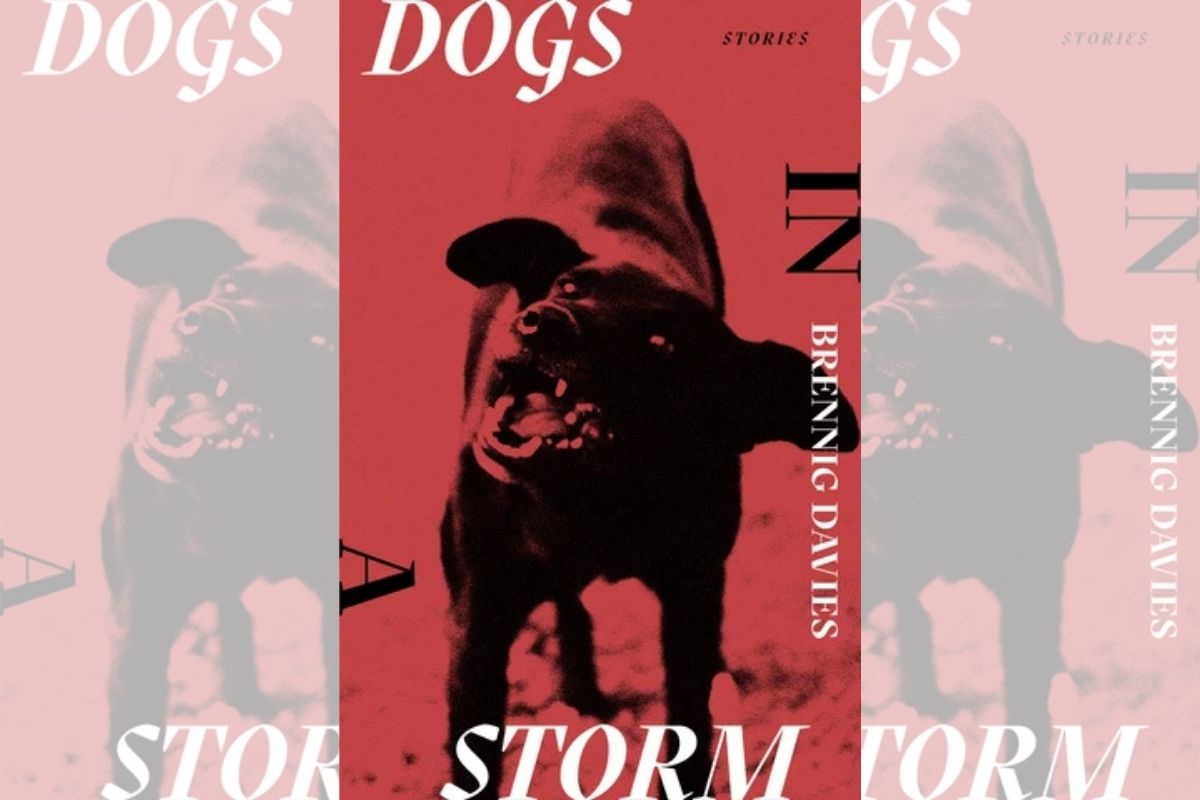
Dogs in a Storm by Brennig Davies is published by Parthian. It will be released on Wednesday 30th of September and you can pre-order here.
Support our Nation today
For the price of a cup of coffee a month you can help us create an independent, not-for-profit, national news service for the people of Wales, by the people of Wales.
Get more trusted Welsh news
Choose Nation.Cymru as a preferred source in Google News to see more of our journalism.



