

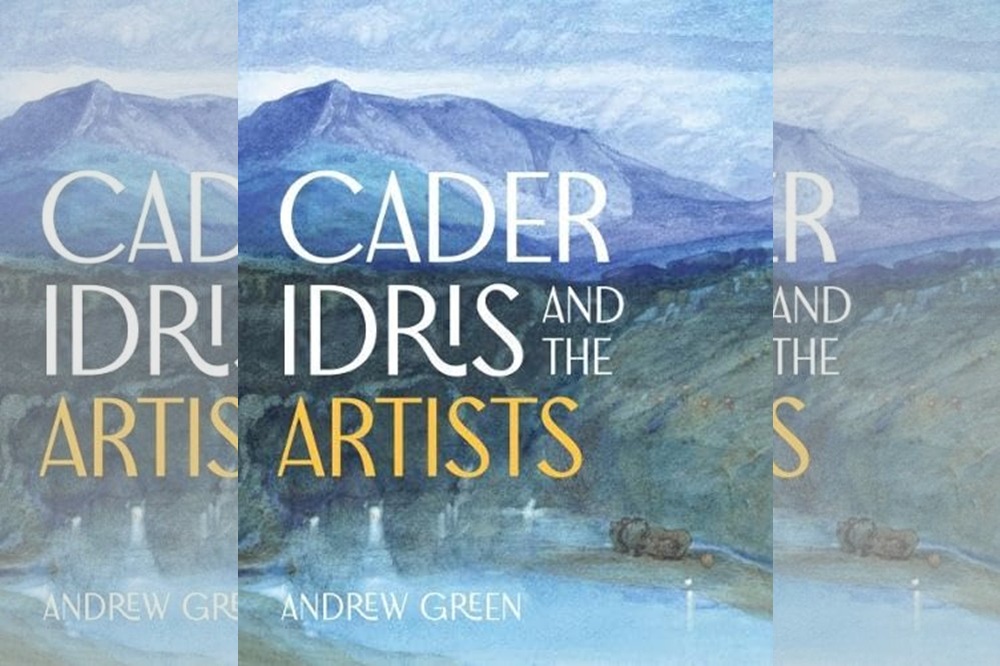
Book review: Cader Idris and the Artists by Andrew Green
Tony Curtis
This new and generously illustrated book on Welsh art is to be welcomed. Andrew Green has brought together a comprehensive survey of artists’ responses to Cader Idris, from Richard Wilson’s “Llyn-y-Cau, Cader Idris in 1765 to our contemporaries.
Thomas Pennant in 1784 said that Wilson’s view of the mountain made a verbal description redundant.
As Andrew Green has it, Cader Idris was from that point “A laboratory for experiment… not as a visual resource but as a potent idea.”
Beginning with the travels and responses of Pennant and other in the eighteenth century, Andrew Green shows that this mountain, as much as the much-lauded Yr Wyddfa, has been a magnet and focus for the Welsh and many visitors who come in search for an escape and a vision of what the world really is, in essence.
Cader Idris is really a series of peaks linked by a ten-kilometre ridge; it has an outstanding feature in Tal-y-llyn Lake. Jim Perrin has described it as “the longest and finest mountain ridge south of the Scottish border”.
So too is Andrew Green’s book a series of peaks, chronologically traversed for nearly three centuries. Of course, he begins with Richard Wilson, born near to Machynlleth in 1714.
Wilson successfully sold Welsh landscapes in London and was a notable artist during his time in Italy. By the middle of the eighteenth century our perception of and involvement in the natural world had deepened and the countryside, particularly the rugged features of mountains and lakes were depicted and seen as the root of emotional and spiritual senses.
Edmund Burke declared in 1757 in his book A Philosophical Enquiry in the Origin of our Ideas of the Sublime and Beautiful, “a perpendicular has more force in forming the sublime, than an inclined plane, and the effects of a rugged and broken surface seem stronger than where it is smooth and polished.” The Sublime took you higher, in every sense, than flatness.
And, following the effective closure of the great European mountains with the French Revolution and the wars against Napoleon, the spiritual force for artists and writers had to be rediscovered in Wales, The Lake District and the Scottish Highlands. When Wilson showed to great acclaim his Llyn-y-Cae, Cader Idris in London in the late 1760s the Sublime was there within reach of the English. And they came.
However, Andrew Green points out that Wilson may have approached the mountain with the words of Ellis Wynne’s Gweledigaethau y Bardd Cwsg in mind: the poet is transformed by his experience of climbing a mountain (probably that of Cader Idris close to his home near Harlech). It is a satire on exaggerated poetic visions, but some fifty years later the idea that mountain climbs gave one more than imagined insights was firmly established.
Italian travels
In any case, Wilson’s Cader Idris is a version, informed by his Italian travels and the prevailing tastes of the buying public, for in 1774 it was accepted for exhibition at the Royal Academy and the following year Edward and Michael Angelo Rooker’s engraving proved very popular.
Wilson’s image improved on the fact of the mountain; in colour and outline, Cader Idris was rendered grander and more ideal. Landscape is not fact and is not fixed by anyone other than an artist of writer at and in his time.
Andrew Green’s six chapters trace, chronologically, the shifting perceptions and records of this mountain. It is, after all not one mountain, not one view, but a substantial area of north Wales to be approached, climbed and viewed through 360 degrees, and through all seasons and all weathers.
The list of those inspired by its aspects and its ascent include – Turner and Cotman, following the steps of “the immortal Wilson”; Cornelius Varley with his “graphic telescope”, Copley, Fielding and Cox. From the middle of the nineteenth century professional mountain guides like Richard Pugh were on hand for visiting artists, while in the first half of the twentieth century Maesteg’s Christopher Williams, war-time artists Kenneth Rowntree and John Piper, and of course, Sir Kyffin Williams, painted Cader Idris.
Later, Tony Cragg and Gillian Ayers developed more abstract inspirations from the mountain; in 2001, Ogwyn Davies’s large mixed media work, using photographs, maps, printed text and a large Gormley-like figure, continued to interrogate the mountains’ immensity to our human lives and scale.
Radical
But perhaps most radical and original was the 2016 Artes Mundi video submission by north Wales native Bedwyr Williams whose “Tyrrau Mawr” saw the mountain and lake through a futuristic transformation, a sci-fi sublime.
Williams is the artist who concludes and completes this excellent survey. His video installation in the National Museum in 2016 was generously staged and proved magnetic; surely in any other year it would have taken the prize, but it was awarded that year to the outstanding John Akomfrah, who went on to represent Great Britain at the Venice Biennale.
One sat in the room with the huge Williams screens and absorbed the transformation of the mountain and lake as one’s senses accommodated the modulations of light and the seemingly relentless march of the urban development.
It was a Sci-fi version of a futuristic city in a place and out-of-place. Compelling and wonderfully paced, the work leaves the viewer intrigued, repulsed and seduced by turns. Is this what we make of our world? Is this what we are doing in our country? So, should one yearn to return to the idealised Richard Wilson Cader Idris, or the romantic ruggedness of John Piper or Kyffin Williams, whose 1948 Cader Idris oil hangs in Highgate School where he taught and from where he would begin to build layers of paint to re-create his remembered homeland?
Eloquent
In this comprehensive and eloquent book, Andrew Green not only outlines the history of seeing the mountain, but celebrates Cader Idris as a landscape subject and an idea which continues to show us who we are and what our own place in the world might be.
There are two launches scheduled at Turner House, Penarth at 4pm and 6pm on the 3rd of June. The 6pm event has sold out, but tickets for the 4pm event may be bought through www.ticketsource or from the Graffeg website.
Support our Nation today
For the price of a cup of coffee a month you can help us create an independent, not-for-profit, national news service for the people of Wales, by the people of Wales.
Get more trusted Welsh news
Choose Nation.Cymru as a preferred source in Google News to see more of our journalism.


