


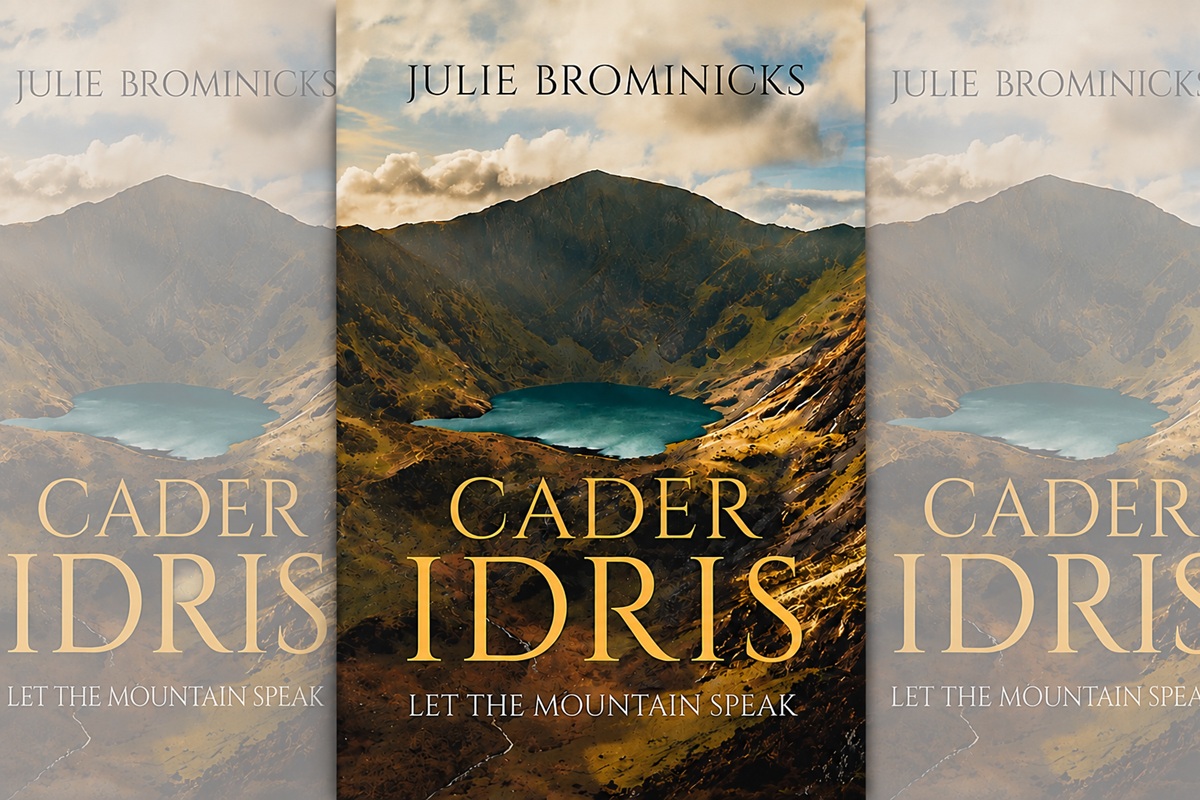
Book review: Cader Idris: let the mountain speak by Julie Brominicks
Andrew Green
In the written record Cader Idris is a Cinderella of Welsh mountains. Though loved and admired by locals and visitors, and despite the richness of its geological, mythological, historical and literary associations, there’s been no full-length treatment of the mountain until now.
The gap has finally been filled with the publication of Julie Brominicks’s substantial, near-encyclopaedic portrait.
She brings two qualities to what’s a challenging task. First, a deep and detailed knowledge of the natural environment of upland areas, and a gift for conveying that knowledge expressively. And second, an instinctive openness to the experience of being a part of that environment.
A glance at the lengthy bibliography shows what an impressive amount of research has gone into the making of her book. Not content with delving in libraries and archives, she seeks out dozens of people – experts, local residents and visitors – who can tell their stories about the mountain’s secrets. And, crucially, she’s prepared to spend many days, and nights, getting close to the bones and skin of Cader’s giant body.
In her first book, The edge of Cymru (2022), Brominicks tracked the Wales Coast Path, while meditating anxiously along the way about the effects of humans on the natural environment and about the condition of Wales. In her new book it might seem that she’s come to rest, in contemplation of a single object. But Cader Idris isn’t a unitary or static feature.
It’s not a single mountain but a long, 12-kilometre mountain ridge, punctuated by spurs and lake-filled bowls. And it’s always changing. Its complexity and mutability demand that its biographer should be constantly on the move in order to capture as full a picture as possible. This is exactly what Brominicks does.
Though she has a model for a ‘mountain biography’ in Jim Perrin’s Snowdon: the story of a Welsh mountain (2012), she doesn’t follow his conventional structure and consistent style. Her treatment is also broadly chronological, but she divides her book into sharply contrasting sections.
After a prologue on the thorny etymological question of Cadair v Cader, Part 1, ‘Cader Idris remembers’, takes the form of a conversation between the personified mountain and the author, referred to only as the ‘Frizzy-haired woman’. These exchanges are interspersed with shorter, personal fragments about specific locations on the mountain. Part 2, ‘The Frizzy-haired woman dreams’, uses the dream motif to flit quickly from topic to topic. Here too we hear the voice of Cader. Only in Part 3, ‘Being attentive’, do we arrive, in the present day, at a more orthodox, documentary style.
Some readers will find Brominicks’s choice of explanatory style in Parts 1-2 a touch whimsical or mannered. But the advantage of a more informal approach is that she’s able to get across a lot of information about the geology and history of Cader without being over-didactic.
The idea of a mountain as a cognitive or sentient being isn’t new. Nan Shepherd wrote in the 1940s of the Cairngorms as a ‘living mountain’. In our own time, when the natural world is under threat as never before, the notion has gathered renewed force, as in Robert Macfarlane’s book Is a river alive? (2026).
Narrative momentum
For me the book comes into its own in Part 3. Here Brominicks records her meetings with a large number of people, all of them concerned, in a bewildering number of ways, with the mountain’s present and its future. The structure, a monthly diary from June 2025 to May 2026, gives narrative momentum, and the interviewees are given space to speak about their specialist expertise and experience.
Freya Canham, a geologist, investigates the links between different lichens and the stones they attach themselves to. Rhys Gwynn, Cader’s warden, shares his knowledge of place-names, pine martens and folk remedies. Rennie Telford peers into moth traps. Hugh Nutting, a farmer, fears for the future of upland agriculture.
Few groups of Cader people have escaped Brominicks’s net. She talks to hikers, swimmers, hunters and anglers, runners and paragliders, farmers, shepherds and drystone wallers, archaeologists, geologists and botanists, military plane spotters, Quakers and pacifists, climbers and mountain rescuers.
Fizzy drink production
Among the Cader-related subjects she treats are fizzy drink production, agricultural shows, the disappearance of the salmon, Christmas tree growing, and metal objects buried under stones in prehistory. Throughout she’s an expert listener and note-taker, always keen to share what she’s learned.
These multiple voices about Cader bring into focus many of the themes of the book. The exiguous impact of humans on it in the context of deep geological time. Its harsh beauty and the difficulty of surviving and making a living on its slopes. The conflicting interests of those who claim an interest in it. Above all, climate change, thinning the range and number of plants, birds and animals that once flourished on the mountain. The difficulty of arriving at a ‘balance’ of nature.
Lyrical
And then there’s the voice of Julie Brominicks herself, fluent and lyrical, but precise. She has a talent for making you feel that you’re there with her, alone on the mountain or in the presence of others, and for expressing moments of transcendence.
In the book’s final pages, she sits with David Smith, an RSPB officer, on the northern slopes of Cader, in search of merlins and ring ouzels. After hours of fruitless scanning, and just as they’re about to admit their fear that the birds may have left the mountain for good, they spot a pair of merlins on the crags above, and then two ring ouzels. ‘The call resonates around the rocks. The mountain is ringing.’
Cader Idris: let the mountain speak is a capacious bag of a book. It will be essential reading for mountain lovers for years to come (perhaps a reprint will include an index and a better map, and correct some minor errors). It’s not hard to imagine Cader Idris voicing his approval and thanks.
Andrew Green is the author of Cader Idris and the artists (Graffeg, 2026).
Support our Nation today
For the price of a cup of coffee a month you can help us create an independent, not-for-profit, national news service for the people of Wales, by the people of Wales.
Get more trusted Welsh news
Choose Nation.Cymru as a preferred source in Google News to see more of our journalism.



We measure in miles here…
Reminds me of the ‘Englishman’ the locals…
RIP Kenneth Griffith…
“A massive global export and backbone of the local economy”, true but without knowing their intended wearer it sort of lacks something don’t you think…perhaps you expand in this new book…
For the weaver it may have been some solace to think that their superior product did supply the best thermal properties to the most unfortunate…
The Liverpool Slave Museum has had some 4 million visitors in near 20 years, Dol could have had some of that. (If one is thinking of a visit it is closed until 2028)…