


Book review: Corn Gwlad – Camu Tua’r Bae / Slouching Towards Cardiff Bay by Desmond Clifford
Dylan Moore
Desmond Clifford moved from journalism into the civil service in 1997, just in time for the referendum on Welsh devolution.
In various roles, including a long stint as Principal Private Secretary to the First Minister, he worked for Welsh Government until 2025. Perfectly placed then, to give a post-retirement assessment of what he calls ‘Devolution’s First Era.’
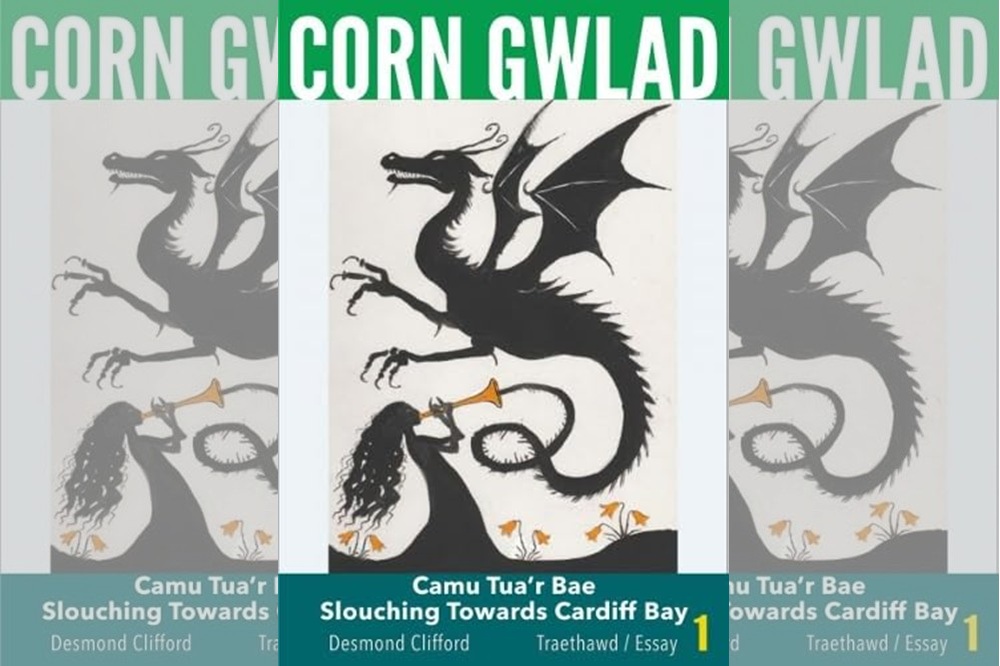
Corn Gwlad takes its name from the Welsh horn, a ceremonial instrument that trumpets public proclamations. Clifford is editor as well as first contributor to what promises to be a specially commissioned series of bilingual essays aiming ‘to throw some pebbles into the water in search of ideas’.
This inaugural effort takes its title from W.B. Yeats’ poem ‘The Second Coming’, its central image a malevolent beast stirring in the desert, a kind of Antichrist.
It’s a neat conceit that carries the metaphorical resonance for an essay that is largely prosaic in its approach, reminding the reader of George Orwell’s six rules of plain-speaking for political writing.
A fast-paced, one-sitting read composed mainly of simple declaratives, Clifford’s essay does not dwell on the titular metaphor beyond once making it clear that the beast stirring in the desert of Welsh politics has a name, and that name is Nigel.
Whatever happens on May 7, there is no doubt the 2026 election will mark the beginning of an entirely new era for an expanded and much-changed Senedd. Whether it truly marks a departure for Wales itself is moot, given the still-muted public consciousness of Welsh politics, even after 25 years of slow, steady maturation of our institutions.
As Clifford notes, turnout in a Senedd election did not top 50% until the Caerphilly byelection in October 2025, which prefigured the expected slug-out between Plaid Cymru and Reform UK to become the Welsh parliament’s largest party.
The essay begins with a whistle-stop narrative recounting devolution’s first quarter-century. If this section is light on policy interventions and tangible differences made to people’s lives, and heavy on piecemeal technocratic constitutional wrangling, that’s because it’s a whistle-stop narrative recounting devolution’s first quarter-century.
Key figures
Clifford admirably avoids beating about the bush or getting into the weeds, and many of those who might be considered key figures in the story do not even get a mention.
David Melding is an ‘intelligent’ and ‘openminded’ backbencher, Carwyn Jones a ‘decent debater’ and Kirsty Williams ‘could have been First Minister’ (if she hadn’t been a Liberal Democrat).
Dafydd Elis Thomas gets a mini-eulogy, but there’s no mention at all of Nick Bourne, Mike German, Leanne Wood or many of the very long serving ministers in successive Labour-led administrations.
It is clear that Clifford rates very highly the triumvirate of First Ministers who dominated devolution’s first era: the main achievement of Rhodri Morgan, Carwyn Jones and Mark Drakeford to keep ‘clear red water’ between the Welsh and UK Labour parties.
Alun Michael ‘made history and was then scrubbed from it’. Vaughan Gething, whose swift downfall precipitated that of his party, is dismissed as ‘hapless’.
There is some understanding for Eluned Morgan, who took the role reluctantly out of duty to party and country, but little sympathy for her political missteps. Her major error: standing by Starmer, a ‘partnership in power’ that abjectly failed to materialise.
Clifford’s essay is strong on making modern Welsh political history and its context easily digestible, a useful recap for those in the know and a primer for those less familiar. But it begins to meander when attention turns to the future.
Conflicted
The author voted for Rhodri Morgan and then Mark Drakeford in Cardiff West, but Plaid Cymru on the regional list (no doubt like many of the country’s soft centre-left majority) and is ambiguous and conflicted about the future.
The final section, titled ‘The Never Ending Dilemma’ begins: ‘I seem not to know quite what I want’.
Clifford’s ‘faith in the union as a vehicle for our well-being’ is declining. He describes a country caught between Welshness and Britishness, the past and the future, ideological certainty and practical powerlessness and ineptitude.
He characterises the majority of Senedd members over the first twenty-five years as decent people, ready to do the right thing if only they knew what it was.
He finishes by comparing the ‘fundamental questions’ faced by Wales today to those considered by Giraldus Cambrensis in the twelfth century.
Chapter 4 is titled ‘What is to be done?’ Clifford criticises the Barnett formula, which has settled funding for Wales since 1978, as having been drawn up ‘on the back of an envelope’, but his own wishlist (‘I’ve collected some thoughts’) seems pretty guilty of similar.
Make a splash
If the Corn Gwlad series promises ‘pebbles thrown into the water’ they will have to be chosen more carefully in order to truly make a splash.
Predictably, the list begins with constitutional matters, equivocation about the monarchy and a point about the wording of the Senedd Oath.
These seem less ‘Slouching Towards Cardiff Bay’ and more tiny stepping stones on the road of ‘sleepwalking to independence’ as Lee Waters called it back in 2014.
Clifford proposes scrapping the Welsh Office and the Barnett Formula and advocates further local government reform. It’s only after these that we get to some fairly scattered ideas about the economy, health, education and transport.
There’s a lot to agree with – and a lot to disagree with (and be annoyed by – especially the teacher-bashing) – but it’s clear this is a series opener, a starter for ten, a scoping document. The best thing about the book is that it exists.
Democracy can’t happen in a vacuum, and the threats to good governance are manifold. Wales is at a crossroads and desperately bereft of direction. If Devo 2.0 is to deliver anything close to what we need, the country – and its next government – will need all the well-intentioned and well-informed contributions we can get.
Support our Nation today
For the price of a cup of coffee a month you can help us create an independent, not-for-profit, national news service for the people of Wales, by the people of Wales.
Get more trusted Welsh news
Choose Nation.Cymru as a preferred source in Google News to see more of our journalism.


