


Book review: Cymru: 100 Llyfr by Jon Gower
Desmond Clifford
You can delay the Christmas vibes for a few days longer if you want – some people insist on 1 December and not a day sooner – but make a note of this book for any literary family or friends.
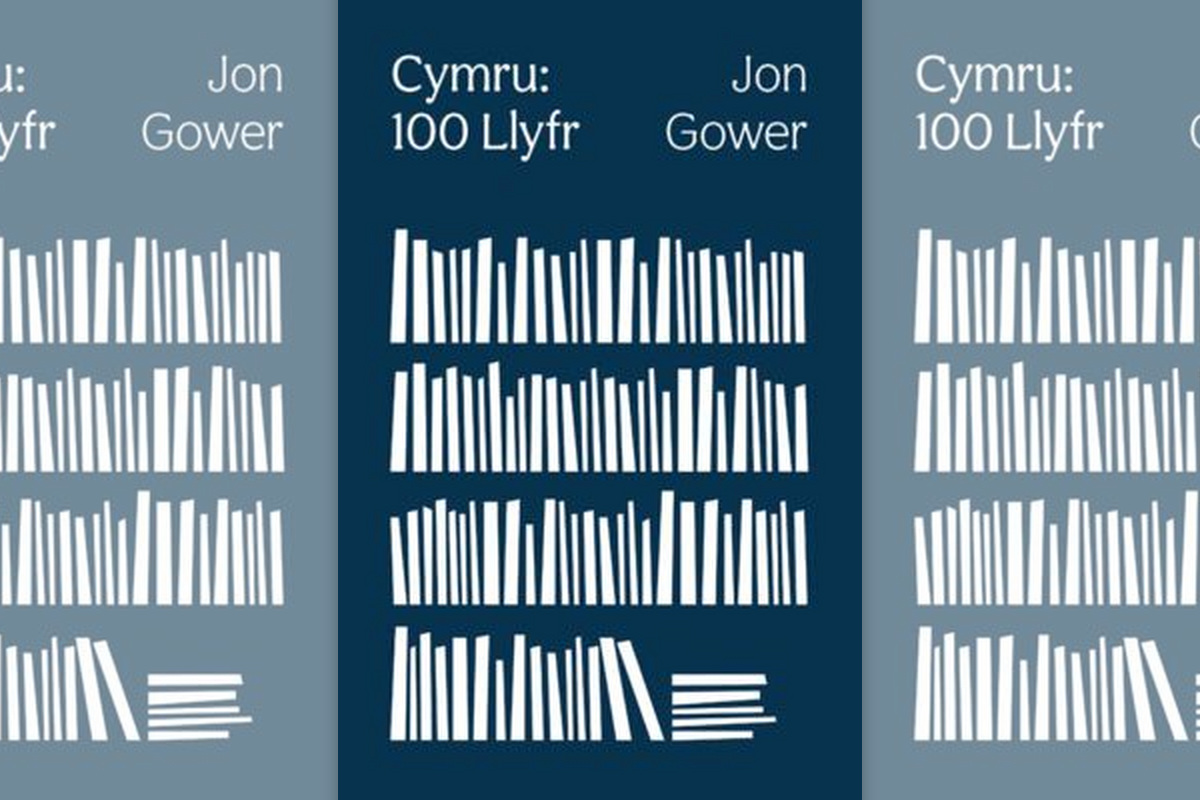
It’s a description (in Welsh) of Jon Gower’s favourite 100 books relating to Wales, either in English or Welsh. Remarkably, this is Jon’s 43rd book and there’s at least one more to come before Christmas.
It was inspired by “Wales: 100 Records”, compiled by DJ Huw Stephens. Jon even deploys the DJ style of segue from one chosen book to the next, which only adds to the fun.
He makes clear in his foreword that this is not the “100 best books from Wales”. It is not a “canon” of Welsh literature with the pitfalls and scrutiny that would imply.
So, no Dafydd ap Gwilym, Saunders Lewis, no Daniel Owen or TH Parry Williams. Gwenallt, Ann Griffiths and Waldo don’t make the cut either.
I can feel the restless spirits of critics and arbiters from earlier times shifting in their graves.
This is Jon’s favourite 100, and no one else’s. If you disagree with him, so much the better. His avowed intention is to get people talking, complaining – and reaching for their shelves.
I’ve done just that; no Harri Webb, an omission I must tackle Jon about when next we meet!
Any aspiring writer should take heed of advice from Jon Gower. Outside of TV scriptwriting he is, I suspect, one of a tiny number of people in Wales who sustain a living from writing, a devilishly difficult vocation. He says, “any writer worth their salt is an enthusiastic reader”. He goes further, “everything I’ve written has grown out of everything I’ve read”. His credentials couldn’t be stronger.
He starts with the Bible which he sees, correctly in my opinion, as the foundation for all Welsh writing in either language. The Bible’s translation was manifestly not commissioned to give longevity and precision to the Welsh language, but that was among its accidental effects. It inspired poetry, hymns and liturgy which became fundamental to Wales’ cultural imprint.
The late twentieth century granted Wales a gifted generation of historians. Gwyn Alf Williams’ “When Was Wales?” is both a literary and historical classic. Someone entirely uninterested in Welsh history would still find it a treat to read. Almost every page has a memorable phrase, none more striking than the closing passage describing the Welsh as “a naked people, walking under an acid rain.”
That’s how things looked in the 1980s. This leads him to John Davies’ “Hanes Cymru”, a magisterial history of Wales, equally available in English.
Swallows
It’s unsurprising that birds and nature are well reflected since Jon is himself a noted ornithological writer. Horatio Clare’s “A Single Swallow” is the pick of the crop (flock?), a unique sort of travel book describing the swallow’s flight from Europe to South Africa.
The Welsh borders are rich in literature. Jon cites Raymond Williams’ “Border Country” as “the best novel in English about Wales”.
This accolade will drive me back to a novel I haven’t read for decades. Mike Parker is a close observer of the border country while Bruce Chatwin’s “On the Black Hill” is, perhaps, the classic of the genre. Jon’s wife and Jan Morris share a view that Lloyd Jones’ “Mr Vogel” is the best novel about Wales.
I’m glad Richard Llewellyn’s “How Green Was My Valley” made the cut. It’s an ambiguous, amphibious affair, much like its author – hard to pin down and not quite what it seems.
The Oscar-winning film version was stunningly successful too. The book has deficiencies, to be sure – stereotypes, rickety storytelling, thin characters and hammy dialogue – and yet, it does something important. It records Wales’ mining story and puts the narrative in the mouths of working people.
No space, though, for Alexander Cordell, a better novelist than Llewellyn, in my opinion, who covered similar ground.
Fun
George Borrow’s “Wild Wales” (1862) – a prototype of the modern travel genre – is, I reckon, the most fun book ever written about Wales.
Readers seem to agree. More than 150 years after its first publication it has rarely been out of print. If Borrow helped found the genre, its greatest artist in modern times was Jan Morris. Her vast output presents an embarrassment of riches. Jon plumps for “Trieste and the Meaning of Nowhere” which, if I recall correctly, was among Morris’s own favourites.
R.S. Thomas has been a major presence in Jon’s life and, indeed, in Welsh literature. He is represented here by his Collected Poems and Byron Rogers’ quirky biography “The Man Who Went Into the West”.
On the great question of which of the two Thomases, RS and Dylan, matters most, Jon falls squarely on the side of RS. As do I.
Ultimately RS has stronger foundations and stands taller, even though I sense he’s starting to fall out of fashion in a way that Dylan, with his sustaining life-myth, has survived. Dylan doesn’t actually make the 100 cut in his own right, which seems a little harsh to me.
There’s a good crop of Welsh novels. Jon recognises “Un Nos Ola Leuad” by Caradog Prichard as “the pinnacle of Welsh prose in the twentieth century”.
He also singles out Bethan Gwanas, Manon Steffan Ros, Robin Llewelyn, Megan Angharad Hunter, Gareth F Williams, Islwyn Ffowc Elis, Caryl Lewis and William Owen Roberts among his favourites.
In the interests of transparency, I ought to note that I know Jon Gower very well; we both write for Nation.Cymru. Jon and I, and our friend Ali, spent Bloomsday together in Dublin this year, retracing James Joyce’s perambulations around the city.
It was a glorious day opening at the Martello Tower where the first scene of Ulysses commences and finishing at an ancient pub off Merrion Square, opposite the Oscar Wilde statue.
Honestly, life gets no better. I was pleased, therefore, to see an introduction (in Welsh) to a collection of Joyce by Aneirin Talfan Davies dating from 1944. I’ve never read this essay on Joyce but will track it down on Jon’s recommendation. Joyce, of course, became one of the great pillars of English writing in modern times but at this point his reputation was far from nailed down.
Outstanding
I was pleased to be reminded of “Bad Blood”, a memoir by Lorna Sage published in 2000. I read it at the time and thought it outstanding among Welsh memoirs. Sage was an influential academic and critic who died prematurely. Her excellent memoir tells of her upbringing by her dysfunctional family in Hanmer in Flintshire.
It’s exactly the right time of year to publish a book of this sort; it’ll make an excellent present. It’s a bedside or coffee table book to be referred to indolently rather than read cover to cover – although don’t let that stop you. The book is in Welsh although the content covers both languages. Ideally an English version will appear at some point in future.
The great joy of this book is that it’s a personal selection of favourites rather than a lugubrious minefield treading through the supposed “Greats” of Welsh literature.
In any case, my personal school of critical theory postulates that there are two types of book: those you like and those you don’t. What’s wrong with that?
And that’s what you get here: the books Jon Gower likes.
Support our Nation today
For the price of a cup of coffee a month you can help us create an independent, not-for-profit, national news service for the people of Wales, by the people of Wales.
Get more trusted Welsh news
Choose Nation.Cymru as a preferred source in Google News to see more of our journalism.


