


Book review: D.R. Grenfell: Socialist, Welshman, Internationalist by Robert Smith
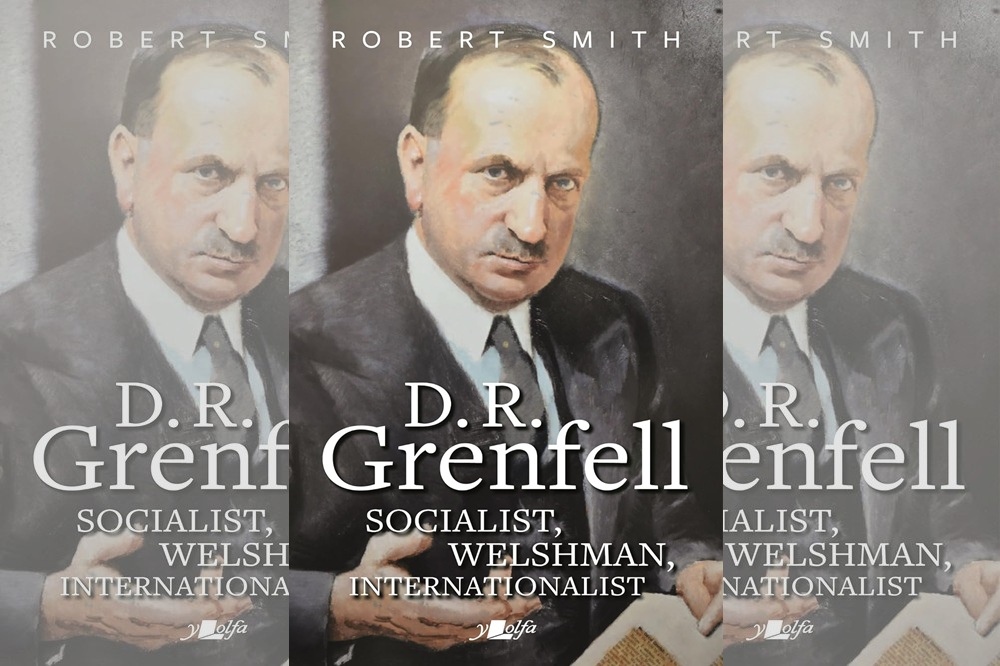
Desmond Clifford
Public memory has been a little unkind to David Rhys Grenfell (1881-1968) but he was a significant figure in Welsh and UK politics in his day.
As MP for Gower, from 1922 to 1959, he lived the history of the Labour Party, from tentative beginnings, supplanting the Liberals and becoming the rock solid, dominant force in Welsh politics, a dominance which is only now subsiding.
He served in Churchill’s World War II coalition government as Secretary for Mines, a turbulent challenge beneath the veneer of national unity. His parliamentary tenure lasted continuously for nearly 40 years making him, from 1953, the first Labour MP to hold the honorary title “Father of the House”.
Obscurity seems a poor reward for such a long career devoted to the interests of mining and working communities.
Unfortunately for him, and indeed others worthy of recall, the pantheon of major figures in the history of Labour and Welsh trade union activism in this period is pretty crowded.
Men like William Abraham (Mabon), Aneurin Bevan and Jim Griffiths cast long shadows and others whose contributions are worthy of recall struggle for recognition.
The author, Robert Smith, aims to put this right with this lengthy (400 plus pages) detailed and comprehensive treatment.
Coal mining
D.R. Grenfell’s family had roots in Cornwall, but his grandfather settled in Blaenavon for the coal mining industry.
Miners were mobile and Grenfell was born in Swansea. He had only the most basic education and left school at the shockingly early age of 12 to start working underground.
Grenfell was clever and disciplined and educated himself at night school. He went to Canada for a period and continued his mining education there. On returning to Wales, he secured a First Class Managers qualification and in time became an agent for the Coalminer’s Federation, pursuing issues for miners.
He became active in Labour Party politics at around the same time and was adopted as candidate for the Gower constituency.
Grenfell fought the seat at a bi-election in July 1922 following the premature death of the sitting member. He held it for Labour against the Coalition candidate only to have to do it all again a couple of months later following the definitive collapse of Lloyd George’s government.
In a four-decade parliamentary career there were few topics that failed to command attention from Grenfell, but his two major interests were the coal industry and foreign affairs.
Naturally, he stood squarely for the miners at a time when hundreds of thousands of men worked underground across Wales and Britain. He opposed pay cuts and closures, and attempted, unsuccessfully, to bring in a private members bill to fix a minimum wage for miners.
Gresford Colliery disaster
Following the appalling Gresford Colliery disaster (near Wrexham) in 1934, in which 266 men lost their lives, Grenfell acted as a special advisor to the enquiry, as a parliamentarian with expert knowledge of the mining industry. He found himself, among other duties, providing simultaneous translation from Welsh to English for those who addressed the enquiry in Welsh.
Grenfell was popular among the Parliamentary Labour Party and widely regarded as a man of ability. In Churchill’s wartime coalition, he was appointed Secretary for Mines. The post put Grenfell at the centre of the domestic war effort.
Although mining was a reserved industry, notionally exempting men from joining the rapidly expanding Armed Forces, in practice Grenfell had to fight a permanent battle to maintain and expand the mining workforce, and provide necessary training, while beating off intense competition for manpower.
It was a constant, and sometimes losing, struggle to maintain workforce and production at the levels necessary to meet the demands of a nation at war and Grenfell was frequently at loggerheads with Ernest Bevin at the Ministry of Labour and his own boss at the Board of Trade, Hugh Dalton – powerful enemies.
Eventually the tensions were too much, and Attlee agreed Grenfell should be dropped from government in summer 1942. That was the end of his short ministerial career but because of wartime censorship it was barely examined in the press (how contemporary governments would yearn for this discretion!).
Rebel
Freed from the constraints of government he became a serial rebel against his own leadership, part of the reason why he never again served in government.
The mining communities from which men like Grenfell emerged were anything but parochial and foreign affairs were a major preoccupation for him.
He travelled widely on delegations and campaigned for numerous causes, including the expansion of trade with Soviet Russia.
He served as chair of the Franco-British Parliamentary body and was honoured by the French Government. He denounced the Molotov-Ribbentrop Pact and travelled to Australia and New Zealand to drum up political support for the Allied cause.
In Europe he gave active help, before the war, to refugees fleeing Hitler’s occupation of Sudetenland.
There was a certain intractability in Grenfell’s character and the end of his parliamentary career was messy and anti-climactic.
He fell out with his constituency. Essentially, they wanted a younger candidate, but he was reluctant to make way. It was a common enough dilemma in those days; aging MPs felt no hurry to move on. Grenfell was pushing 80 years old, and it wasn’t wholly unreasonable for the constituency to want fresh blood, and eventually they prevailed. (A decade or so later, S.O. Davies, MP for Merthyr Tydfil, faced a similar row when he refused to stand down in his 80s.
Deselected
He was deselected by the constituency so stood as an independent and won by more than 7,000 votes against the official Labour candidate).
The student of Welsh labour history will find this book a useful and informative addition to the body of work in that field. The non-specialist and more casual reader may feel it’s over-long for a second rank figure, and a touch intimidating.
There’s a publishing dilemma for this kind of territory. Should the author prioritise definitive history to the fullest extent possible, with primary appeal to those with a specialist interest? Or is it better to aim at a possibly wider general readership with a shorter and more compact treatment? It’s a dilemma without a clear answer.
Grenfell’s political career was distinguished by its length and constancy. The interests of working people were what brought him into politics and what sustained him over decades.
He never reached the highest rank of politics and was a minister for barely two years. He was, nevertheless, influential at times and contributed across a wide policy horizon encompassing industry, foreign affairs, environment and tourism. His influence was felt in Wales, the UK and internationally.
We get a limited sense of Grenfell the man and his life outside of politics is largely a closed book, although we know he had a long marriage and a daughter. The author Robert Smith is himself frustrated by the lack of sources about Grenfell’s domestic life.
If there was a danger of historical obscurity for Grenfell, his contribution has been comprehensively rescued by Smith.
Support our Nation today
For the price of a cup of coffee a month you can help us create an independent, not-for-profit, national news service for the people of Wales, by the people of Wales.



I’m really looking forward to reading this, partly because of an interest in the historical period in which he was politically active, but also because his daughter often bemoaned the fact that Grenfell’s contribution wasn’t sufficiently acknowledged. We had many conversations, with her standing at the gate of Ardwyn and me trying to keep my toddlers under control. Once she found out where I worked at the time and that Hywel Francis was my boss, Miss Grenfell (I wouldn’t dare call her Eileen) was invariably out there waiting for me as I left chapel or Cylch Chwarae, often with a… Read more »