
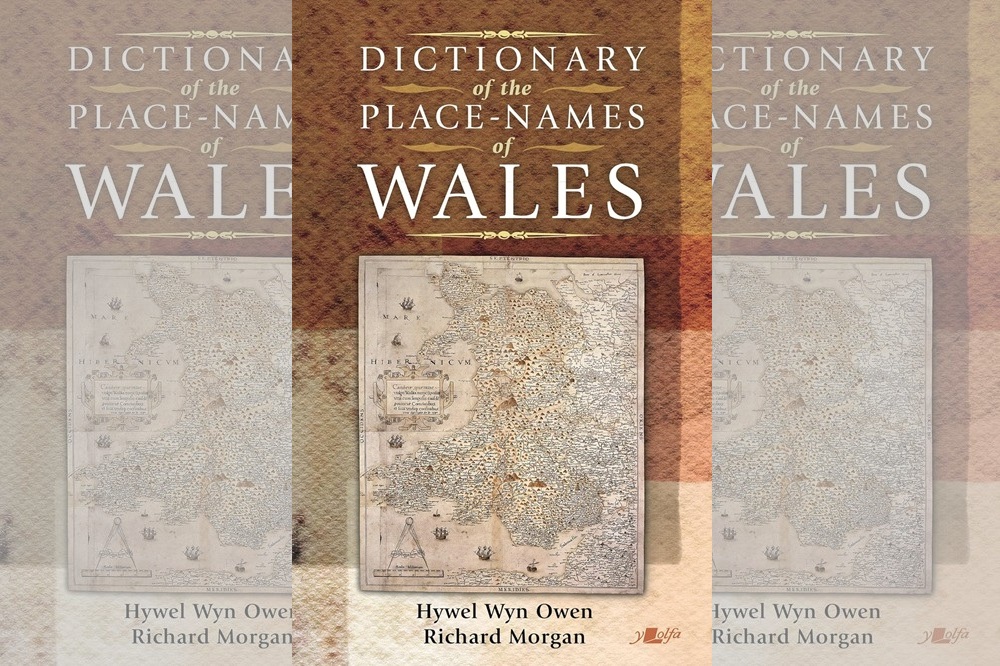
Book review: Dictionary of the Place-Names of Wales – 2026 edition by Hywel Wyn Owen & Richard Morgan
Desmond Clifford
You can learn a lot about a country from its place names. For all that Wales endured comprehensive invasions and long-lasting occupations, the great majority of place names are Welsh in origin.
This is an important marker of identity. Through the names of our towns, villages and headlands we have good records of the geography, history and languages of Wales.
The “Dictionary of the Place-Names of Wales” is an outstanding work of scholarship. This 2026 version is a new edition, compiled by Hywel Wyn Owen and Richard Morgan, and builds on the original version published in 2008.
A good deal of scholarly ink has been poured since then and common usage of place names has also begun to shift quite markedly, reflecting wider cultural and political change in Wales.
The current editors are punctilious in noting and acknowledging the work of earlier generations of scholars. Any work of this sort is inevitably the product of multiple brains working on an inter-generational basis.
The Christian history of Wales is very evident. Many villages and hamlets are named after saints or churches associated with the area.
In this way the names of ancient Celtic Church luminaries have been kept alive: Llanbadarn (Padarn), Llanallgo (Gallgo), Llanbabo (Pabo) – and so on. The entries under the element “llan” – a parish usually – is the thickest section of the book.
The nicest sounding name in the whole of Wales, in my opinion, is rendered in Welsh as Llanfihangel-y-Fedw; Michaelston-y-Fedw in English, and just not as nice.
It’s in the modern county of Newport City but is listed in the dictionary’s rubric as Monmouth, the historic county identity lasting from 1536-1974.
After 350 years politicians started playing with local borders and haven’t stopped (unlike Ireland which has very definitive county identities, and revolution would unseat the national government which tried to interfere with them).
The authors explain that they have omitted the names of very minor localities, which seems fair enough if the book is to remain practical and usable in length.
They further explain, “we have omitted names of localities which have become suburbs through the expansion of towns and cities”.
In the nicest possible way, I find myself a little less satisfied with this. It feels like a trick missed to exclude the very places where most of the current population lives.
Inconsistency
In any case, there’s some inconsistency. For example, Roath, Ely and Llandaff, assuredly suburbs of Cardiff today, are included, while Canton, Llanrumney and Grangetown are not.
It would fatten the dictionary still further but perhaps there’s room for scholars to think more about suburban place-names between now and the next edition.
Common usage of language is driven by organic forces and, as the editors recognise, their function is to describe and not dictate usage; “the dictionary should not, in every instance, be regarded as the definitive authority on standard place-name forms.”
Placenames are, among other things, a guide to changing social and cultural attitudes. A generation or two ago, many road signs and official documents noted primarily English usage for names which actually existed in both languages and are, in most cases, Welsh in origin.
That situation, which stood as the status quo for a very long time, is now in retreat as Welsh forms of place names are increasingly reasserted.
There was an anglicised spelling of Caernarfon still in use fifty years ago which has disappeared; the town is now universally attached to its Welsh spelling. The same is true of Llanelli, which used to have an absurd anglicised version with a bizarre “y” dangling at the end instead of “i”.
I reckon the anglicised version of Caerffili could disappear naturally in the years ahead. Partly this is a simple matter of evolving orthography and authenticity, and partly a record of Wales itself changing.
Y Farteg
I was surprised that Varteg/ Y Farteg is not listed. The village lies between Pontypool and Blaenavon and grew out of the ironworks in the industrial revolution. It was at the centre of a row some years back, which still flares up from time to time, when it was mooted that the common usage of Varteg be revised to Y Farteg in line with modern views on orthography.
For obvious reasons, many locals scented a problem and thought it wiser to stick with the English version. This name has attracted quite a literature and public controversy – an odd one to miss.
Although Welsh and Celtic are the dominant sources of place names, the history of the country is audible and visible as each wave of visitors, invited or otherwise, left their mark.
English if, of course, is very present, especially in place names associated with industry and commerce, for example, Shotton, Fairbourne and Port Talbot.
Wales’ non-conformist religious revivals in the nineteenth century contributed with place names lifted from the Bible: Bethesda, Nebo, Bethlehem.
Scandanavian influence is felt particularly along the western coast – Swansea and Fishguard. Norman influence is recorded, for example at Roch near Haverfordwest, and Malpas in Gwent.
The Romans stayed for several hundred years and left significant Latinising influence.
Delight
This reference book is a delight and would sit comfortably on the shelf of anyone with an interest in Wales and its history.
It might be used to look up specific information – we all want to check our hometowns and places with which we have connections – or else to browse. At nearly 500 pages it’s on its way to being a doorstopper and could be much longer – or perhaps multi-volume – if resources sometime in the future allow a fully comprehensive approach.
Every self-respecting library and school should have this book, and any home which values history and language will benefit too.
Support our Nation today
For the price of a cup of coffee a month you can help us create an independent, not-for-profit, national news service for the people of Wales, by the people of Wales.



Great book for the importance of our indigenous names, but even in an English language version the old Wales / outsider insult should be replaced by Cymru.