

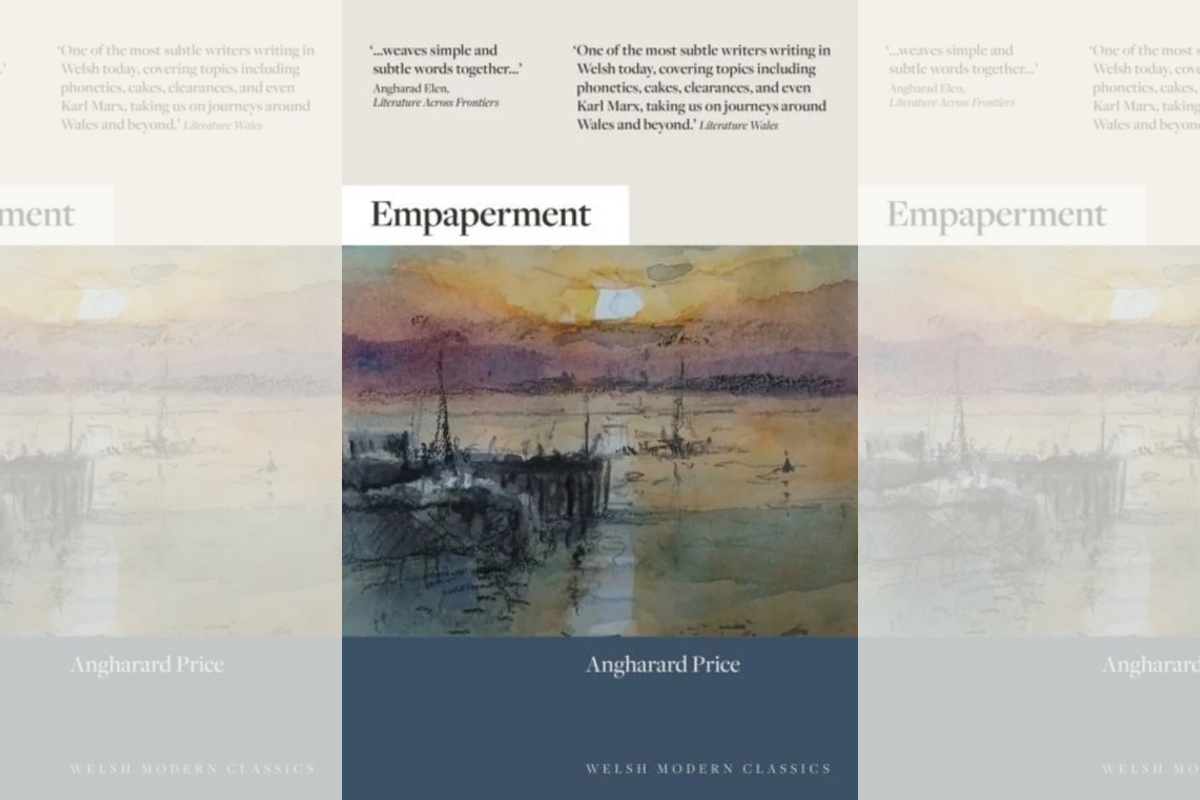
Book review: Empaperment by Angharad Price
Desmond Clifford
A collection of essays which are literate, insightful and surprising is just about my favourite genre, and that’s exactly what’s offered here by Angharad Price.
These essays first appeared in various Welsh magazines and then as a collection (Ymbapuroli) in 2020. The author is very well known as a novelist and critic in Welsh, and it is among the complexities of our culture that even celebrated Welsh-language writers are often unknown in English.
It’s very welcome, therefore, that this volume should appear as part of Parthian’s Welsh Modern Classics series.
The essays are essentially about people and places. The people include her father, Karl Marx, Jan Morris, Ann Griffiths and novelist Ngũgĩ wa Thiong’o. The places include Trier, Rome, Bethesda and Holyhead.
My favourite is an essay on the poetry of Ann Griffiths (1776–1805). Again, Ann Griffiths is largely unknown to the English-speaking audience, but she is certainly among the most scintillating and vaguely troubling poets of the Welsh language. Her work almost frightens with its intensity.
At the very least, it reminds us how distant the past sometimes can be. It’s virtually impossible for us now even to imagine the religious intensity which Ann and her contemporaries were able to summon. Right until the very end of her short life, she proclaimed she preferred death and closer knowledge of God to life. Only at the end, poignantly, did she see life differently.
The author is critical of Calvinism’s influence in Wales, a critique I wholeheartedly share. Some things were “done to” Wales, but Calvinism was a miserable and mean-spirited homegrown choice.
There’s a plausible theory that the outstanding tradition of Nonconformist hymn-writing owes much to the rejection of images in Nonconformist chapels and reliance on the word alone. I think this holds water.
The Catholic Church has many distractions — statues, the crucifix, Stations of the Cross, images, incense, liturgy — and its hymn-writing tradition is second-rate. Broadly speaking, the Catholic Church does liturgy well and hymns badly; Nonconformism does the opposite.
Ann Griffiths was the product of a literate culture, and the Word infused her every thought. Her entire being as a Christian, a woman and a human is expressed in her poems. In essence, she has a love affair with the unseen, unknowable God.
Her voice is unmistakably that of a young woman deep in passion and vigour, and this is part of what makes her work so unique. When she writes Disgwyl yr Arglwydd / Waiting for the Lord, it is she, Ann, who is waiting, and she alone. There is nothing impersonal or objective in her work. Angharad Price explains all this better than I can in her superb essay “Living to See the Unseen Being”.
“Marx in Trier” considers the strangely invisible founder of communism in his hometown, where the author spent time as a student. In the first half of my life (shockingly, I see that I am now in my mid-60s), Marx was possibly the most famous name on the planet, and his image was projected around the world. Students in 1980s Aberystwyth had his poster on their walls; thousands had copies of the Communist Manifesto (published with Soviet Union subsidies). Marx was vaporised with the Berlin Wall and is now the subject only of academic interest.
Interestingly, the places Marx lived are the ones that always made the least fuss of him. Certainly Brussels, where he wrote a chunk of the Communist Manifesto at La Maison du Cygne on the Grand Place (still a perfectly nice, unpretentious restaurant), makes no great fuss of him. Even London, apart from pilgrims to Highgate Cemetery, makes no great noise, even though he lived half his life around Kentish Town. Trier, his birthplace, makes — or at least made — the least fuss of all. Until the collapse of European communism, Marx was still, even in death, a powerful political player. Today he’s definitively safe for the heritage industry.
“Holyhead After Brexit” is still topical and visits a corner somewhat neglected by Welsh writers, though not by Jonathan Swift, who was forced by bad weather to spend a few days there in 1727 waiting for a boat to Dublin. He was desperate for company but not so desperate that he didn’t try hard to avoid the local vicar, whom he knew from previous visits and found a bore. He records that he would happily have spent time with the locals except that they mostly didn’t speak English.
The pedant in me can’t avoid correcting the assertion that Holyhead is “the busiest ferry port in the United Kingdom”. In fact, it’s second to Dover by a considerable margin. But this pedantry doesn’t diminish the central importance of Holyhead as the transit hub between Ireland and Wales/Britain. As well as its economic importance, this border connects Wales with its only neighbour apart from England. It is no less of a border for being maritime rather than land.
She says, “Caergybi is also a centre of sorts for us, the gateway of Welsh-speaking Cymru unto global maritime highways”. There is always that sense of possibility at ports: the sense that life need not be static, that people can and do move and create new lives — and that identity is, at least in part, a matter of choice rather than a genetic affliction imprinted immovably at birth.
Brexit, I suppose, was such a choice. A majority of voters on the day in question said they didn’t want to be European. That choice hit Holyhead hard. Overnight after Brexit, trade freight coming through Holyhead dropped by 30%. Irish traders found it less troublesome to bypass Holyhead altogether in favour of new continental routes from Rosslare, once the sleepiest of Irish ports but now booming. The Welsh ports, on the other hand, are languishing. It remains to be seen whether a closer UK-EU relationship from here on can recover some of this trade.
Rome
The volume’s final essay, “Mater Dolorosa”, is the most personal. It describes a short solo trip Angharad made to Rome, an elegy for the period of life after children have left home for good. She bares her soul and tries to explain what this loss means to her as a mother. It’s very moving and insightful. She looks to Roman art for comfort, or at least for clarification: “Mari, the daughter I’d christened with my mother’s name, Mair, both of them versions of Mary. I’d placed her in that matrilineage from birth”. I spent half my childhood kneeling in front of statues of the Virgin Mary, so all this makes perfect sense to me.
With some caveats, she enjoyed the trip and felt better going home than coming out. Her son wanted football memorabilia and, I sense, this very ordinary and purposeful want counterbalanced some of the inward turmoil she had felt. For so long as children want football memorabilia, parents have a continuing function.
The essays in this volume have accumulated over twenty years and record episodes in the author’s life. I worry for the future of the essay. The podcast is everywhere, and progressively our culture is shifting from literate to oral. I have nothing against podcasts and oral culture, far from it. However, we need a world of ideas which is best refreshed by writing: reflection, the considered point of view, perspectives balanced. That’s what a good essay offers.
Planet
I worry too about the future of magazines which carry essays. I greatly miss Planet, which was forced to close a couple of years back after its funding was withdrawn. Over half a century, no other Welsh publication provided such depth, breadth, variety and perspective on Wales.
It was unique, and its closure was sheer vandalism. Certainly, its coverage is not reproduced elsewhere — there is simply a hole where it used to be. I hope the consultation on culture currently being carried out by the Welsh Government may lead to its restoration.
Empaperment is an excellent volume, and I recommend it to anyone interested in good writing and Welsh perspectives. It’s a broad-ranging collection and sophisticated without being even in the slightest bit pretentious. I hope Angharad Price writes more essays, in English or Welsh, or both, and I hope there will still be places to publish them.
Support our Nation today
For the price of a cup of coffee a month you can help us create an independent, not-for-profit, national news service for the people of Wales, by the people of Wales.
Get more trusted Welsh news
Choose Nation.Cymru as a preferred source in Google News to see more of our journalism.


