


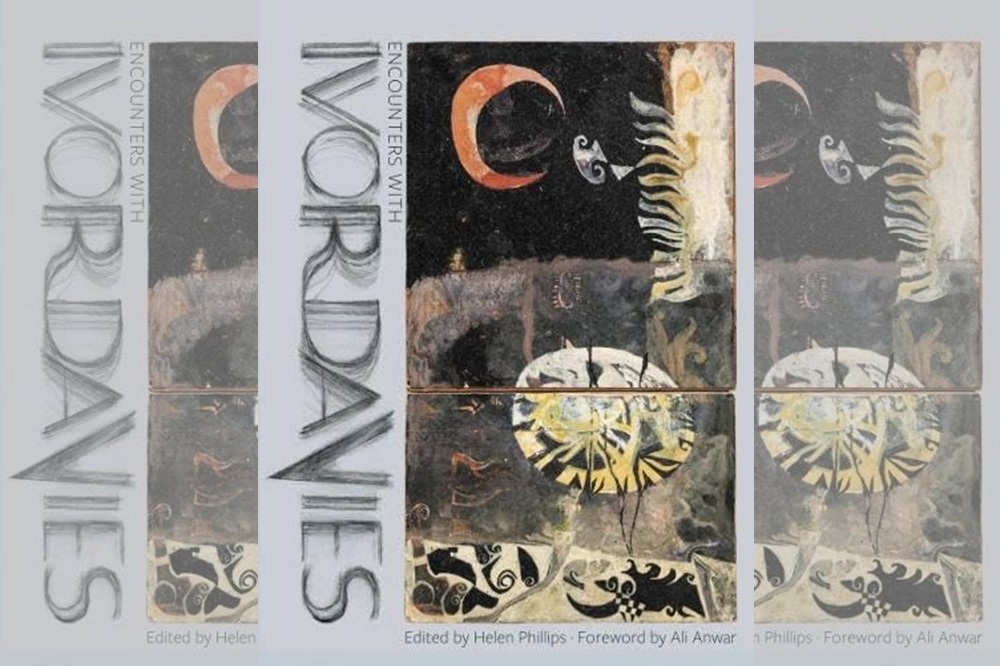
Book review: Encounters with Ivor Davies, edited by Helen Phillips
Desmond Clifford
In a culturally just world Ivor Davies would be well-known everywhere. He is among Wales’ pre-eminent contemporary artists and has contributed enormously to rescuing Wales from a visual arts nether world where it lay for generations.
Welsh art still faces challenges – we’ll touch on some of them – but would be immeasurably poorer with Davies’ contribution.
This superb volume is published to mark his ninetieth birthday. He spent his childhood in Penarth and lives there still.
His education in art took him to Cardiff, Swansea and Lausanne in Switzerland. He taught in Edinburgh before returning home to teach at Gwent College. Davies is a Welsh-speaker and deeply committed to Welsh culture and language.
He is sponsor of the Ivor Davies Award at the National Eisteddfod and himself won the Eisteddfod’s Gold Medal for Fine Art in 2002.
Half a century ago visual art was very much the poor relation at the Eisteddfod and Davies is among those artists who have progressively raised standards and expectations.
“Encounters with Ivor Davies” collects, first and foremost, beautiful reproductions of his work. The quality of print is excellent. The “encounters” take the form of around 30 short essays from fellow-artists, critics, collaborators and friends who have in some way been influenced by the artist.
The volume is edited by Helen Philips, who also contributes an introduction to Davies and his work – especially useful for those of us under-informed on his output.
A foreword is provided by Ali Anwar, the publisher and patron of the H’M Foundation, and friend of the artist.
The important feature of any book about art is, obviously, the art itself and the best way to appreciate Ivor Davies is to view his work. There’s a large selection online if you don’t live near enough to a gallery featuring his work.
In his ninetieth year and still productive, it’s quite difficult to say what kind of artist Ivor Davies is.
Across his life’s output he seems to have tried most forms and styles. In the 1960s he collaborated with the then unknown (outside narrow avant-garde art circles) Yoko One and collaboration with other arts has been a feature of his life.
Perhaps this explains how he has kept his work fresh and avoided reproducing, as some artists do, a single type of work on rote.
One critic, David Alston, said of his work at a Theatr Clwyd exhibition, “Entering, you would think this was an exhibition of ten artists.”
In his essay, Peter Davies explains how Ivor Davies joined the “Beca” group of artists. This was – and is – an informal group of Wales-minded artists using their work to comment on Welsh politics or society. Members included Peter Davies and his brother Paul, Shelagh Hourahane, Iwan Bala and others. “
Beca” derives from the Rebecca Riots and suggests radicalism and clear focus on Wales and its history, languages, geography, myths and people. All of these elements are present in Davies’ work.
Alongside his work Davies is pre-occupied with the politics of art. He believes strongly in the importance of Welsh art institutions and notes – laments really – the absence in Wales of a National Portrait Gallery and a Museum of Modern Art. There isn’t even, strictly speaking, a National Art Gallery of Wales.
Currently the National Museum of Wales covers art alongside its dinosaurs and mounted creepy-crawlies. It does art very well and affords it highest priority, but I have argued elsewhere in these pages that art should be extracted from the museum and a National Art Gallery should be opened next door in the shamefully under-used Cardiff City Hall building.
So there’s a simple and transformational task for the new Welsh Government: three new properly-funded art institutions please; a National Art Gallery, National Portrait Gallery and a Museum of Modern Art – MOMA CYMRU, it has a nice ring?
Ivor Davies could practically fill a national portrait gallery all by himself. Among his better-known works is a portrait of “Y Tri” – Saunders Lewis, Lewis Valentine and DJ Williams – the men who burnt down a planned RAF training schools at Penyberth near Pwllheli, an act of civil disobedience which inspired modern Welsh nationalism.
We learn that a version of this portrait hangs on the wall of Jon Gower’s lounge – lucky Jon!
Politically committed
The politically committed Davies also painted Eileen and Trefor Beasley, whose campaign in the 1950s to pay their council tax on a Welsh form inspired a generation of language equal-rights campaigning (and inspired a Dafydd Iwan song).
In the field of culture Davies produced portraits of William Williams Pantycelyn, Ann Griffiths and an ethereal portrait, “Waldo Williams Looking Down”.
ID’s sense of Wales reaches back into the past with portraits of Gruffydd ap Llewelyn, Owain Glyndwr, Lord Rhys, Hywel Dda, Mary Jones and others.
It’s likely that Davies’ most seen work is his mosaic portrait of St David at Westminster’s Roman Catholic cathedral (an incongruous setting perhaps for an artist born into Welsh Nonconformism!).
This stunning work features spotted dolerite from Mynnydd Preseli, illustrating the ground in Llanddewi Brefi which, according to the recorded life, rose beneath St David allowing him to preach seen by all (there’s a joke wondering why creating yet another hill was considered an impressive miracle in Wales).
The mosaic was blessed by Pope Benedict in 2016.
Although the position of Welsh art has improved in some ways, Davies remains frustrated that it is largely ignored outside the country, “Things are still London-centric. I think that devolution helped a little.”
It’s an interesting comment and the relationship between devolution and culture is a topic which bears further study. The visibility of Welsh culture generally is higher now than it used to be, but it feels like there’s a way to go.
Iwan Bala describes Davies as “the single biggest influence on my career as an artist”. He further notes that, although Davies is 20 years his senior, he – Davies – now seems the younger one because of his exceptional energy and output.
A luscious tribute
This book is a luscious tribute to an important artist whose work should be better known here at home as well as beyond.
Any text on art runs the risk of at least occasional lapses into pseudery but any such moments are few and far between.
The large number of contributors conveys the spread of Davies’ art and interests, and friendships, though the number of essays made a degree of repetition inevitable.
The art is unambiguously superb. It brings together a selection of highlights and will inspire new admirers to seek out his work and to admire the artist’s still productive, still important career.
Support our Nation today
For the price of a cup of coffee a month you can help us create an independent, not-for-profit, national news service for the people of Wales, by the people of Wales.
Get more trusted Welsh news
Choose Nation.Cymru as a preferred source in Google News to see more of our journalism.


