


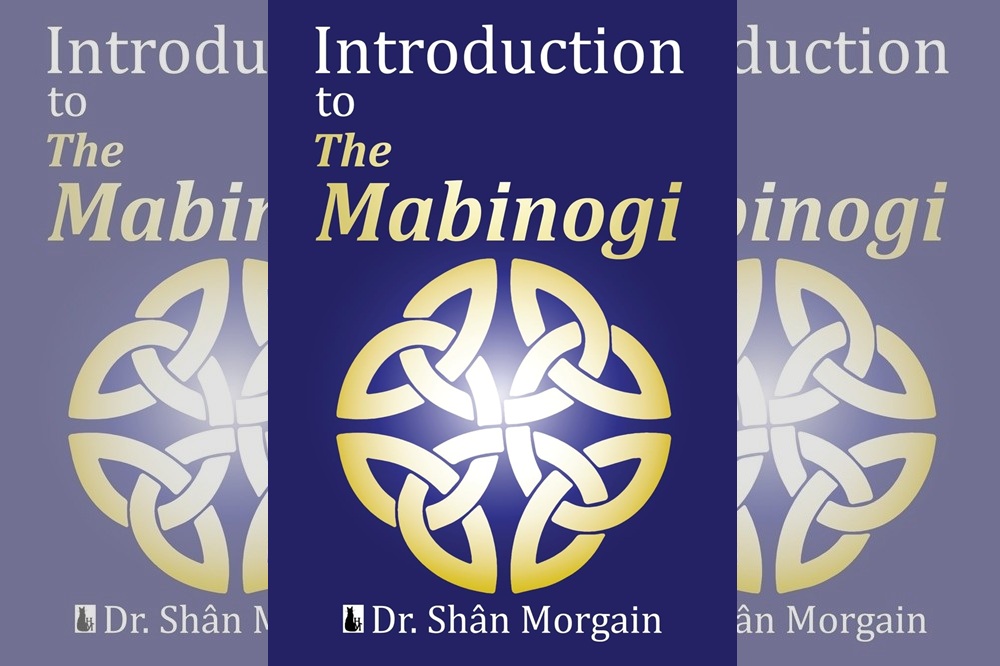
Book review: Introduction to the Mabinogi by Shân Morgain
Simon Rodway
Readers of Nation.Cymru may well be familiar with Shân Morgain’s inimitable style. You may have read some of her entertaining, eccentric and insightful articles on medieval Welsh literature and other topics.
This useful little book, designed to be an introduction for the uninitiated to the Four Branches of the Mabinogi, is very much in the same vein.
It conforms neither to the forbidding conventions of an academic work nor to the vague (and often inaccurate) clichés of most popular writing on medieval Welsh texts (or ‘Celtic myths’ as they are often called).
As in everything, she ploughs her own furrow. This is not to say that she goes in for iconoclasm – while occasionally brusque, she is even-handed and respectful in treating the work of others.
A real strength of this work is its inclusiveness and generosity of spirit. This is skilfully balanced with a passionate and personal engagement with the work: dry this book certainly is not.
The Four Branches of the Mabinogi are medieval Welsh stories recorded in a handful of manuscripts from the thirteenth and fourteenth centuries, and readily available in English translation since the 1830s and 40s.
They have never gained the ubiquity of Greek mythology or Arthurian romance in the popular consciousness, and in the world of Celtic studies they sometimes languish in the shadow of the vast and bewitching corpus of early Irish literature, but a smallish band of scholars and, ahem, ‘normal people’ in Wales and beyond have long been fascinated by them.
The work of a dedicated circle of linguists, historians, literary scholars and others means that we now have a more and more sophisticated understanding of them.
Nonetheless, much of the literature aimed at the non-specialist reader about them does not reflect this, but recycles tired old ideas steeped in the Romantic primitivism of Matthew Arnold and his ilk in the mid nineteenth century.
Thus there was definitely a gap in the market for a book like this.
Relaxed retelling
Following a brief introduction, we have what is referred to as ‘a relaxed retelling’ of the Four Branches. Morgain refers to her versions as ‘summaries without every tiny detail of a full translation’ (p. 21).
In fact, these ‘summaries’ are not really any shorter than the tales themselves, and generally do translate the text quite faithfully. I feel that it would have been preferable to aim for precise translation throughout.
In general, however, the reader can rest assured that what they are reading here is a pretty faithful rendition of the tales. They can check any given passage against one of the myriad English translations listed by Morgain.
Following the ‘summaries’ we have a chapter titled ‘Ideas about the Mabinogi’ in which Morgain divides modern scholarship on the Mabinogi into three camps divided along chronological and national lines, the Welsh tradition (1700 – 1870s) which treated the texts as part of a national and broadly historical narrative, the English tradition (1870s – 1970s) which treated them as the garbled remnants of Celtic mythology, and the American tradition (1970s – 1990s) which treated them as skilful pieces of literature.
This is, of course, an over-simplification, but it helps guide the reader through a formidable array of secondary literature quite neatly. Morgain does a good job of reasserting the importance of William Owen Pughe here – his lexicographical follies should certainly not detract from his serious work elsewhere.
I think the ‘national’ designations are a little misleading. In particular, the ‘English tradition’ is English insofar as it was aimed at an English-speaking audience: most of the scholars included here were actually Welsh.
This chapter ends with a useful, even-handed look at women and the Mabinogi, the women in question being both characters in the tales and modern scholars.
Ancient mythology
Morgain then tackles the fraught issue of whether or not the Four Branches contain vestiges of ancient mythology.
Briefly, it is recognized that some characters in the Four Branches bear the names of pre-Christian gods, the most explicit example being Lleu, whose name is cognate with Gaulish Lugus.
This has often been interpreted as indicating that the stories are in origin ancient myths, superficially Christianized by a process known as Euhemerization after the ancient Greek writer Euhemerus who argued that the Greek gods were in fact extraordinary human beings (Morgain’s explanation of Euhemerization is rather too concise, I feel).
An alternative approach is to see names like Lleu as retaining some sort of aura but being applied to entirely new characters by Christian writers of a sort of ‘historical fiction’ – one might note that the fact that one of the characters in the Harry Potter novels is called Minerva does not make them myths.
Once again, Morgain’s conclusions are sensible – her advocacy of a middle road is in stark contrast to the tiresome back-and-forth of accusations of ‘appropriation’ and ‘gatekeeping’ which typifies much of the discussion of this issue.
She is generous about my own contribution in 2018, which I now feel was unnecessarily inflammatory. I did feel better having got it off my chest, however!
Creative responses
She has an interesting section about creative responses to the Four Branches in English. She doesn’t mention the many modern literary works in Welsh inspired by these tales, some excellent recent ones being Dadeni by Ifan Morgan Jones (like a mash-up of Indiana Jones Buffy the Vampire Slayer with a side-order of political thriller) and Pumed Gainc y Mabinogi by Peredur Glyn (Lovecraft inspired cosmic horror without the appalling racism which makes Lovecraft so unpalatable today).
Morgain then looks at art, and the book is liberally garnished with artistic representations of the tales, an excellent idea.
The chapter ‘Patterns’ is an incisive look at the literary craft of the Four Branches.
Here we see discussion of the work of John Bollard and others as well as original insights. This is rounded off with a short critical summary of the work’s value as a piece of literature.
Throughout, Morgain wears her learning lightly. She is concise, using short, clear sentences which are arranged almost in bullet points rather than paragraphs.
She is modest about her own abilities, and scrupulous about crediting others. The reader can easily find references to the work of other scholars and follow up on issues of interest.
In short, Shân Morgain has produced a truly useful and accessible introduction to the Four Branches, and she deserves our gratitude.
Support our Nation today
For the price of a cup of coffee a month you can help us create an independent, not-for-profit, national news service for the people of Wales, by the people of Wales.


