


Book Review: Llyfr Agored by Ant Evans
Malachy Edwards
The Canadian wheelchair athlete, Rick Hansen wrote in his autobiography (1987): ‘My disability is that I cannot use my legs. My handicap is your negative perception of that disability, and thus of me.’
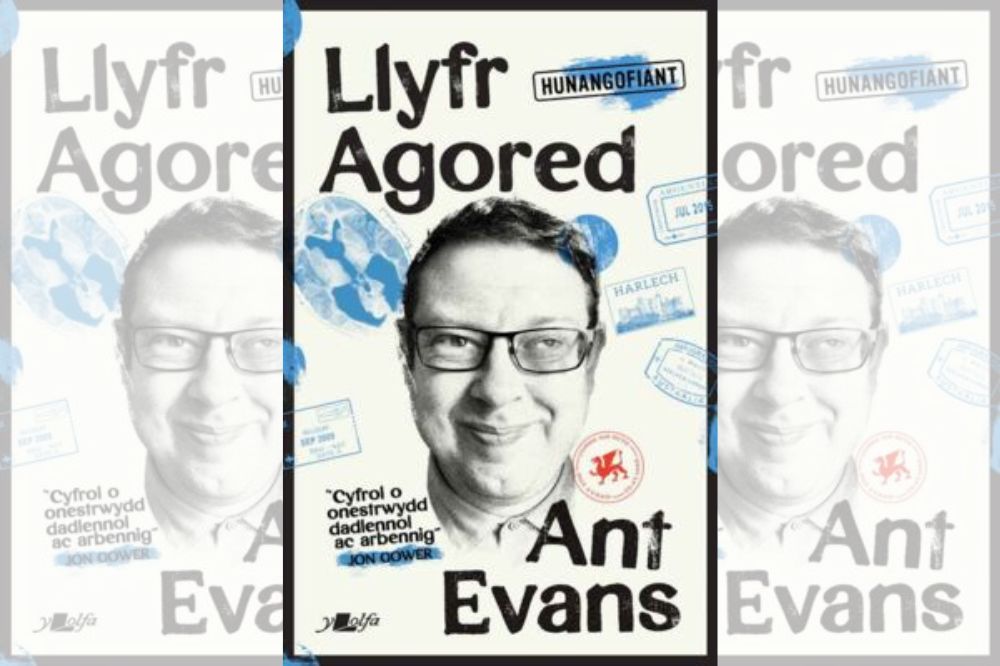
I thought about Mr Hansen’s quotation as I read Ant Evans’ autobiography, Llyfr Agored – the author’s debut.
Ant Evans is a book reviewer for Nation Cymru and so will be well known to this audience. The title of his autobiography, Llyfr Agored, translates to Open Book in English. Raised in Harlech and now based in Caernarfon, Llyfr Agored is an apt title for a book reviewer who has written a frank and honest account of a disabled man’s life in Wales.
The author was born with Hydrocephalus, a condition in which cerebrospinal fluid builds up within and/or around the brain. Hydrocephalus, and complications arising from it, have caused his physical disabilities.
I thoroughly enjoyed the passages where we gain insight into Ant’s perspective on the world. Due to his partial sight, Ant forms a first impression of someone based on their voice rather than their appearance. Crossing the road has become more perilous due to the increased presence of electric cars (they’re quieter). From the outset, one gets a sense of his determination too: he has limited use of his dominant right hand, which meant he had to learn to write with his left.
Ant is my contemporary. I raise the matter of age (the author is 38), because it’s the first time I’ve read an autobiography by a Welshman who is a similar age. For me, his account had an added poignancy as he met each milestone – primary school, secondary school, university at roughly the same time as myself (albeit in different parts of Wales), which caused me to reflect on how differently our lives have unfolded.
Llyfr Agored is going to be an uncomfortable read for the people and institutions who failed and wronged Ant. Truly, Mr Evans has had to wrestle and grapple with the negative perception of his disability – and thus of himself – at every stage of life.
For example, Ant’s condition does not include cognitive or learning disabilities, but that didn’t prevent medical practitioners from successfully discouraging his Welsh-speaking mother from speaking her native language with her son (they wrongly assumed the would-be linguist wouldn’t be able to acquire more than one language).
In fact, the Local Education Authority told his mother not to bother sending her son to school at all because: ‘Hefo’i anableddau, byddai’n wastraff amser trio dysgu unrhyw beth iddo fo o gwbl / With his disabilities it would be a waste of time trying to teach anything to him at all.’
Shamefully, the LA and local schools are alleged to have frustrated and blocked Ant’s legal entitlement to full-time education, and only relented when Ant’s Mam threatened the authority with legal action. The result of this illegality was that Ant missed a whole school year and was only finally admitted to Ysgol Tan Y Castell when he was six years old (the legal compulsory school age is five).
Alas, his school experiences were negative and he was subjected to bullying from both fellow pupils and teachers. He reveals, in his forthright and bold account, how the educational institutions he attended at the time were institutionally prejudiced against disabled people, and some of the misconduct he alleges against professionals in the book is appalling.
Mr Evans describes movingly how the difficulties and unfavourable treatment he experienced throughout his education had a lasting impact on his confidence and relationship with people, which led to him socially withdrawing and seeking the company of animals instead.
The author has just cause for feeling aggrieved at his treatment by the authorities, employers and the job market. With respect to our treatment of disabled people in our communities, we’re not where we need to be as a country.
However, it’s important for me to emphasise that Ant has written the story of his life with warmth, humour and emotional honesty throughout. Yes, there is difficult subject matter in the book: Ant doesn’t shy away from other people’s failings, nor his own. And between the covers, we do read about some rotten people, but I stress that we become acquainted with good people too – none more so than his late mother, Elspeth.
Mam was his great defender and champion and imbued her son with grit, belief and determination. They clearly had a warm and special relationship and, when she passed away, naturally it was a difficult time for Ant. The subsequent sale of the family home even led to a period of homelessness. In life, his Mam was determined Ant would prove the naysayers wrong, and I think this innate ‘stubbornness’, as he calls it, sustained him through this difficult period.
I encourage Nation Cymru readers to read this book. Llyfr Agored is an important and moving contribution to Welsh literature, and its perspective on being a disabled man in Wales deserves a wide readership.
Llyfr Agored by Ant Evans is published by y Lolfa and is available to purchase here.
Support our Nation today
For the price of a cup of coffee a month you can help us create an independent, not-for-profit, national news service for the people of Wales, by the people of Wales.
Get more trusted Welsh news
Choose Nation.Cymru as a preferred source in Google News to see more of our journalism.



Wonderful. I used to see him on Twitter.