


Book review: Llys Glyndwr: a creative response to the lives of Owain Glyndwr’s supporters
Desmond Clifford
Glyndwr is perhaps the most compelling figure in Welsh history. He comes closest to fulfilling the requirements of bravery, vision, and unambiguous Welsh intention demanded by the heroic model.
The odds were stacked against him, not ridiculously so at the beginning of the rebellion linked to the Tripartite Indenture (an alliance with English rebels Edmund Mortimer and Harry Percy), but with increasing desperation as years ticked by and allies fell away.
Glyndwr performed two vital services to Welsh history. Firstly, he never flinched and never turned back, his was a journey was to the end.
Secondly, he was never captured, he simply slipped into history leaving a residue of – of what? – a spirit, a memory, a blank canvass.
Inspired
Glyndwr wasn’t a one-man show. He inspired a movement. His rebellion was serious. It had soldiers, civil servants, poets, financiers, diplomats, families.
We know so little about these characters, they are hardly more than names and functions which have survived and floated down through history.
That’s the starting point for this excellent book. Artist Dan Llewelyn Hall has created portraits of Glyndwr and the key people who sustained his rebellion. Some, like Iolo Goch, Rhys Gethin and John Trefor are well-known to those familiar with the era, while others will be new names.
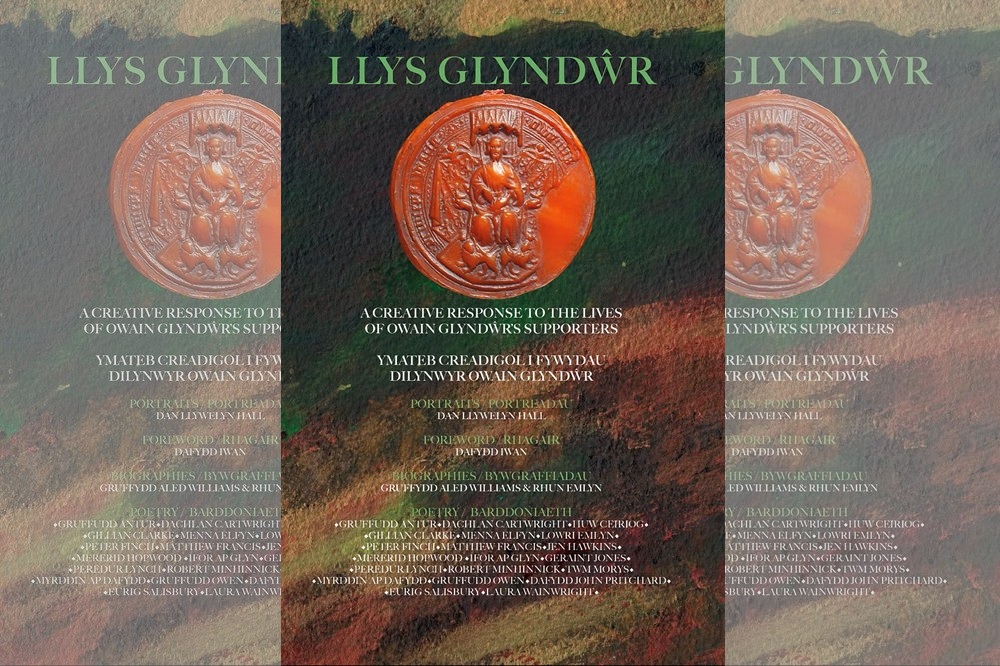
The portraits are necessarily inventions since there are no contemporary images to work from – Glyndwr’s seal survives but doesn’t help much, it offers a only generic medieval figure with a crown and longish hair with kiss-curls, a sort of 1980s New Romantic look.
Dafydd Iwan
As Dafydd Iwan notes in the foreword, much of what Glyndwr advocated for Wales has come, belatedly, to pass: the Senedd, an independent Church, universities, and, if not the law of Hywel Dda, then at least a growing body of law passed in Wales by its own representatives.
I must challenge Dafydd, though, in his dismissive reference to Shakespeare’s “Glendower” (granted, the misspelling is annoying) as a “minor sub character”. This couldn’t be more wrong.
Glendower’s part is a cameo, yes, but he absolutely steals the show with his superbly articulate and poetic self-advocacy, contrasted with the rather limited and transactional speech of his English allies.
Shakespeare liked Glendower and as stereotypes go, it’s not a bad one.
Record-keeping in fifteenth century Wales was poor and patchy (in England, by contrast, records were well-developed by this point) reflecting the relative fragility of the Welsh aristocracy’s position.
As a result, reliable knowledge about Owain and his retinue is scarce. The standard book of modern times is RR Davies’ excellent “The Revolt of Owain Glyndwr”(1995).
Artist Dan Llewelyn Hall was stimulated by Gruffydd Aled Williams’ work on the last days of Owain Glyndwr (Wiliams’ book appears in both Welsh and English versions) and he partnered with him, and historian, Rhun Emlyn, to devise a cast of key figures in the court and cause of Glyndwr.
Substance
These are the portraits which provide the substance of this book while the historians provide brief biographical supporting text. In addition, each portrait is supplemented by a poem from different poets interpreting the life of the subject.
The portraits are intriguing. Glyndwr himself is pictured hugging hounds to his chest. He has bold piercing eyes, purposeful with martial determination. He is virile, a man who won’t back down.
By way of contrast, all the other portraits are more impressionistic reflecting the lack of source images.
The artist doesn’t really know what any of them looked like, so he invents an image based on their mission while retaining the impressionist’s vagueness, especially around the eyes where, in life as in art, a person’s true character is most revealed.
There are twenty portraits in all. They are of individuals except in one case, a portrait of Jean de Rieux and Robert de la Heuse, two of Owain’s French allies (the French were generally open to supporting anyone who’d attack the English crown).
We meet Marged Hanmer, Owain’s wife from Maelor. They’d been married nearly 20 years when Owain rebelled, and she had borne six boys and three daughters.
What were her thoughts as the standard of revolt was raised? We can only conjecture.
We know she was captured as the revolt collapsed and imprisoned with her daughter Catrin in the Tower of London. In a romantic parallel with her husband, Marged’s death is also unrecorded; like Owain she disappeared into the shade of history.
Catrin’s portrait is also created by the artist; she was married to Edmund Mortimer, also pictured, one of Owain’s powerful English allies.
Gruffudd Yonge
In 2000 I was appointed by the Welsh Government to open a European Union office in Brussels. The First Minister Rhodri Morgan said in the press release that it was the first diplomatic appointment by a Welsh authority since Owain Glyndwr sent Gruffudd Yonge to deliver the Pennal Letter to the King of France in Paris.
Rhodri referred to this in his memoir published in 2017. Ever since, Yonge has been my favourite among Glyndwr’s followers. He was a cleric – they were the civil servants of the time – and was primarily responsible for managing diplomatic relations with France during the rebellion.
Yonge was rewarded by being made Bishop of Bangor and he was marked to become Archbishop of the Welsh Church at St David’s, a centuries-long ambition for Wales, if the rebellion had succeeded.
As things turned out, he was forced into exile and worked as a diplomat for the Pope. He is depicted here wearing a clerical mitre, his features somewhat obscured as he contemplates his duel spiritual and temporal duties.
A beautiful feature of the book is the poem which accompanies each portrait. These appear with a translation from whichever of English and Welsh they were first written in. The poems feature some of Wales’ best-known poets in both languages; Gillian Clarke, Twm Morys, Menna Elfin, Myrddin ap Dafydd, Robert Minhinnick, Mererid Hopwood, Ifor ap Glyn, Peter Finch and others.
Delightful
This is a delightful book. It’s a work of imagination and history combing art, text and poetry. The book has been produced in A5 format but would work just as well in other larger formats too.
In an ideal world where Welsh publishing, marketing, distribution and sales were well-integrated this book would sell very many copies, and I hope it does.
It would work very well in schools as a way into the Glyndwr history, bringing to life the men and women who conceived and sustained the rebellion and who looked forward to creating the new Wales Owain had in mind. It wasn’t to be, and Wales was held back for centuries.
In our own age, the new Wales has emerged with a Senedd of laws and ambitions for a better country.
We can be proud of Owain and his vision, and I hope he would be proud of what Wales has achieved in our times.
You can buy a copy of Llys Glyndwr here.
Support our Nation today
For the price of a cup of coffee a month you can help us create an independent, not-for-profit, national news service for the people of Wales, by the people of Wales.


