


Book Review: LOL – Love, laughter and the messy business of starting over
Llinos Dafydd
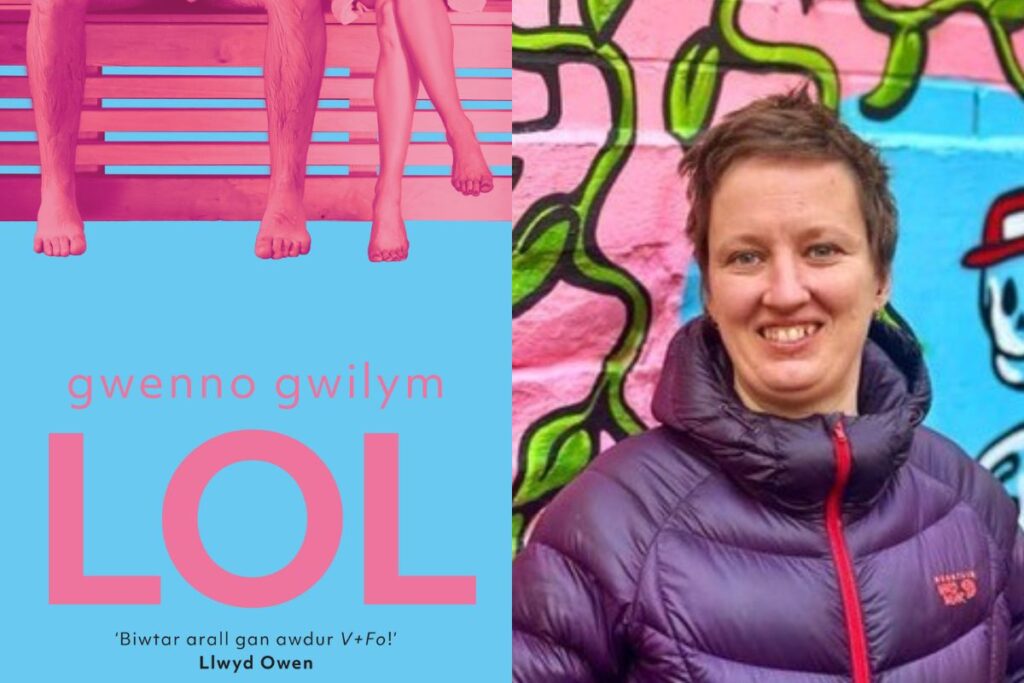
I read Gwenno Gwilym’s debut novel, V + Fo, in one sitting. I couldn’t put it down. So when her second novel, LOL, landed in my hands, expectations were understandably high.
And Gwenno Gwilym certainly knows how to make an entrance.
Within the opening pages, we’re introduced to Olwen Tomos – Lol to everyone who knows her – whose carefully constructed London life has spectacularly fallen apart.
An ill-advised confrontation in a work meeting, a married boss and a broken heart have left her questioning just about everything. And when the dust settles, she finds herself back in Cymru, working at the very campsite where she spent her sixth-form years.
Same place. Same job. Considerably less money. And a whole lot more emotional baggage.
But beneath the sharp one-liners, romantic complications and gloriously chaotic inner monologue, there’s something rather more substantial going on.
LOL is a novel about the things we become dependent on, the people we allow to define us, and the uncomfortable business of learning to live differently.
And, crucially, it’s very funny.
Coming home
Lol is 35, broke, heartbroken and back living with her parents. Her older brother Owi is getting married, her mother seems to have a busier social life than she does, and her former London existence suddenly feels a very long way away.
Then there’s Jonny Greene.
An old acquaintance from school, Jonny is someone Lol remembers with considerably less than affection. So discovering him working at the family home, and later at Sea View Campsite, is hardly the homecoming she’d imagined.
But people change. Or at least, some do.
What follows has all the ingredients of a contemporary rom-com: awkward encounters, simmering attraction, misunderstandings and plenty of sexual tension.
Yet Gwenno Gwilym is too interested in the messier aspects of human behaviour to leave it there.
Lol’s relationship with Pete, her married boss in London, is far more complicated than simply falling for the wrong man. He’s older, wealthy, powerful and accustomed to getting his own way. She knows the relationship is damaging her, but knowing something and acting on it are two very different things.
And that’s where Gwenno Gwilym gets it right.
Lol isn’t always likeable. She makes questionable decisions, ignores perfectly sensible advice and has a remarkable talent for making an already awkward situation considerably worse.
But she’s also funny, vulnerable, fiercely self-aware and wonderfully human.
You want to shake her at times. At others, you want to give her a hug. Occasionally, both.
Her return to Sea View brings its own humiliations, not least the realisation that she’s somehow ended up financially worse off than she was as a teenager.
As she puts it:
“Pwy fysai’n meddwl fod bod yn dlawd yn job mor ddrud?”
Who’d have thought being poor was such an expensive job?
It’s a wonderfully sharp observation, and typical of Gwenno Gwilym’s ability to find humour in situations that are anything but funny.
No filter
One of the things I loved most about V + Fo was Gwenno Gwilym’s ability to get under the skin of her characters. That talent is very much present in LOL.
The novel is told through Lol’s wonderfully chaotic internal monologue, with thoughts tumbling over one another in a mixture of colloquial Welsh, English, popular culture references and self-deprecating humour.
The language is one of the novel’s greatest strengths. Gwenno Gwilym writes in a Welsh that feels spoken rather than carefully polished for the page, switching between languages with an ease that reflects the way many of us actually communicate.
It’s refreshing to read characters who sound like people you might genuinely know, rather than people who exist solely within the pages of a Welsh-language novel.
That said, the constant references to social media, self-help culture and contemporary trends can occasionally feel a little relentless. There’s so much happening inside Lol’s head that the narrative sometimes struggles to find a moment of quiet.
But perhaps that’s precisely the point. Lol doesn’t particularly enjoy being alone with her thoughts, and neither, it seems, does the reader get much opportunity to escape them.
Beneath the humour, though, there’s genuine vulnerability. And Gwenno Gwilym is particularly good at allowing those moments to emerge without turning the novel into something overly sentimental.
More than a rom-com
For me, the most interesting aspect of LOL is its exploration of addiction.
Jonny is a recovering alcoholic, and his efforts to maintain his sobriety shape the way he lives, the decisions he makes and the boundaries he sets.
Lol, meanwhile, is struggling with a different kind of dependency.
She’s addicted to Pete. To the messages, the attention, the possibility that he might finally choose her. She knows the relationship is unhealthy, yet the smallest sign of affection is enough to draw her back in.
There’s a clever parallel here, and one that gives the novel considerably more depth than its rom-com packaging might suggest.
Neither character has everything figured out. Both are trying to break patterns that have caused them harm. And both, in their own ways, are terrified of what might happen if they let themselves want something again.
At one point, Jonny makes his priorities painfully clear:
“Plis paid â gneud i fi neud y dewis yna eto yn Berlin. Achos rhaid i fi ddewis fy adferiad bob tro.”
Please don’t make me make that choice again in Berlin. Because I have to choose my recovery every time.
It’s a moment of genuine vulnerability from a character who, until then, has often seemed frustratingly guarded.
And it’s a reminder that Jonny’s boundaries aren’t simply about keeping Lol at arm’s length. For him, the stakes are considerably higher.
Yet Jonny isn’t always entirely convincing as a romantic hero.
He’s certainly no knight in shining armour, and thankfully so. He comes with baggage of his own, and while his attempts to protect Lol are often well-intentioned, they occasionally veer towards telling her what’s best for her.
When he challenges her relationship with Pete, he tells her:
“Lol, gŵgla abuse of power.”
It’s a sharp, effective line, and one that forces both Lol and the reader to consider the relationship from a different perspective.
But it also raises an interesting question. Is Jonny helping Lol find her own voice, or is he sometimes speaking for her?
The contrast between the two men can feel a little too neat at times. Pete represents wealth, power and emotional manipulation, while Jonny offers a simpler existence, honesty and the possibility of something healthier.
Yet Jonny has his own fears and contradictions, and the novel is at its strongest when Lol begins challenging him rather than simply accepting his advice.
After all, learning to stand on your own two feet shouldn’t mean finding someone else to lean on.
Finding your feet
There’s something particularly relatable about the idea of returning home in your thirties and discovering that everyone else appears to have moved on without you.
Lol’s brother is planning his wedding. Her parents have established their routines. Even the people she remembers from school have become versions of themselves she barely recognises.
Meanwhile, she’s back where she started, wondering how on earth it all went wrong.
Gwenno Gwilym captures that uncomfortable feeling beautifully.
There’s humour in the indignity of returning to your childhood bedroom, but there’s sadness too. The sense that you’ve somehow failed to live up to the expectations you once had for yourself.
And perhaps that’s what makes Lol such an engaging protagonist.
She’s not particularly interested in becoming a better person in any conventional sense. She’d quite like a better wardrobe, a healthier bank balance and a man who isn’t already married, but she’s not about to transform herself overnight into some impossibly serene, yoga-loving version of womanhood.
Her progress is messy, inconsistent and occasionally infuriating.
In other words, entirely believable.
One of the novel’s most telling moments comes when Lol begins to recognise the similarities between herself and Jonny.
“Dwi mewn rhyw fath o recovery fy hun, dwi’n meddwl.”
I’m in some kind of recovery myself, I think.
It’s a throwaway line, delivered with characteristic understatement, but it gets to the heart of the novel.
Recovery, Gwenno Gwilym suggests, isn’t always about alcohol or drugs. Sometimes it’s about learning to stop wanting someone who was never particularly good for you in the first place.
And for Lol, that’s proving rather easier said than done.
In one particularly revealing exchange, she finally tells Pete:
“I’m tired of being your light relief, Pete.”
It’s a simple sentence, but it speaks volumes. Lol is beginning to understand that being someone’s escape from reality isn’t the same as being loved.
And crucially, that she deserves more.
A second helping
Following a successful debut is never easy, particularly when that debut has already established such a distinctive voice.
V + Fo felt genuinely different when I first read it. Its characters, language and contemporary setting were exactly the sort of thing I felt Cymraeg literature needed more of.
LOL doesn’t have quite the same element of surprise. We already know that Gwenno Gwilym can write sharp dialogue, convincing characters and wonderfully awkward encounters.
And occasionally, the familiar ingredients are a little too obvious. The romantic complications, the misunderstandings and the contrast between the two men sometimes follow a recognisable path.
But what makes LOL worthwhile is what’s happening beneath all that.
This isn’t simply a story about a woman choosing between two men. It’s about learning to recognise the difference between being wanted and being valued, between excitement and happiness, and between the life you thought you should have and the one you might actually want.
There’s also something important about a Welsh-language novel being allowed to be this entertaining.
We need books that challenge us, certainly. But we also need books that make us laugh, keep us turning the pages and remind us that reading in Welsh can be an absolute pleasure.
Gwenno Gwilym understands that. So does Gwasg y Bwthyn.
And while LOL might not quite have the novelty of its predecessor, it confirms that V + Fo was no one-off.
Gwenno Gwilym has found a voice that feels contemporary, confident and distinctly her own.
Cymraeg literature is all the richer for it.
Support our Nation today
For the price of a cup of coffee a month you can help us create an independent, not-for-profit, national news service for the people of Wales, by the people of Wales.
Get more trusted Welsh news
Choose Nation.Cymru as a preferred source in Google News to see more of our journalism.


