

Book review: Measuring the Distance by Dai Smith
Desmond Clifford
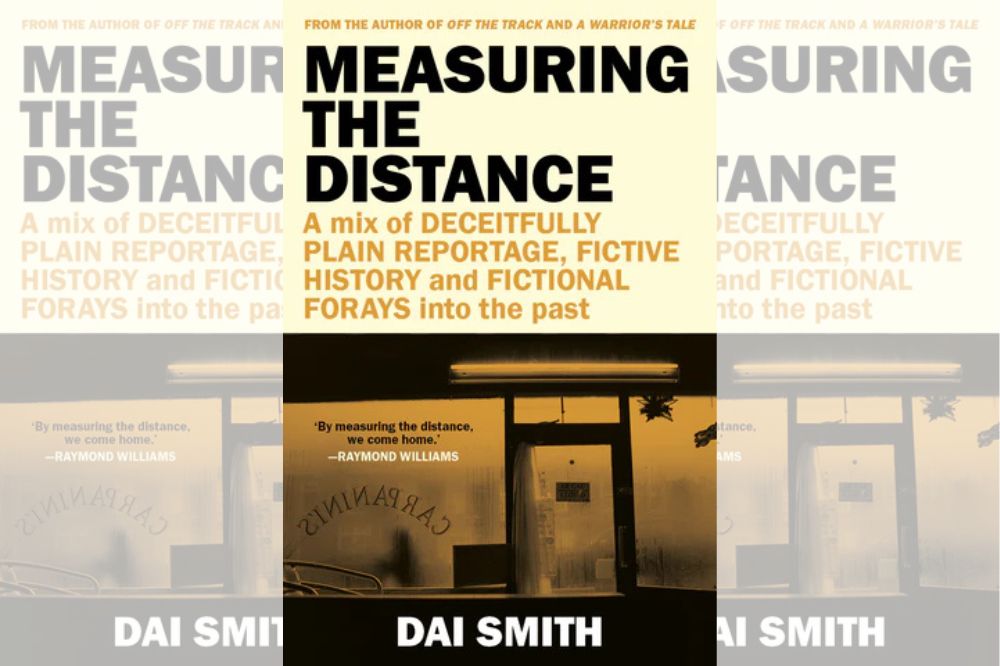
An event was held in Cardiff not long ago marking Dai Smith’s 80th birthday. He continues to write with remarkable vigour and variety. Measuring the Distance is an eclectic collection of history, fiction, literary essays, poems, and, in his words, “fictive history and fictional forays into the past.” If it feels like a lucky dip, there are some decent prizes.
His 2023 autobiography Off the Track is his best book in my opinion, and certainly the most fun to read. It charts a varied career as a university historian and professor, broadcaster, BBC executive (he was once among my bosses, a genial presence, though we were separated by many rungs of the rope-ladder), Chair of the Arts Council, essayist, novelist and, most recently, poet.
He is described on the blurb of Measuring the Distance as a “public intellectual”, and fair enough, one of few really in our culture. Throughout his career he has advocated a view of Wales and a form of Rhondda Exceptionalism. He spent his early formative years in Rhondda before moving for secondary school to Barry, to which he attaches rather less mystique.
Culture of Wales
For half a century Dai Smith has been associated with promoting the English language culture of Wales. Alongside figures such as his friend Meic Stephens, he was determined that Wales’ English language writers should be taken seriously and recognised in Welsh education and culture. He is especially attuned to the cultural and historical experience of the Rhondda and Wales’ industrial past.
Dai was the beneficiary of Geraint Talfan Davies’ (the two were university buddies) decision in the 1990s to separate management of BBC Wales’ English-language output from the Welsh, thus opening the post to English speakers where, previously, the combined output confined the job to Welsh speakers.
There is a valedictory aspect to Dai’s late work (in a humorous fictive piece here, “Obit Page”, an aging politician/author reviews a draft obituary while still alive). The span of his lifetime records the mining industry in its full vigour followed by its defeat in the miners’ strike of 1984-5, its rapid decline thereafter and, ultimately, something like a vaporisation.
In some former mining communities, it’s as if the industry never existed. Incredible in just a generation. In some ways, Wales’ mining experience is already as elusive as Owain Glyndwr.
Mines and miners
My favourite piece in this eclectic collection is “John Hopla and the Tonypandy Revolt”. Hopla, I think it’s fair to say, is largely unknown outside of labour studies’ circles, and Dai tells his story with verve.
Born in Pembrokeshire in 1882, like thousands of others he migrated to the Rhondda mines. Hopla was dead at 32 and during his short lifetime Rhondda’s population trebled to 180,000. He became a miners’ leader, alongside figures like Will John and WH Mainwaring, both later Labour MPs, and led the strike action which pre-figured the unrest known as the Tonypandy Riots in 1910-11.
The miners, and Hopla in particular, were trying to prevent black-legging, the process where owners transported miners in from other areas – like Cardiff – to do the work of sacked strikers. Labour was 70% of the production cost and owners were constantly pressing down on wages and safety. We learn that there were an astonishing 595 deaths caused by explosions and accidents in Rhondda collieries between 1902 and 1909 (and, to boot, for every 1000 births in that decade, some 200 infants died before 12 months of age – this in the world’s richest country).
After the rioting, Hopla was imprisoned on flimsy evidence and sentenced to 12 months with hard labour, which contributed to his ill-health and early death. The movement he helped lead changed loyalties from Liberals to Labour, established a minimum wage for miners and, with the eventual election of the Labour government in 1945, nationalised the mines, created the NHS and introduced state benefits. The long period of Labour domination in Wales ushered in by this movement is only now, it seems, finally running out of steam. John Hopla was, “a lightening conductor of the transformative social storm that broke over mid-Rhondda in 1910” – and here deservedly rescued from obscurity.
Honoured
Dai is a fine essayist. His piece on Max Boyce – “Maximum Boyce” – is a treat. He attributes to Boyce a historical perspective where the ups and downs of his career mirror “the social fissures of the past half century”. Through the 70s/ early 80s Boyce reflected a cultural buoyancy based on the romance of stylish (and winning!) Welsh rugby, a country punching above its sporting weight, and the social vigour of coalfield communities.
Boyce was of that world and his performance reflected that community back to itself and outwards to the wider world – at his peak, he played to a packed Sydney Opera House and sold two million albums. Boyce was “the jubilant ventriloquist of a travelling army of carousing worshipping, gob-smacked, bobble-hatted, joyful supporters”.
On the other side, the 1984-5 miners’ strike, the world within which Boyce made sense began to crumble and collapse. Sadly, Welsh rugby mirrored rather than alleviated the pain of industrial demise in the late twentieth century. Boyce’s career dipped into relative obscurity and he “looked and sounded like a relic of a past time.” Devolution created a new cultural context for Wales and gave Boyce a fresh lease; he was commissioned (by Dai Smith!) to perform a successful new show on BBC Wales in 1998.
Today, Boyce is one of few people honoured with a hometown statue unveiled in his own lifetime. Dai endorses a
comment by historian Martin Johnes that Max Boyce was, in his way, as important culturally as Dylan Thomas or Saunders Lewis – to me, an entirely uncontentious view.
Class and Nation
Dai has worked hard to promote Wales’ English-language culture and has contributed greatly to this cause through his writing, broadcasting and editing, particularly the important Library of Wales series. This series republished more than 50 books in English by Welsh authors, conferring a kind of classic status on the selection. More importantly, it provides a map for the study of Wales’ literature in English and marks out some significant contours.
A long-term Labour supporter, Dai refers rather snidely to the concept of “Welsh Labour”. He laments the “Welsh” prefix and says, “For Labour, Class once trumped Nation, and still should.” Surely Welsh Labour is a natural reflex to the devolution which a Labour Government brought about? As for Class, why must it be opposed to Nation? Why can’t class consciousness and a determination to better the lot of working people be rooted in Welsh identity and its communitarian values?
He repeats the canard that “constitutional tinkering” is not what Wales needs – and he could not be more wrong. It is precisely our hamstrung set of constitutional/ financial powers which inhibits properly effective and progressive government in Wales by Welsh Labour or anyone else. The brake on progressive policy in Wales doesn’t, so far as I can see, originate in Wales but with the UK Labour Government and its let-down prioritisation of the City’s interests in preference to pensioners, the disabled and working people.
Bilingualism
In advocating for Wales’ English-language culture, Dai has sometimes prodded and provoked the Welsh language community. In an essay “Outwith the People”, surveying the post-devolution landscape, he complains of “a bilingual society-to-be in which Cymraeg would be prioritised across the board and Wales’ alternative linguistic voice would be increasingly downplayed.”
The idea that the English language in Wales is disadvantaged by an emphasis on Welsh is, bluntly, bizarre. The overwhelming cultural advantages belong to English, surely. There’s nothing to gain from pitting English and Welsh against each other in phoney contretemps: both can be vibrant; both can flourish, and Wales will be better for it.
Dai as historian, essayist, memoirist and cultural commentator is sure-footed and there is ample substance in this book (I am mystified, though, by a reference to Sean O’Casey as “Catholic apostate”; O’Casey was raised in the Church of Ireland and his father was a protestant missionary). The volume is interspersed with short pieces of fiction which work less well in this context, and their inclusion here feels slightly confusing. Dai has come late to poetry and a couple are included here, taken from his recently published volume, Street Fighting and Other Past Times.
At his best, Dai Smith is a scintillating essayist. He is knowledgeable, committed and contrarian. As he says, we need a civic society which accommodates “dissent and disagreement to make our culture significantly worthwhile.” Hear, hear to that. His writing can sometimes be dense and, occasionally, elliptical. On the other hand, sparklingly struck phrases gleam like newly discovered nuggets of gold, lending weight and insight to the accumulation of facts.
Measuring the Distance by Dai Smith is published by Parthian.
Support our Nation today
For the price of a cup of coffee a month you can help us create an independent, not-for-profit, national news service for the people of Wales, by the people of Wales.


