


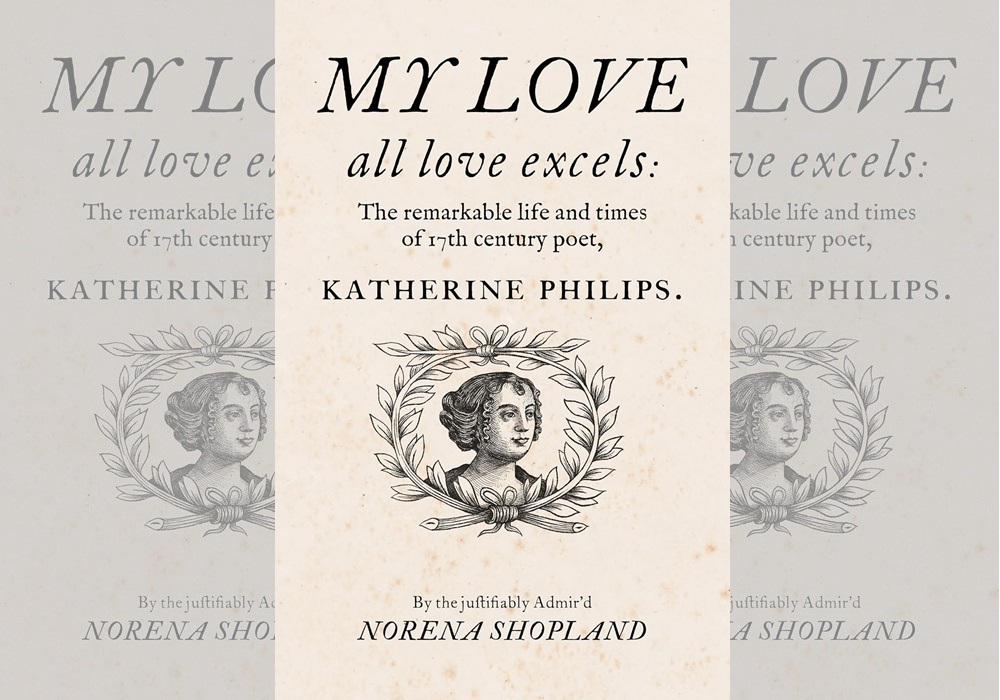
Book review: My Love all love excels by Norena Shopland
Desmond Clifford
Just a few weeks ago I visited Dublin for Bloomsday, the day commemorating the action of James Joyce’s ‘Ulysses’ (16 June 1904). I went to the city’s oldest theatre, the Smock Alley Theatre, for an event.
In 1663 it was called the Theatre Royal and had not long re-opened after the Puritan closures. On 10 February the first play by a woman in the British Isles, “Pompey” by Katherine Philips, was performed there. “Pompey” was an adaptation from the French of Pierre Corneille, a contemporary of hers.
Katherine Philips was among the first identifiable female poets in English, and among the first to write of same-sex attraction; her work is claimed as a foundational text of LGBT literature. Her play was the first by a woman to be commercially produced.
As a seventeenth century upper class woman Katherine spent a lot of time sitting at home. Her address was Cardigan Priory, set in two hundred acres adjacent to Cardigan Castle. She had time and privilege for writing.
Katherine was born in Wiltshire in 1631. The essayist John Aubrey was a friend of the family and records her life in his Brief Lives under the title “The Matchless Orinda”.
“Orinda” was Katherine’s pen name, and she was one of only a handful of women written about by Aubrey. She had grown up in a highly literary atmosphere; the Welsh poet Henry Vaughan was another friend of the family.
After her first husband’s death, Katherine’s mother remarried a rich landowner and they moved to Picton Castle, Pembrokeshire. In 1648 Katherine herself married James Philips, her sister’s widowed husband, and relocated to Cardigan, half a day’s travel away.
Katherine was an ardent Royalist, like most of Wales, while her husband was a committed Parliamentarian. Politics seems not to have troubled their relationship. They were kind to each other and mutually tolerant and Katherine did her best to help her husband when he most needed it.
Life in Cardigan was very isolated for her. Although she makes sympathetic reference to Welsh poetic traditions in one of her poems, there’s no evidence she acquired any Welsh even though she was a linguist and proficient in French and Italian.
Genteel educated English speakers were thin on the ground around Cardigan, unlike Pembrokeshire, and it’s unsurprising that letter-writing played such a large part in her life.
Katherine set up a Society of Friendship, what people now call a “friendship group”, linked by letters. She allotted pastoral names drawn from the classics – today we’d call them “usernames”; nothing really changes! – to her friends. Katherine’s two great female friendships were “Rosania” – Mary Aubrey – and “Lucasia”, Anne Owen, from Anglesey’s gentry. As well as a stream of letters, Katherine wrote poems to and about her friends.
Katherine’s mind was unusually fertile, and she displayed a rare boldness of character. She crossed swords with the militant Fifth Monarchist preacher, Vavasor Powell, a sometime colleague of her husband.
Powell had written a poem glorifying the execution of the King. Katherine was horrified and responded vitriolically in verse. Powell could dish it out but was quick to take offence himself. He was supported by the influential power-broker Colonel John Jones, also a Fifth Monarchist, and Katherine was obliged to apologise, after a fashion, to avoid embarrassment to her Parliamentarian husband. (As a footnote to this tale, Col Jones was gruesomely executed a few years later at Charring Cross as one of the 59 signatories of the King’s death warrant).
Katherine’s husband, James, prospered under the Commonwealth but his fortunes reversed rapidly after the Restoration. Under Cromwell he was showered with offices, became the local MP and acquired lands confiscated from supporters of the executed King. Although James Philips escaped a death sentence he was mired in legal challenges and land disputes. Katherine stood by her husband and her status as a writer of royalist verse likely helped his otherwise uncomfortable position.
Katherine followed her friend “Lucasia” (Anne Owen) to Ireland to spend time with her at her new marital home, an estate in County Down, even though she disapproved of Anne’s husband. She then spent time in Dublin on family business and cultivating her literary career.
Driver
She seems to have thrived in Dublin. The atmosphere was freer than London and her play was given a chance there which it was not in the more conservative London. Dublin was more parochial, cheaper, and designed to meet the needs of a Protestant elite cut off from the lives of ordinary Irish people. Across the British Isles, this was the great age of big houses and rent-seeking aristocracy; Britain before industry.
Katherine spent lots of time writing letters. We learn that a letter from Cardigan to London cost the equivalent of an ordinary person’s wages for two days. Katherine wrote constantly and must have spent a fortune. Among the literate and the wealthy, letters cultivated an intensity of expression gradually eroded as the cost of postage declined and communications became more frequent.
The intensity applied to poetry too. In this period poetry was declaratory and a means of eulogising or demonising according to taste. The chief subjects of Katherine’s works were women, especially her friends, “Lucasia”, Anne Owen, and “Rosania”, Mary Aubrey. She may have had a lesbian devotion to her friends. Certainly, her poems and letters were passionate but there’s no definitive evidence of her sexuality either way and it’s difficult to distinguish between sincere personal feelings and the exaggerated poetic conventions of the time.
Katherine’s poetry is quoted extensively in the volume. She was the first woman recorded to have written poetry in English in Wales, and among the earliest English language Welsh poets of either sex.
LGBT studies
Katherine was well-known in literary circles in her lifetime – unusually so for a woman – but slipped into obscurity until her rediscovery in the twentieth century in the context of feminism and LGBT studies.
There remains an element of conjecture. Even the most daring writers were circumspect on the topic of sex in the seventeenth century – with the notable exception of Samuel Pepys who behaved shamelessly but disguised his activities in his diary with a secret shorthand.
Katherine left behind ninety-six poems, two plays and a cache of vivid letters. Most of her poems weren’t written for publication but circulated in limited form.
Death often came suddenly and cruelly in those days; Katherine caught smallpox and died young in 1664.
Is she a good poet? Her work strikes me as mostly conventional. She is certainly proficient although saccharine and inclined to melodrama rather than straightforward expression. That said, seventeenth century literature will rarely make sense when read through a 21st century lens.
Poetry was deeply personal and often a means of responding to the dramas of daily life. The language is grandiloquent reflecting the reading and writing of the time, based on the classics which formed the basis of education. The endless diet of iambic pentameters and quatrains is simply how they did it in those day but can be jarring and trite to our reading.
Ground-breaking
Norena Shopland avoids over-claiming on her subject’s behalf. She notes that Katherine was an important and ground-breaking poet and playwright – which is surely correct – without making exaggerated assertions about her work.
Katherine was well-known in literary circles in her time and for a short period after her death, only to be revived in recent times in response to feminism and the rise of LGBT literature.
This book is packed with interest and Katherine’s writing is only the half of it. We learn a good deal about civil war politics in Wales and the social isolation of the English-speaking gentry. They were intimately connected to each other but hardly at all to the Welsh speaking world which surrounded them. London was their magnet, the source of money, fashion and society – then as now.
The chapters on Katherine’s time in Dublin are fascinating; the city was just beginning its development as the second city of the British Empire, a cut-price and provincial imitation of London.
It’s a good habit to approach books with an open mind. I wasn’t entirely expecting to enjoy a biography of a minor seventeenth century poet, but this book is gripping. The strength of feelings in Katherine’s relationships with women is revelatory, her loyalty to her under-threat husband during tricky times is admirable and her determination to write and get noticed is admirable.
Support our Nation today
For the price of a cup of coffee a month you can help us create an independent, not-for-profit, national news service for the people of Wales, by the people of Wales.
Get more trusted Welsh news
Choose Nation.Cymru as a preferred source in Google News to see more of our journalism.


