


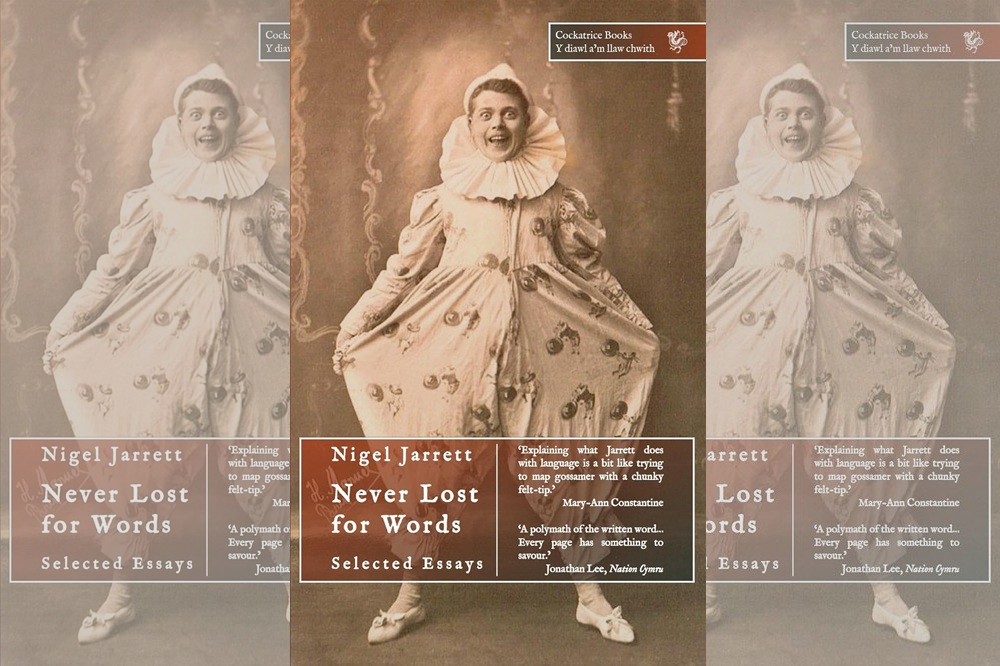
Book review: Never Lost for Words: Selected Essays by Nigel Jarrett
Desmond Clifford
The joy of writing for its own sake is treasured by Nigel Jarrett after a career in journalism.
Curiously, many people who write for a living find themselves distracted and distanced from the very the thing they most want to do – to write what they want, not what is demanded by their employer.
I have solidarity here. For some years at the BBC, I wrote bulletins about car crashes, murders, parliamentary questions, rugby team selections (“Steele Lewis, Pontypridd” sticks in my mind; what a player, what a name!), union disputes, planning applications, visiting royals – you name it.
And what do I have to show for it? It’s poor material for a Collected Works of D Clifford, volume 1.
I spent the next 30 odd years writing stuff for the Welsh Government. I must have produced a word volume equivalent to the combined works of Tolstoy, Dostoyevsky and Dickens. And I’m afraid my volume 2 would be no more exciting than volume 1.
Nigel Jarret classifies his essays as “whimsy”, another way of saying he writes about whatever grabs his attention. Themes include a piss-up in London, pornography, his Jewish neighbours and a disused internet chess site.
He writes that he is one of only two people living who now know Pat Nixon’s bra size (the wife of the famous president). Inexplicably, I feel short-changed he didn’t tell us.
Whimsy is a lucky dip. The essayist dips his quill in the same manner as a fisher in the river, and we wait for what comes out.
In “Public Libraries On Borrowed Time” he laments what he sees as their decline. I share his mystification at the relentless sale of “excess” library stock. My shelves are peppered with ex-library books picked up for practically nothing at second-hand stalls over the years.
The odd one is quite rare and would actually have been worth a few bob if Lazy County Council had bothered to do some research. Better still, they could have left it on the library shelf where it remained accessible to everyone.
My local library was a life-saver, as they were for millions. Even so, I much prefer the atmosphere of libraries now – busier, warmer, proper meeting-places rather than silent authoritarian cloisters.
Far from objecting, bring on the coffee bar I say, and the more reading out loud and computer-tapping the better.
A quick glance at the readily available evidence suggests book sales are holding up pretty well. Growth areas are, counter-intuitively perhaps, driven by younger readers consuming fantasy and romance.
Fine by me: I could care less if no one reads Trollope anymore; read Andrew O’Hagan and Paul Murray instead.
Nor do I see the growth of audio-books as evidence of decline and fall; no one has accused Radio 4’s Book at Bedtime of undermining civilisation and it’s been going for about 300 years.
Non-fiction books
Worryingly for people like Nigel Jarrett and me, sales of non-fiction books are suffering the most. Presumably people think anything worth knowing can be found for free on the search engine I refuse to name (that’ll show ‘em).
Children’s books have been remarkably resilient and sustain a vital part of any book business.
For all the challenges presented by technology and the manifold distractions offered by YouTube and TikTok, I feel that the collapse of civilisation has been prematurely heralded.
Just as my generation was incomparably advantaged by the availability of television, so I envy today’s young people with the online world at their fingertips.
Of course, there are drawbacks and dangers, but I don’t understand why the terms of debate are cast in such apocalyptic terms. Mankind, and especially the young, are not retreating into the caves – though some sensible regulation wouldn’t go amiss.
“The Tweeting Facebook” is a reflection of what we persist in calling “social media” – how dreary and yuk-laden that phrase has become. Jarrett quotes Jonathan Franzen saying that social media outlets have soaked up energies of writers who otherwise should be making a living from writing freelance.
This is certainly true. Twitter, Facebook, YouTube,TikTok and all the rest, acted at first as a kind of liberation.
Communications were democratised. Musicians can produce studio-quality recordings in their bedroom without being “discovered” and enslaved by a record company.
Making money from music remains problematic, but wasn’t it always for the toiling majority? YouTube liberated the talented from the terrestrial broadcasters and their narrow view of what should, and shouldn’t, be broadcast.
Tripe
Twitter and Facebook were great in theory, providing an open and democratic forum for chat and opinion. The price of such democracy is the never-ending river of tripe and bile pouring daily from the minds of the malicious and maladjusted – the Silent Majority’s noisy opposite (the Loud Minority?).
Grim as its sometimes is, we should remember that every technology has unleashed lowest denominator garbage alongside the great and elevated.
We remember Shakespeare and Dr Johnson but not all the puerile scandal sheets which constituted a large percentage of printed material for hundreds of years.
With historical echoes of today’s debates about social media, the great and good of earlier times tried very hard – sometimes with lethal measures – to limit and control printing presses precisely because they feared the Vox Populi.
They were right to fear it but wrong to control it. We need laws and regulation to go with them, but control of human expression doesn’t have a great history.
In “Music, Ho!” Jarrett recounts his experience as a music critic, mostly for the South Wales Argus. He notes that changing tastes and the internet killed off the reviewer’s monopoly: “Suddenly everyone was, or could be, a critic.”
Equally he recognises that newspapers “locked out” many “authoritative voices” (along with the avalanche of dullness which fills the internet).
There’s little rancour in his tone on this, nothing more than a touch of resignation and recognition that change is change and can’t be reversed.
Talent
As technologies settle – insofar as they ever do, which, of course, they don’t – you have to hope there’s still a world where talent and attainment can be valued and recognised. As the villain in the Pixar movie The Incredibles notes, “When everyone’s super, no one will be”.
Jarrett writes well, sometimes delightfully. Just occasionally he treads a foot across the invisible line which marks the border between clever and too-clever-by-half.
Whimsy is a warm bath and there’s plenty here in which to luxuriate. The nature of essays, if they work, is that you’ll find some triggers to stimulate your thoughts, your agreement, your objections.
As Forest Gump’s mother said of the box of chocolates, you never know what you’re going to get. But if there’s nothing here to meet your taste, then you’re hard to please.
Support our Nation today
For the price of a cup of coffee a month you can help us create an independent, not-for-profit, national news service for the people of Wales, by the people of Wales.


