


Book review: Owen Williams, Atrocity Exhibitions: Grieving in the TikTok Underworld
Niall Griffiths
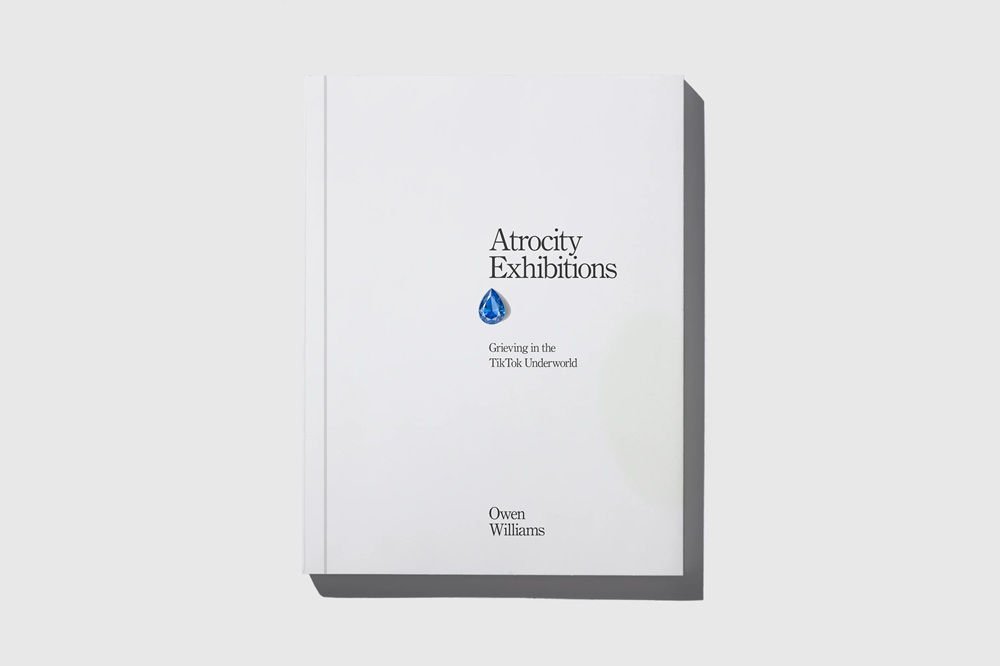
Small, little bigger than a pamphlet, stark monochrome cover, black font on bright white background, a blue diamante tear affixed; what a beautiful artefact this is. Delicate, yet with a strange heft.
Rough Trade Books are treasures, and the splendour of the design in this instance is more than honoured by the words within. This is an incandescent tract.
Owen Williams is the singer-songwriter of the Tubs, and formerly of the brilliantly-named Joanna Gruesome. He is the son of the novelist/biographer/critic/musicologist John Williams and folk singer/writer Charlotte Greig, who took her own life in 2014.
This is his first book, and what kind of book is it? A memoir, a disquisition on suicide, an analysis of contemporary shame, grief, humiliation?
More accurate to call it a guide through the demented jungle of the adjacent actuality of the online (which will impinge upon you and influence you whether you wish it to or not), with all of the extensive intrepidity and acceptance of derangement and, indeed, brave confrontation of various abysses that that might suggest.
I’m middle-aged; of course I’m IT literate, and I engage with the online out of necessity and the demands of research, but I really don’t fully know what it’s like to have my identities, my experiences, mediated through anonymised voices on chatrooms and digitised screenscapes; in fact, I confess, even, to being bamboozled by the Googling of ByteDance, which only took me to a link to a ‘Chinese internet technology company operating a range of contact platforms’. There was nothing about any Atrocity Exhibition. But no matter; Owen will take you there.
So, what is it, beyond a JG Ballard novel? It is ‘currently the most depraved place on earth. Something in its curation has granted it access to the primal forces of chthonic nature’. I was never entirely sure whether it exists in both digital and meat-world avatars (as I say, I’m middle-aged) but that distinction has no relevance anymore.
This is the world, now; berserk, for sure, but ‘also a touching, lonely, funny, heartbreaking place’.
We begin with a quotation from Nathaniel West’s Miss Lonelyhearts, the rarity and judiciousness of which reference instantly raised an impressed eyebrow; West was the author of only four short novellas before his death at 37 but whose work is, in the 21st century, reading as remarkable foresight.
Williams uses West as one guide amongst many well-chosen others (including Paglia, Artaud, John Waters, Arendt etc) through the thrash and tangle of being alive and, with profound empathy and compassion, becomes one himself.
That is no exaggeration; his erudition and literary alacrity and humour and razor analyses made me grateful that he was walking point ahead of me.
Suicide
Take the chapter on Suicide, a subject full of mines for the son of one which Williams adroitly avoids, partly due to his learned sensitivity and his lacerating, blistering honesty; he references Durkheim (as he must, here) and refers back to his own personification of ‘Suicide’ in a somewhat cringe experimental theatre endeavour and then, with great skill, takes us through the phenomena of suicide clusters (most pertinently in Bridgend), Plutarch, the ‘Werther effect’, Sontag: the self-annihilating youngsters of Bridgend ‘wanted to feel seen’.
Each themed chapter is a small masterpiece of elision and concision and packed, allusive thought.
And, too, and extraordinarily, he finds hope in despair and dismay; his unique analytical take on the extremes of human behaviour invariably leads him there – it’s as if he can’t help himself, even in a realm which ‘aims to annihilate art entirely. . . [T]he public are finally free to consume snuff films, celebrity brawls and AI slop porn’.
In the chapter on ‘Sex’, we get a discussion of the exploits of Bonnie Blue (get Googling, if you’re unfamiliar, and can manage another seismic shock to your faith in humanity) which, with the help of Camille Paglia, he sees as the indomitability of the pagan, Dionysian impulse in the human soul.
I must confess that I took some convincing, here, and I’m still not fully persuaded (there’s no consideration of the self-legitimising emptiness of fame-at-any-cost, for instance) but, God, it offers a unique and unexpected angle of consideration: ‘Blue has the power to traumatise by her apparent inability to be traumatised. To these men, she is more nature than woman, and this terrifies them. . . [They} want to see inaccessibilty accessed ad nauseam. But when, in Blue’s case, this doesn’t lead to the usual presumption of shame or vulnerability, an outraged disappointment takes over.
‘She has remained inaccessible despite being accessed repeatedly’.
This doesn’t entirely dispel, for me, the ‘nausea’ bit in ‘ad nauseam’, but it coaxed open the lids of a third, sleeping eye and invited a new way of seeing. For which I was both grateful and impressed, as I was consistently by this fascinating piece of work.
Trauma
What impresses most is the fact that never, not once, in this exploration of human depravities and shadows, is the great trauma and heartbreak of losing a mother to suicide forgotten or overlooked; Charlotte’s ghost, the memories of her, are backlit throughout.
She is a constant and salutary hovering presence; I was fond of her, and, in these pages, it was a relief and a pleasure to contact her again, her poise and intelligence alive once more through her son’s extraordinary writing.
Such is the abiding strength of the written word; and what power these particular words have.
Support our Nation today
For the price of a cup of coffee a month you can help us create an independent, not-for-profit, national news service for the people of Wales, by the people of Wales.


