


Book review: Portmeirion: The Architecture of Pleasure by Sarah Baylis
Jon Gower
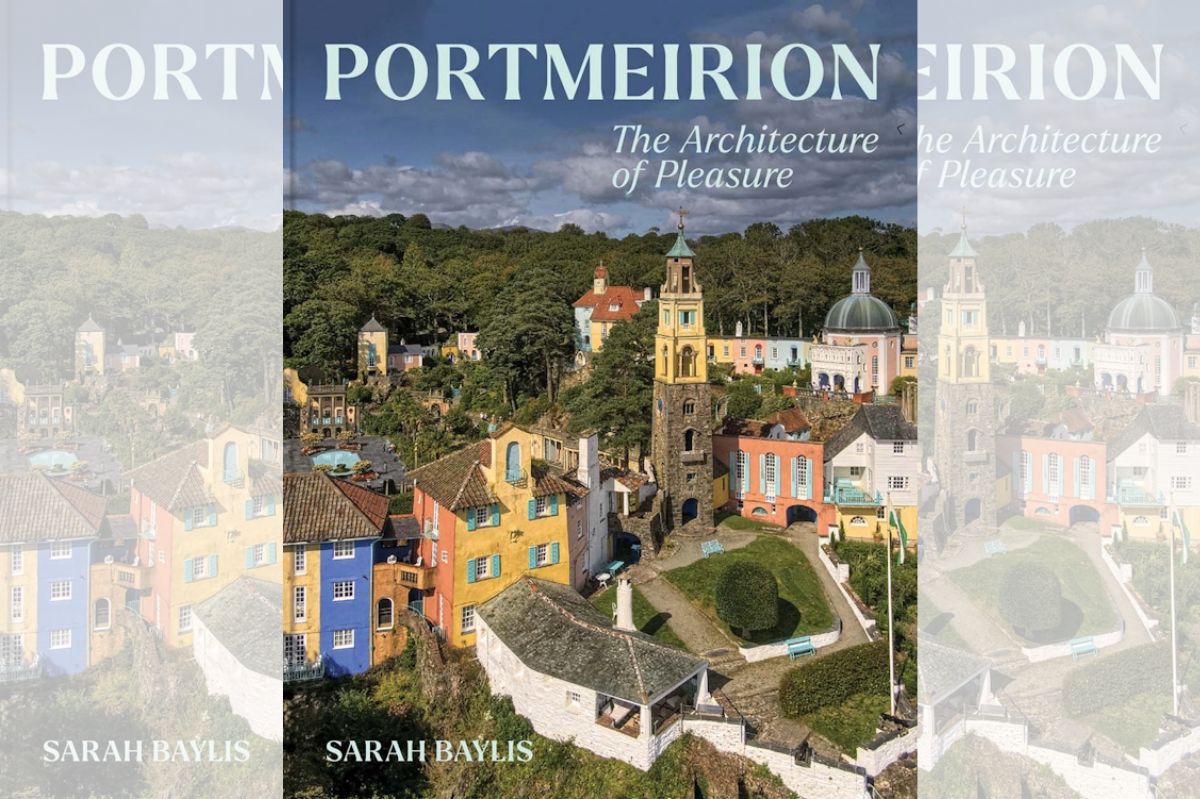
Portmeirion is a fascinating architectural confection set on the rim of the Dwyryd estuary. Its visionary creator, Clough Williams-Ellis was a human magpie, collecting pieces of buildings or rescuing entire ones to transplant to his ‘home for fallen buildings.’ And he was a magpie fully willing to fly hither and thither to gather his material.
Demolition work
An advert in ‘Country Life’ magazine once alerted him to the imminent demolition of Emral Hall in Flintshire and he duly turned up for the auction, keen as can be to save the seventeenth century ceiling plasterwork depicting the Labours of Hercules. He bought this for a song, along with the rest of the room – the ‘old leaded glass in its mullioned windows, its fire grate, its oak cornices and architraves – the lot.’ This mutated into the Town Hall at Portmeiron, another expression of Clough’s own Herculean labours in fashioning beauty from junk, generating symmetry and fine line from stuff others threw away. And Clough being Clough he topped it off with a cupola on top, made from an upside down copper boiler which had once been used for pig swill, set beneath a burnished copper crown.
Haphazard assemblage
There was lots of such haphazard assemblage. The place is awash with mermaids, relocated from the Sailors’ Home in Liverpool and all assembled somewhat theatrically, for Clough’s intention was ‘to create, out of stone and concrete, a village of that fairy land across the footlights.’ This wasn’t, as many believe, his life’s work, for much of it came into being when he was in his 70s, 80s and 90s. In that it’s an example of what Edward Said described in his book ‘On Late Style,’ the sort of mature flourishing that gave us the late music of Mozart, the final plays of Jean Genet and the finest novels of Thomas Mann. In Clough’s case, as author Sarah Baylis explains, it involved turning to a ‘different, contrasting style of architecture, one more classical in its inspiration. As before, his main interest was in creating curious juxtapositions and colour combinations; clusters of buildings linked together in unusual ways, which “talked” to each other.’
Playful creation
This delightful, elegantly designed book brings Clough, his family and his peerless and playful creation very much to life, with Baylis arranging her material with her sense of pattern in things. In this she’s been blessed by having access to the Portmeirion archive, which is a treasure trove in itself, not least Clough’s architectural drawings which remind one of those by Frank Lloyd Wright. Indeed the two supremely gifted men once met at Portmeirion when the American genius paid him a much treasured compliment by suggesting to Clough’s wife Amabel – ‘why, I do believe you married an architect.’
Clough stands centrally in this story, of course, and we get the gist of his life by a judicious filleting of his three autobiographies. We get a lot of colour and colours too, when we learn about his insistence that his buildings were painted with four gradations of colourwash, ‘the deepest at ground level – to stimulate the picturesque effects of age and weathering, of damp creeping up an old wall’ which was very much in keeping with his love of the patterns of mould and damp.
The aesthetics of decay
Another colour Clough much admired was also consonant with this aesthetics of decay, namely verdigris, the patina that turns copper from sheen to green and he was eventually to create his own colour, Portmeirion Blue Green, which he kept for exclusive use. Much of the new photography by Martin Crampin for this volume captures the subtle palette of the buildings and their relationships with each other, not least the way in which Clough managed to make things seem bigger than they actually were. He could concertina so much into relatively little space and still give them space to breathe: be it via Fountain Square and Battery Square or a little piazza shoehorned into a spare corner.
Bright cast of characters
This fluent history of Portmeirion, published in its centenary year, is busy with a bright cast list of colourful characters, featuring those who worked there and those who visited. There’s Clough’s writer wife and soul-mate Amabel who co-wrote, with Clough, a history of the Tank Corp and Uriah Lovell, a gypsy basker weaver resident in a bender tent in the woods. There was the founder of CND, philosopher Bertrand Russell and the ever dapper Noel Coward who, during a week of chain-smoking and intense creativity, managed to summon up not some but all of ‘Blithe Spirit.’ And then there was daughter Susan, a great swimmer and snorkeller, who painted a lot of mermaids and all manner of sea-creatures and, in order to do so,‘developed a method of drawing underwater using coloured oil pastels or crayons on plastic tracing film.’ It’s tempting to suggest she became a mermaid in so doing.
My own special memory of Portmeirion connects with a night when he convened there for a memorial event for the poet R.S.Thomas. As R.S’s fellow poet Menna Elfyn was reading an insistent tapping noise interrupted her flow. It was a blue tit, pecking determinedly against the window. Some of us found it easy to imagine it was the priest and avid birdwatcher somehow taking part in the proceedings, as his complicated personal theology might have allowed. Or the small bird might have been picking at the aphids that like to feed on the linseed oil in window putty. Take your pick.
Idiosyncracies
Portmeirion is an extraordinary place and this new book addresses it idiosyncracies and uncovers some secrets, offering a sort of amiable saunter around an Italianate village which has so much more than just Italy and a whiff of Portofino about it. It takes us to the rhododendron groves of Y Gwyllt, the wild woodland on the old estate of Aber Iâ and to enjoy the theatricality of Clough Williams-Ellis’ creation, an architectural performance if ever there was. You can almost imagine the old gent, dressed in knickerbockers and sporting a wry smile, taking a well-deserved bow after a shoreline show that is never quite over.
Portmeirion: The Architecture of Pleasure by Sarah Baylis is published by Yale University Press and is available from all good bookshops.
Support our Nation today
For the price of a cup of coffee a month you can help us create an independent, not-for-profit, national news service for the people of Wales, by the people of Wales.
Get more trusted Welsh news
Choose Nation.Cymru as a preferred source in Google News to see more of our journalism.


