

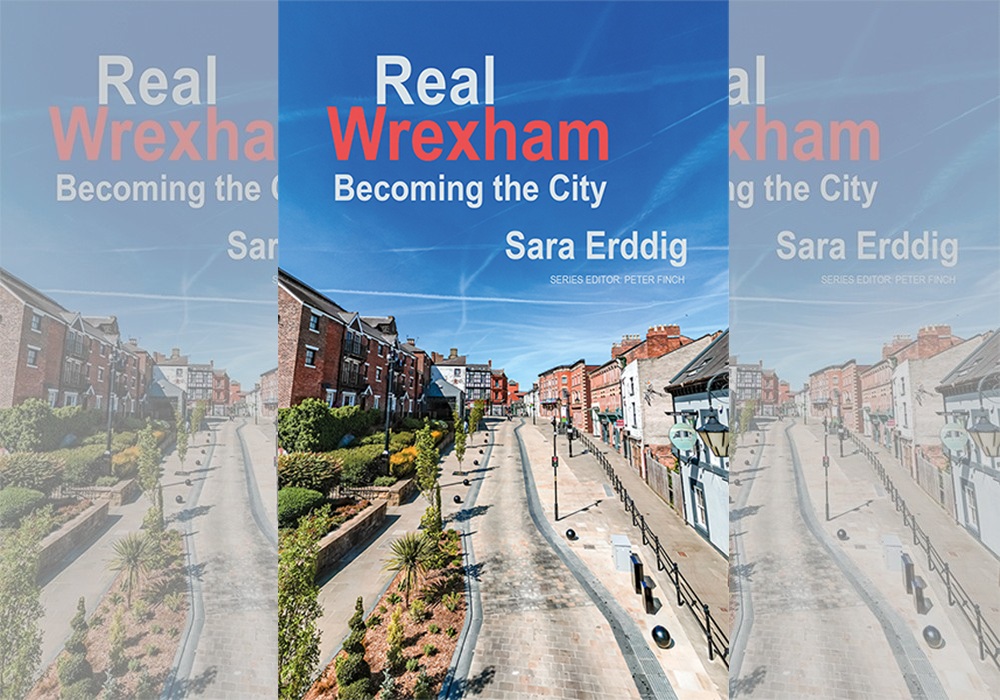
Book review: Real Wrexham: Becoming the City by Sara Erddig
Desmond Clifford
The “Real Series” is among the success stories of modern Welsh publishing – quite an accolade in a notoriously fickle and difficult trade.
The original inspiration came from John Barnie, then editor of Planet. Mid-way through an unprecedented economic boom in the late 90s he noticed major change underway in fin-de-siecle Cardiff and asked Peter Finch to write about it. Peter accepted the commission and his writings eventually evolved into the original book, “Real Cardiff”, published in 2003.
There was more to be said and “Real Cardiff Two” appeared. This was followed by an adaptable series covering other areas: Swansea, Aberystwyth, Newport, Wrexham, Gower, Gwynedd etc. The series is infinitely flexible and extends beyond Wales: Dorset, Bloomsbury, Glasgow, Chester, Oxford, Cambridge and others have all so far been covered.
The books have been labelled “psychogeography”. I am a sworn enemy of literary theory but I don’t demur at the “psychogeography” tag for this series.
Conventional travel lit is one of few genres in which Wales is not notably under-served. There’s plenty of guidance through the nation’s A roads with advice on agreeable walks, stops at cafes and pubs, and with a dollop of history and culture to keep you entertained.
The “psychogeography” occupies a different perspective. Effectively it’s an essay, or a series of essays, describing the inter-relationship between a place and a person or people. Its primary purpose is not to provide the functional information that a tourist might normally want to access, but to articulate a sense of the place.
Those places may not even be locations of conventional tourist interest. The places seen and the people met trigger responses from the author, and it is through these reflections that we build a sense of somewhere. The ability to convey this “sense of place”, rather than rehash the factual information about it, is the “Real Series” at its best.
The original “Real Wrexham” by Grahame Davies appeared in 2007. The fact that this second volume, “Real Wrexham: Becoming the City”, was commissioned is testimony to the rate of change around Wrexham in recent years.
Pleasingly, its trajectory has been vertically upwards after lengthy periods of doldrums and stasis.
There’s an unmistakable sheen of coolness attached to the area today which is not, I reckon, a sentence many would have expected to see even a decade or two ago.
A positive spirit, which I am thoroughly pleased about, attaches to contemporary Wrexham so I’ll get my gripes out of the way early.
The book’s conceit is how Wrexham has adapted in the light of acquiring “city status” in 2022. Here’s my gripe. When and why did we become obsessed with all this “city status” malarky?
I’m afraid I view it somewhat negatively. It’s an annoying characteristic of Britain/ Wales that we’re never happier than when looking for new ways to categorise and rank difference.
This has always been true of our dismal class system where we dissect birth, education, accent, address, clothing, cars – just about anything we can think of to drive distinction and difference.
The modern “city status” obsession is a wholly artificial and confected mumbo-jumbo to persuade people that something important has changed in their area as a result of a parchment being handed over to the mayor. Is this just me!? Perhaps I’m getting old and grumpy.
Sara Erddig loves Wrexham so much she adopted its principal park as her nom-de-plume in the Welsh style (real name: Sara Louise Wheeler). She has spent most of her life in and around the city (as we must now call it). She breathes life and memory into its schools and housing, its pubs, bars and clubs.
Bricks
Any visitor to Wrexham will notice its distinctive brick colouring – apparently Etruria Marl clay, discovered in Ruabon – but I am pleased to learn that this is also the brick used for Cardiff’s distinctive Pierhead building. I’d vaguely wondered where it came from and am gratified that it’s home grown.
I must have been dozing in 2022 because I didn’t realise that Wrexham Glyndwr University had dropped “Glyndwr” from its name on the grounds that it was too Welsh and confusing.
This craven and pathetic decision represents what’s wrong with Wales. Does Magdalen College, Oxford worry about its strange pronunciation? Gonville & Caius?
Wrexham University’s institutional self-loathing reflects poorly on those charged with its stewardship. They should have grabbed the Glyndwr name with both hands – it’s a privilege, not a burden – worked it for all its worth and created a dynamic identity around it. It’s worked for de Montford, Harper Adams, John Moores, Brunel and Anglia Ruskin among others. Elihu Yale will be turning in his grave at St Giles Church.
The major source of energy in Wrexham’s renewal these last years has come, of course, from Hollywood and the remarkable, if random, investment of Ryan Reynolds and Rob McElhenney.
It’s an amazing story which has been well-documented. Sara Erddig deals with it sensibly, not ignoring it – which would be bizarre – but not repeating in lavish detail matters which have been recorded elsewhere and are well-known. She honestly appraises its energising impact on the locality and acknowledges the profile money alone couldn’t buy.
Darker underbelly
The author describes her experiences as a younger woman of the darker underbelly of Wrexham. Any town has a dark underbelly – so does the countryside – but that’s rarely the part that appears in tourist guides.
Poor and unsafe housing, drugs and alcohol abuse, sexual predators, constant threat – Sara writes about these alongside the poetry, literary groups, art works and neighbourliness that enliven the town. An important aspect of psychogeography is that different people can experience the same places in very different ways.
Greater Wrexham gets a look in as she touches on places around the county – Wynnstay Park, Coedpoeth, Chirk and the exceptionally interesting Wrexham Industrial Estate (industrial estates are a greatly under-explored aspect of Welsh heritage).
She also writes a short, interesting and humane passage about HM Prison Berwyn, a major employer in the area but which sits, frustratingly, outside Welsh Government control, thus inhibiting creative policy initiatives.
In Glyn Ceiriog she comes across a hand-printed poetry pamphlet by “a poet called Huw Ceiriog” and she wonders who he is. Her friend Eurig Salisbury puts her right, that Huw Ceiriog is a native of the area who “has lived for several years in Ceredigion”.
With a little psychogeography of my own, I recall my all-too-brief career as the nation’s most junior library assistant at the National Library, Aberystwyth, circa 1985, and the friendly Ceiriog poet who sat a few desks away from me in the cataloguing department.
National Eisteddfod
Sara Erddig writes a lengthy chapter on last year’s Wrexham National Eisteddfod, widely judged a great success. Oddly, the National Eisteddfod is another generally under-examined topic. I say “oddly” because the Eisteddfod has wall-to-wall tv coverage while it’s on, but little is written about it journalistically, either before or after it.
Inevitably there are significant differences of opinion among Eisteddfod people on what to do, how to it and how to respond to the unexpected. As with everything else, there is politics involved. Yet very little is written about it, at least in English.
Here Sara Erddig gives a vivid and personal account of her perspective on the Wrexham Eisteddfod and the part she and other community members played in it. It’s informative, revealing and entertaining – one of my favourite sections of the book. I reckon there’s a gap in the market for an annual essay on the Eisteddfod, charting its development, its controversies, its disappointments and its triumphs. I’d be an avid reader.
Real Wrexham is an enjoyable and varied book. It contains some unexpected encounters, catches the spirit of the moment and amply justifies its mission to update the sense of Wrexham. I vented at the start about city status and our obsession with divisions and demarcations. In spite of my whinge, I am very glad to see Wrexham’s star rising. I’ve always felt it’s a part of Wales that’s somewhat overlooked in terms of national recognition.
North Wales as a whole has traditionally declined to recognise Wrexham as its regional capital in the way that Swansea, Carmarthen and Newport all represent versions of that function. Writers on Wrexham, including Sara Erddig, have tended to note a certain ambiguity; Welsh but borderline, borderland, not quite this and not quite that. Perhaps this ambiguity is declining as Wrexham’s profile rises.
Because of the Hollywood effect Wrexham has catapulted to a new and unlikely level of recognition, and hopefully it can build further on this. Perhaps Real Wrexham 3 will be there to record the journey.
Support our Nation today
For the price of a cup of coffee a month you can help us create an independent, not-for-profit, national news service for the people of Wales, by the people of Wales.
Get more trusted Welsh news
Choose Nation.Cymru as a preferred source in Google News to see more of our journalism.


