


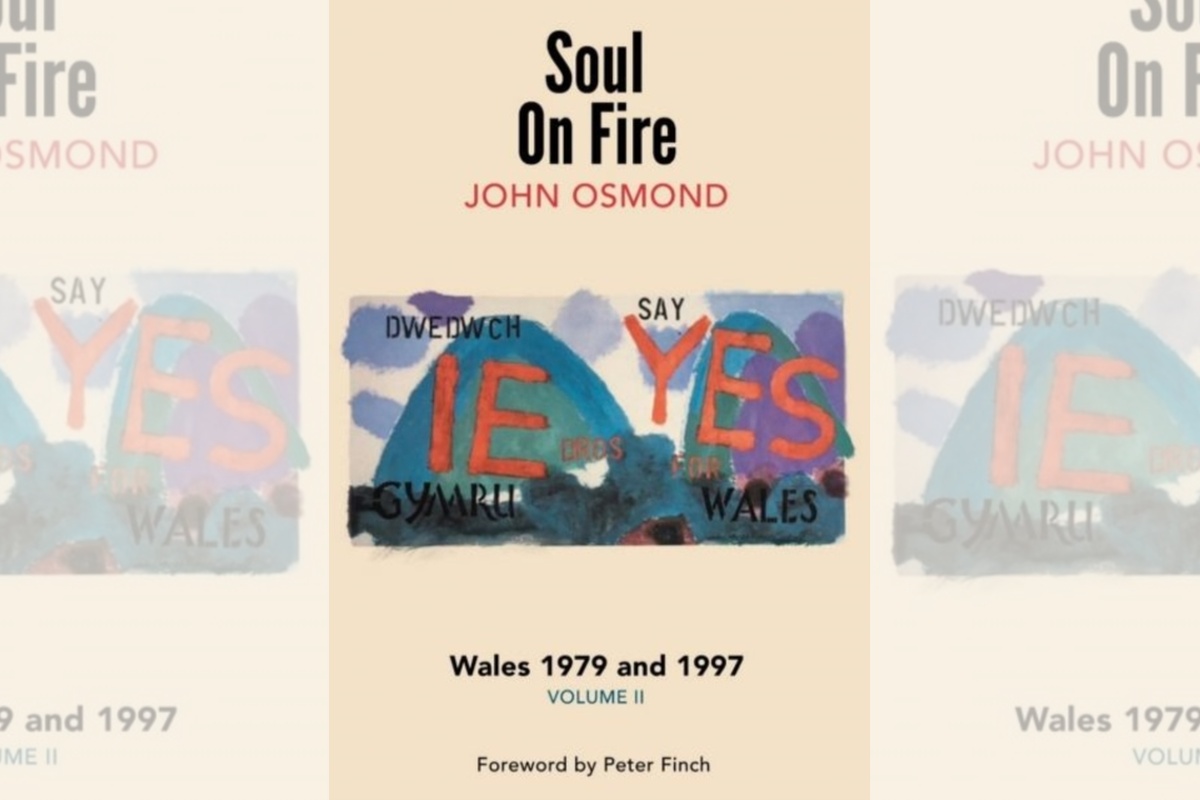
Book review: Soul on Fire – Wales 1979 and 1997, Volume II by John Osmond
Desmond Clifford
For many people, Welsh national politics began with the referendum of 1997. John Osmond reminds us of what happened before that. Devolution didn’t occur in a vacuum; it was the result of ambitions and setbacks played out over two generations.
He throws light on the great turnaround in Welsh politics, explaining why flat rejection of devolution in 1979 was converted into victory, albeit of the narrowest kind, in 1997.
“Soul on Fire” (from Idris Davies) takes the form of a “documentary novel”. This approach combines history and fiction to produce a genre with vivid narrative form. The story is told substantially through dialogue. It’s a form common in America but much less so in Britain. In Cold Blood by Truman Capote is the Shakespeare of the genre: Killers of the Flower Moon by David Grann is a more recent example. Osmond’s book is prefaced by a sparkling introduction from Peter Finch – in a way, Osmond’s literary equivalent, both Long Marchers on Wales’s journey from provincialism to nationhood.
The author is clear that the events in the book are real, but there remains a jeopardy: as readers, we can’t know with full precision what’s history and what’s fiction.
Records and interviews are used extensively, but the author freely discloses that some conversations are invented, necessarily so where no record remains.
For example, in 1980 Gwynfor Evans threatened a hunger strike in protest at the UK government’s U-turn on its manifesto pledge to create a Welsh television channel (S4C). Evans went to see Pennar Davies, a Christian minister, to discuss the moral implications of his proposed action, including the risk of inciting violence.
No record of the conversation exists, but Osmond reconstructs it from his imagination (pp. 37–40) based on his knowledge of the two men. It elucidates the moment, but is it history? Equally, fiction can be an alternative vehicle for kinds of truth not available to the historian. Look at Hilary Mantel’s wild success. There’s merit in this, and Osmond succeeds in bringing a Wales gone by back to life.
Be warned, this book weighs in at 650 pages – and this is Volume II. That’s a lot of pages, but then, Wales has a lot of history.
Osmond worked as a journalist and large sections of the book are based on transcripts of TV programmes he made. His chosen genre requires a fair amount of informative exposition from the mouths of his characters.
There are occasional passages like this: “There are three routes north once you get to mid Wales. There’s the north-east route through Newtown to Wrexham, that’s the A483. The A470 carries on through Blaenau Ffestiniog to Llandudno. Then there’s the north-west road through Porthmadog to Bangor, the A487.” It’s not wrong, but it’s not exactly zinging.
The fictional format has a basic novelistic structure. We see things through the eyes of a journalist, Owen – obviously Osmond – and another journalist/activist, Rhiannon. Rhiannon is an important reminder that there actually were women in Wales in the 1980s and 1990s in roughly equivalent numbers to men!
In fairness, Osmond covers the female experience in depth – the role of miners’ wives, Greenham Common, the women’s movement for devolution – but there’s no avoiding the extent of male domination of politics through that period. It’s only a generation ago, but it’s a reminder of how much has changed and how different politics looks today.
Owen and Rhiannon’s lives become entwined professionally, politically and – eventually – personally. It’s not quite Jane Austen. There are two sentences of romance in 650 pages: “Owen stepped across the room, stretched a hand to her waist and, leaning down, kissed her hard and long. Straightening he said, ‘I’ve been waiting all day to do that.’”
This tender interlude occurs in Machynlleth and is placed between reflections on Dr Phil Williams and Judge Dewi Watkyn Powell – a very specific style of sweet-talking.
The book picks up after the debacle of the 1979 referendum. The UK Government’s policy was ill thought out, and the Welsh public was under-prepared. The Labour Party was hopelessly divided and campaigned both for and against its own proposal. Plaid Cymru was persuaded to canvass for a feeble institution it had no real faith in. As if all that wasn’t enough, at the end of the 1970s, the whole country – Wales and Britain – was demoralised and mired in industrial strife. No one knew it at the time, but government was about to pass into Conservative hands for the next eighteen years.
So why the dramatic change between 1979 and 1997?
The miners’ strike of 1984–85 was an epic moment in Welsh history. It presaged what was once unimaginable, the end of coal mining in Wales. The strike was turbulent, divisive, violent at times, and socially catastrophic. The next two generations of Welsh politics were conditioned by it.
Working-class solidarity
Among the hard lessons of the strike was that British working-class solidarity wasn’t all it was cracked up to be. The Welsh miners remained largely solid in support of the strike (Osmond explains why Cynheidre, isolated to the west of the coalfield, had a different dynamic) and were the last to return to work largely united – while the strike in parts of England had crumbled significantly. For some, it was the end of a socialist dream. It turned out that the workers of the world weren’t quite united and, in a few years, the workers themselves were vapourised by a careless British government.
Osmond argues that the strike changed people’s thoughts about Britain and Wales. Many concluded they could no longer rely on a British government for their future and should take greater charge of their own decisions.
Other things changed. The Welsh language became less divisive. A broader political consensus of support emerged across the parties. The idea that devolution would somehow precipitate a takeover by Welsh speakers, an ancient canard dating back to the nineteenth century, began to appear preposterous. Britain’s membership of the European Union had a powerful bearing on political thinking. Increasingly, it was understood that Wales needed its own voice to win benefits from Europe and that otherwise it would be marginalised.
Exclusion
Above all, it was the exclusion of Wales from power during the eighteen Conservative years which tipped the balance. What was the point, people intuited, of always voting Labour if Labour was excluded from the UK Government? This argument tipped Ron Davies, who voted No in 1979, but who led Yes to victory in 1997. Osmond is especially interesting on Labour figures who changed, or at least modified, their views – figures like Donald Anderson and Leo Abse. The Labour Party struggled – and struggles still – to find consensus on what devolution should precisely mean, but it became widely recognised that the UK as a monolith no longer worked for Wales.
I doubt “Soul on Fire” is one for the holiday beaches. It will be appreciated best if you’re interested in devolution and how Wales got to where we are today. There’s no better guide than John Osmond since he’s been at the centre of every important campaign linked to devolution these last fifty years.
Telling history through fiction has some pitfalls. The text is clunky in parts; there’s a lot of narrative and exposition shoehorned into supposedly natural dialogues. On the other hand, anyone who knows John Osmond will note that he does in fact speak in whole sentences and paragraphs. It’s an absorbing book, not at all difficult to read, and its episodic nature allows readers to focus carefully on passages of particular interest while skipping more quickly through other parts – without losing sight of the whole.
The book closes on the run-in to devolution. Following John Smith’s death in 1994, Ron Davies stood firm to demand the strongest form of devolution he could deliver. It wasn’t straightforward. Tony Blair was lukewarm at best and appointed figures like Jack Straw and Kim Howells to try and hold devolution in check.
Flawed
As a result, the devolution delivered by Labour in 1999 was ambiguous and flawed. Some ambiguity was corrected by a further referendum in 2011, but the conflict exposed in Labour’s ranks has never been resolved and haunts them still. The Welsh public, meanwhile, has moved on.
John Osmond may feel he has had enough, but if he has further appetite, there’s plenty more material from 1999 onwards. Some of us feel a debt of gratitude. Far too little is written about devolution and Welsh politics generally. John Osmond has almost certainly written more words on the topic than anyone else and his contribution helped a nation take its politics seriously. This volume tells a substantial part of the national story.
Support our Nation today
For the price of a cup of coffee a month you can help us create an independent, not-for-profit, national news service for the people of Wales, by the people of Wales.
Get more trusted Welsh news
Choose Nation.Cymru as a preferred source in Google News to see more of our journalism.


