


Book Review: Storm by Alex Hubbard
Niall Griffiths
Ah, Aberystwyth. Born on a perilous rock. Liminal, between mountains and sea. Next parish, New York (if you circumvent Ireland). Inland, the green desert of the Cambrians (in Harri Webb’s phrase). Town and gown. One huge pub with lots of corridors, to paraphrase Richard Burton. End of the trainline. Come for a day and you’ll never leave. UNESCO City of Literature, and intriguing literature it is, for such a small place: Saunders Lewis, Caradoc Evans, Caryl Lewis, Malcolm Pryce, Carson’s Stripping Penguins Bare, and the semi-literate gobshite whose name escapes me that wrote Grits and Stump and Broken Ghost.
And now here’s Alex Hubbard; a blow-in (in the northern Irish parlance) from London, dyspraxic, ‘passionate about stories, words and thinking about things which aren’t real’, and evidently enamoured of the town, ensnared and ensorcelled, like so many before and to be.
He gets the place, for sure, and is concerned that we do, too – he endearingly wants to share his delight with us, wants us also to feel the glee of discovery, so we get histories of temperance, port, centre of language activism, battlefield and, most pertinently, student town.
We’re thrown into the place as it is battered by storm: ‘The wind blows against her [,] pushes down on her like something from the great up above’. You can feel the wailing and the drench; this is strong writing. The starlings, Yoko’s, the mad and untameable sea. This is Aber alive. You can feel this.
The ‘her’ is Josephine, a student from London, laden with the baggage of bereavement; the awful death of her mother will recur and haunt the narrative (as it also will the reader): ‘the white bone and the rotting skin. . . the awful shriek’. She is making a life, or at least a chapter of one, in Aberystwyth; we see her doing this through her own perceptive observation and through the lens of an omnipresent, knowing, self-aware narrator, who frequently breaks the fourth wall to directly address the reader.
We are bounced between registers and time-frames and put into orbit around a small group of students; their interactions, their clashes and connections, the muddled stuff of their lives. There is no plot, really, in the sense of cohesive narrative structure, but the dialogue, the characterisation, the pacing, are all propulsion, are all grip.
The storm isolates the place still further – ‘there seems the town, the hills, and then nothing. No one has managed to leave. . . since the storm came in. The railway tracks are flooded and the. . . buses have all broken down.. . . [W]alkers who attempt to stray further than Tan-y-Bwlch find themselves strangely pulled back as though the town is some great black hole on the edge of the west’. Having lived in Aberystwyth for over a quarter of a century, I know this feeling.
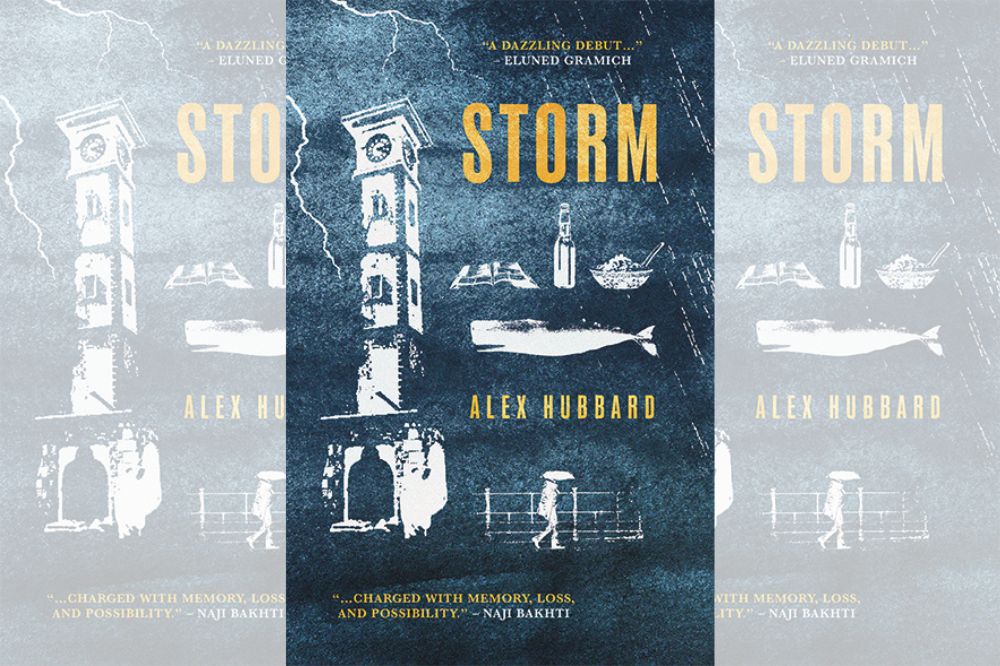
The tempest cracks a continuum and the book takes a magical realist swerve and history irrupts; peculiar characters appear in the town, including a fire-and-brimstone preacher (who gathers a kind of cult around him) and a woman with white teeth to whom, she declares ‘people usually bow’. A sperm whale is washed up on the beach, slipping between life and death (tangential declaration: I’ve been working on a novel that has as its core a beached sperm whale for a couple of years. Any similarities between that and Storm will be purely coincidental, honest). It all goes a bit Murakami: ‘history is shifting and shaking, and it is made from water. It is speaking from the walls.. . It is persuading people that things should not be as they are. . . The town begins to go mad’. Owain Glyndwr appears, toting a machine gun. A troop of WW1 soldiers materialise, as do pirates. The elephants that feature in the famous photograph take on flesh. The character Glynn inhabits a horse trapped in a trench and, I have to confess that, for me, it all gets a bit daft.
It’s highly subjective, of course, and profoundly personal, and if you’re the kind of reader who likes this sort of thing you’ll lap this book up (and more power to you if you do, I hope you enjoy), but for me, this type of hard magic realism doesn’t work; far from augmenting the world and adding to its mystery it rather suggests that those marvels are not enough, and that they fall short, somehow. The old Jewish proverb that ‘every day we walk sightless amongst miracles’ is shredded here.
I’d been enjoying the visit to student-land; enjoying the intrigue and interaction, and been impressed by the writing – the depiction of the ketamine trip is very well done, and the character of Robbie is completely convincing in his teeth-clenching arseholery, and Josephine was alluring and immersive – but the oneiric climax completely lost me.
More: I felt that the emotional investment I’d put into the book’s first half had been misplaced, even squandered. The world teems with mystery and magic and occult fascinations (which Hubbard is initially alert to, here) and this kind of fairy tale/fantasy stuff seems to implicitly refute that, despairingly so. I see no point to it. It’s facile. But, well, as I say, it’s personal, and if this is Your Thing, then you’ll find much of that thing here. It’ll satisfy. Me, well, I very much enjoyed being back in Aberystwyth, for around 150 pages.
Storm by Alex Hubbard is published by Seren and is available to purchase now.
Support our Nation today
For the price of a cup of coffee a month you can help us create an independent, not-for-profit, national news service for the people of Wales, by the people of Wales.


