

Book review: Take Three Canadians
Nigel Jarrett
One Canadian writer coming to live and work in Wales is interesting; two is a coincidence; there may be a description for three but it would be insufficient to suggest that it marked the start of a Canado-Welsh literary movement, especially when the extant writing is about Canada. The title Take Three Canadians could beg the addendum ‘as an example of what?’ or be as good a label as any other for gathering together a trio of writers with little in common except their country of origin, their place of transferred domicile, and their Welsh publisher.
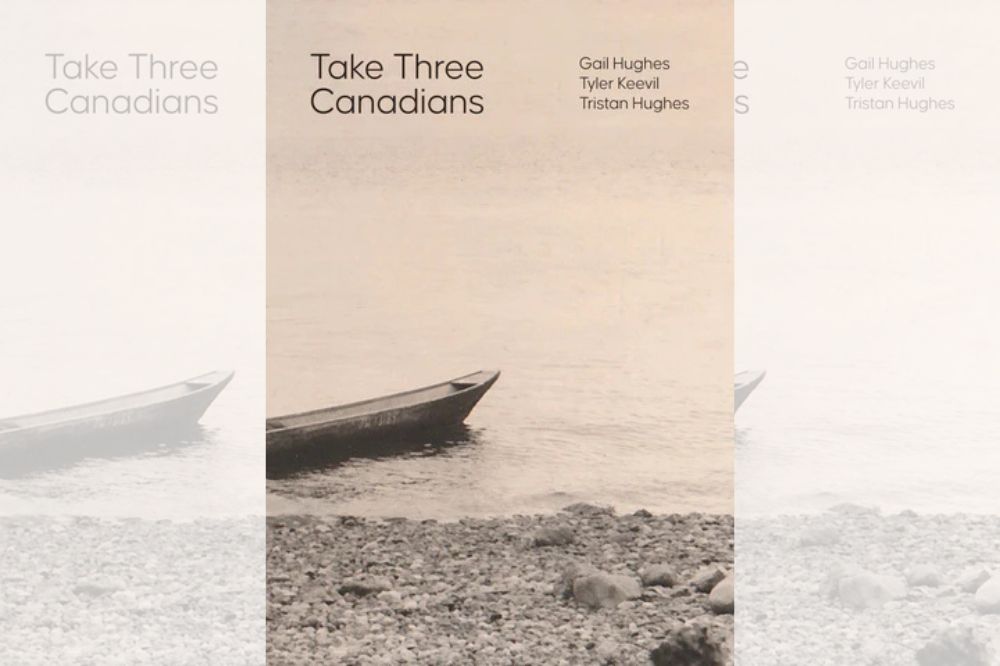
The writers are Tristan Hughes, Gail Hughes and Tyler Keevil, and the publisher is Parthian. The book is a slim hardback of stories – two by Gail Hughes, who died in 2001, and one each by Hughes and Keevil – with art work by Catrin Menai and photographic illustrations. Menai is Gail Hughes’s daughter. Maybe the Welsh connection reduces to novelty (coincidence as mere starting-point), in which case Take Three Canadians must be prepared to expect a weightier critical burden, if only on the basis of its brevity.
Such poundage is invited from the start, with a foreword by Christina E. Kramer, Professor Emerita of Slavic and Balkan Languages at the University of Toronto. Also a canoeist, the qualification that gives her authority, she reminds us that the locale for all four stories is the ‘vast, lonely and forbidding’ Canadian north. Most Canadians eschew the wheat belt for the populous urban one strung along the country’s southern border, which – though Kramer doesn’t say it – is probably just as capable as the northern flatlands and Rockies of inspiring some singular form of experience. The north of Canada is where humans ‘toil, eking out marriages, relationships, a living.’ It’s what the characters in these stories mostly do, having mustered all they can in the way of accommodation.
Immensity
Up Here by Tristan Hughes describes a Canadian wilderness – a national ‘park’ as big as a country – where individuals and events are swallowed up in an immensity. It also describes a place that permits or expects human acts to take place that wouldn’t elsewhere. The narrator has drunkenly agreed to shoot his lover’s old and ailing dog with her equally drunken connivance. It’s an act of commitment for him to a relationship that in the end seems to have been overtaken by time or seemingly limitless topography. It’s where place, as well as intoxication, allows an individual to end the life of a decrepit pet (though one doesn’t have to live in an ocean of land to find the means of blowing a dog’s brains out other than taking it to the vet).
In the end, the act, the relationship and the despatched hound have vanished; in the end, it’s the fulfilment of the act of love that remains, despite the meagre evidence that it existed. What occurred was an act that might not have been the sort of commitment one would or could have expressed in another place. Unless you farmed a Welsh hillside, for example.
In Gail Hughes’s Flamingos, young Ellie’s family, the Mayhews, have pitched up in the Canadian prairie wheat belt, renting a place on a farm owned by Sam Hercules, whose name connotes a huge physical presence and a threat, like the land itself. We don’t know why the move has been made: Ellie’s father has come to teach in the local school but her mother is vulnerable to the advances of their menacing landlord. Ellie senses all this and retains an image of flamingos she saw at Calgary Zoo but now transposes to the idyllic corners of her vast new environment, whose raw and unforgiving features are softened by the distaff names given to the towns: Nancy, Elsie, Caroline (created by male pioneers in remembrance of loves left behind, according to the mother). Ellie has not yet succumbed to the perils of place.
In both stories, there’s an unspoken sense of the landscape having exerted its own pull on individuals for whom, paradoxically, it proves hostile, even comminatory. Hughes’s narrator seems to have succeeded in overcoming a natural reluctance in love and the proving of love, and there’s a strong sense in which five-year-old Ellie’s lease on paradise will not be eternal, given the Herculean shadow thrown early and destructively. But it lasts a while longer.
Downpour
In The Dinosaur, The Mayhews – embittered father, long-suffering mother, innocent Ellie – have moved to more rented accommodation: a house that no-one else wanted, with ‘a no man’s land of boardwalk and a rickety length of railing to delineate house from prairie.’ It’s just a different place in the wild, where spring rain uncovers a dinosaur skeleton, only for it to be lost to memory by a more insistent downpour, when ‘the clouds emptied their cargo’. Ellie’s disappointment turns to salvation in a dream, her source of happiness among the mud and the ’emerald carpets’ of wheat.
Keevil’s story, Sealskin, is the longest and, because of that, it creates an imbalance. Where the others are short, lean and suggestive, Sealskin is overloaded with narrative description and – in a story about fishing and fish-processing – marine and dockside arcana: ‘Beside the crane was a wheeled cart onto which he lowered the skip. Detaching the lifting chains from the hook, he left it hanging there as he pushed the cart towards the dumpsters at far end of the plant.’
Unlike the others, too, the desolate landscape is attraction and escape. Beyond the dock and its breakwater, it’s where Liam, a non-union outsider, lives and wants to be, instead of at the mercy of co-worker Rick, an officious racist bully who eventually beats him up. His only relief is feeding a seal, which Rick and a friend kill and skin. Liam sails his tug into the sunset, as it were towards the blue Canadian yonder, wearing the skin like a cape. (It might be pedantic to mention, but on page 28, in a reference to the drinking of morning coffee, Keevil writes: ‘Liam had stopped partaking in that ritual.’ Partaking, participating – surely it still matters.)
Panorama and perspective
As with Hardy’s Egdon Heath, panorama and perspective are the silent players in the drama of these stories; they are the big backgrounds subsuming the small scuttlings of a few men and women. The three writers featured magnify and illuminate the humanity with short-form skill and existential focus reasonably well. But since the Welsh dimension is only nominal, why are there only three writers and fewer than 67 pages of words?
Take Three Canadians resembles a sampler of something bigger, a conspectus of Canadian writing, say, that a Welsh publisher could not countenance without wider subvention, excusing itself on the grounds that there are no more Canadian writers living in Wales to call upon. Since we already know the three who do or did, as well as what they’ve written, what was the point of the exercise? Is there more to come? Do three Canadians writing in Wales a tradition make?
Gail Hughes’s biographical note acknowledges the influence of ‘Alice Monroe’, a misspelt ‘Alice Munro’. Having dismissed the possibility of a homophone, no reviewer could ignore it, on grounds of otherwise being taken to task by readers. The testimonial to Canada’s greatest story writer in a book celebrating Canadian short stories is not so much a howler as a thousand-decibel clanger. I’m told it will be corrected for the paperback edition. Also The Dinosaur appears on the dust jacket as Dinosaur and Sealskin as Seal-Skin.
Take Three Canadians is published by Parthian and is available online and in selected bookstores now.
Nigel Jarrett is a regular contributor to Nation.Cymru. A winner of the Rhys Davies Award for short fiction and the Templar Shorts Award, he’s the author of nine books. His Selected Essays: Never Lost for Words, is due this year from Cockatrice Books.
Support our Nation today
For the price of a cup of coffee a month you can help us create an independent, not-for-profit, national news service for the people of Wales, by the people of Wales.



Could Gail Hughes be referencing Alice Monroe, the paranormal guide and ex food taster to Celine Dion, rather than the noble prize winning Canadian writer Alice Munro ? Just a thought. Note: to Parthian Copy Ed.
Hello, Robert. My instinct is to doubt it!