

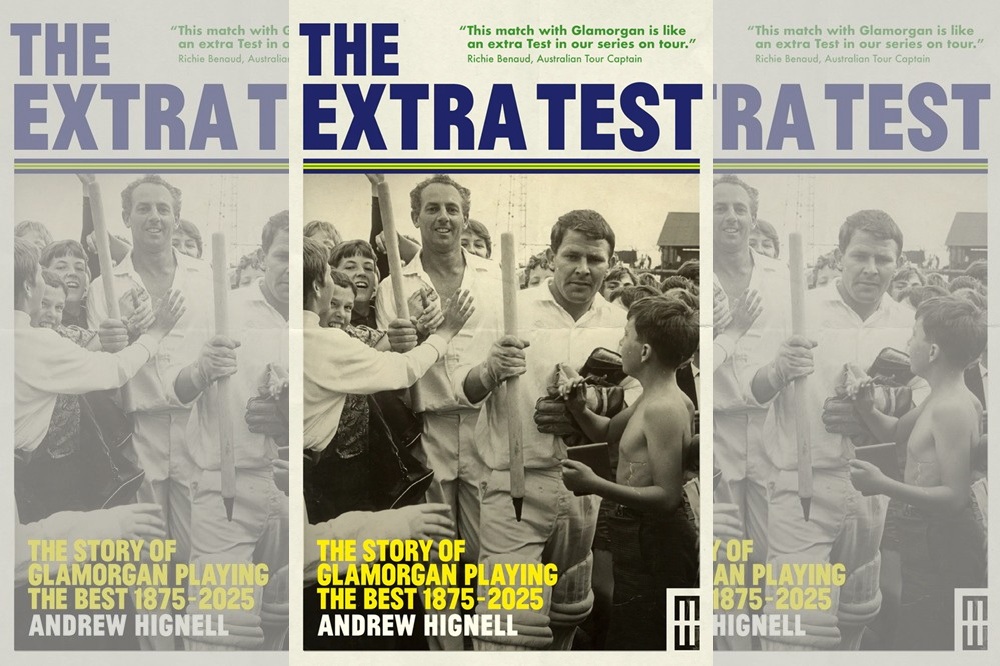
Book review: The Extra Test: the story of Glamorgan playing the best 1875-2025 by Andrew Hignell
Desmond Clifford
A history of Glamorgan Cricket will appeal unconditionally to fans, but the club’s story has wider resonance. The connection between sport and the developing sense of Welsh nationhood is very marked.
Glamorgan County Cricket Club was founded in 1875, the Football Association of Wales in 1876, and the Welsh Rugby Union in 1886.
Elsewhere in the forest, the Cymru Fydd society – a kind of proto-devolution movement – was established in 1886 and briefly aimed to restructure Welsh politics along national lines.
Cymru Fydd fizzled out and it was a hundred years before Wales was again willing seriously to engage debate about political autonomy. But the concept of Wales the nation, as opposed to an uncertain territorial adjunct to England, has roots in this period.
Wales’ sporting identity went from strength to strength, even where on-field performances waxed and waned, and played a huge part in developing and reflecting Welsh identity as something distinct and meaningful.
“The Extra Test” tells Glamorgan’s story through the international teams it played against.
For a long time, the concept of Glamorgan, as a proxy for Wales, playing an “extra test” against touring international sides, was a major element of cricket in Wales.
Without it, the professional game would probably never have taken root. Initially it was Australia, New Zealand and South Africa and latterly they were joined by India, Pakistan and the West Indies.
Matches moved around across South Wales locations, but St Helens in Swansea was a favourite destination, drawing large crowds and a distinctly Welsh atmosphere.
The author Andrew Hignell has excellent credentials. He has been the scorer at Glamorgan for more than twenty years and, in addition, manages the Museum of Welsh Cricket at Sophia Gardens in Cardiff.
The book is generously illustrated with photographs. My personal favourite is a parking pass from 1926 reproduced here, allowing reserved parking off the Mumbles Rd for punters attending either of the “Welsh Eisteddfod and Cricket Match, Swansea”. Charming.
I was also attracted by a flier from 1930 advertising an Australia match, “Great Holiday Attractions For South Wales: Bradman Definitely to Play.”
I was struck by a photo portrait of Maurice Turnbull, in uniform. He was killed in action at the invasion of Normandy in 1944. Turnbull was an outstanding batsman and captain; he is the only man in history to have played rugby for Wales and cricket for England.
Another photo portrait records Wilf Wooller, one of the giants of Glamorgan’s history. Wooller survived incarceration in a Japanese prisoner-of-war camp and, in true Boys Own fashion, played cricket for Glamorgan, rugby for Cardiff and even football for Cardiff City. He missed out on England cricket selection on several occasions due to business commitments.
Mark Drakeford
Essays by Alan Wilkins and Mark Drakeford complement the main text. Alan Wilkins grew up in the game through his father who was a former player and senior office holder at Glamorgan.
Wilkins describes how he made his unexpected debut at Sophia Gardens in 1971 while still a schoolboy at Whitchurch High School. He had caught the bus in from Radyr to watch a touring Indian side play Glamorgan.
He was sat in the pavilion, minding his business, when Wilf Wooller himself stood over him and told him to find some kit and prepare for the field – amazing! Wilkens went on to have a highly successful career with Glamorgan and, subsequently, a distinguished broadcasting career in Britain and around the world.
Mark Drakeford has been a lifelong cricket fan. He joined Glamorgan County Cricket Club in 1970 and it’s the only organisation he’s belonged to longer than the Labour Party.
I was Mark’s senior civil servant throughout his time as First Minister. I was witness to his exceptional diligence; he was devoted to his files well into the evening.
The only time he ever sloped off remotely “early” was on long summer evenings to catch the last hour or 40 minutes of play at Sophia Gardens on the way home.
Mark’s engaging essay makes two important points. The first is that cricket is not a passive spectator sport. The ebbs and flows of the four-day game makes “the tragic cricket watcher” a connoisseur, a choral participant in an unscripted and unfolding drama.
The second point is personified in his memory of his great friend, Rhodri Morgan, walking around the Eisteddfod Maes listening to a Glamorgan match on a transistor radio, “a conjunction of sporting achievement and national identity which sums up the experience of being a follower of Glamorgan.”
Wales-wide
“The Extra Test” conveys the sense in which Glamorgan has always been something of a Wales-wide institution and not simply a county designation.
The club has been kept afloat financially by a combination of fans-through-the-turnstiles and outside revenue sources – industrial benefactors in the early days, then television and commercial sponsorship, and today a complex mix of all those source plus corporate and governmental investment.
It’s a precarious balance, always has been and always will be.
For example, a game against the Australian tourists at Cardiff Arms Park in 1905 raised £1,114, a full three quarters of Glamorgan’s revenue for the year.
Essentially, the “extra test” subsidised the first class county game for years. (Incidentally, 1905 was the first time Hen Wlad Fy Nhadau was sung as an anthem at a rugby match, Wales against New Zealand at the Arms Park – what a thrilling time to be a sports fan in Wales!).
Cricket fans are renowned for strong views and debate about different forms of the game rages with the intensity of medieval theology.
Test cricket now features on the Cardiff calendar and The Hundred has introduced a thoroughly contemporary and fast form of the sport. Inevitably this has presented some challenges and compromises.
The debate on cricketing purity – is there actually such a thing? – will continue alongside the perennial financial challenges for as long as the professional sport is played.
Household names
As happens with most profile sports, a few players burst through the cricket boundary to become household names and part of the national furniture. I’ve mentioned a couple already but you might easily add Ossie Wheatly, Peter Walker, Tony Lewis, Malcolm Nash, Eifion Jones, Robert Croft, Matthew Maynard and Hugh Morris.
Many years ago, as a rookie reporter, I was sent to Sophia Gardens to cover the first day of the cricket season – an “atmosphere” piece rather than a match report (reporters who knew what they were doing covered that).
I was trying to find my way from behind some terraced seats when I saw the slow, swaggering walk of a man straight from the pages of The Iliad coming towards me. It was Viv Richards, in his pomp. I was awestruck; it was like bumping into Achilles in your back garden.
Cricket has changed over the years and Glamorgan with it. A permanent home for the club was created at Sophia Gardens from the 1960s onwards as the Arms Park developed into the definitive home of rugby.
Changes in logistics and corporate expectations led to centralising play in Cardiff and winding down the peripatetic traditions of Swansea, Pontypridd and elsewhere.
The decline of the regional spread is a pity but, in compensation, Glamorgan began hosting one-day internationals from the 1970s onwards and achieved the dream of hosting its first text match, against Australia, in 2009.
This realised £6 million of revenue for Glamorgan, the equivalent of two years normal revenue, and an estimated £20 million for the wider economy.
Corporate influence
As well as growing corporate influence, both Cardiff City Council and the Welsh Government now recognise the contribution of sport to the national economy and personality and have invested accordingly as part of their economic strategies.
After London and Manchester, Cardiff is among the UK’s leading sports destinations. In an exceptional year the spectator can see first class cricket, rugby, football, boxing and a host of other events. Few other UK cities come close.
Cricket fans will need little encouragement to read this book rich, as it is, in the sort of detail beloved by serious followers of the sport.
There’s a broader potential readership among those less single-minded about cricket but who want to understand better the social and cultural history of modern Wales.
It should come as no surprise that political devolution and the rising sense of firmer Welsh identity which characterises Wales today has roots and comes from somewhere.
The development of Glamorgan Cricket is part of that story.
The Extra Test is published by Parthian and can be purchased here and at all good bookshops
Support our Nation today
For the price of a cup of coffee a month you can help us create an independent, not-for-profit, national news service for the people of Wales, by the people of Wales.


