


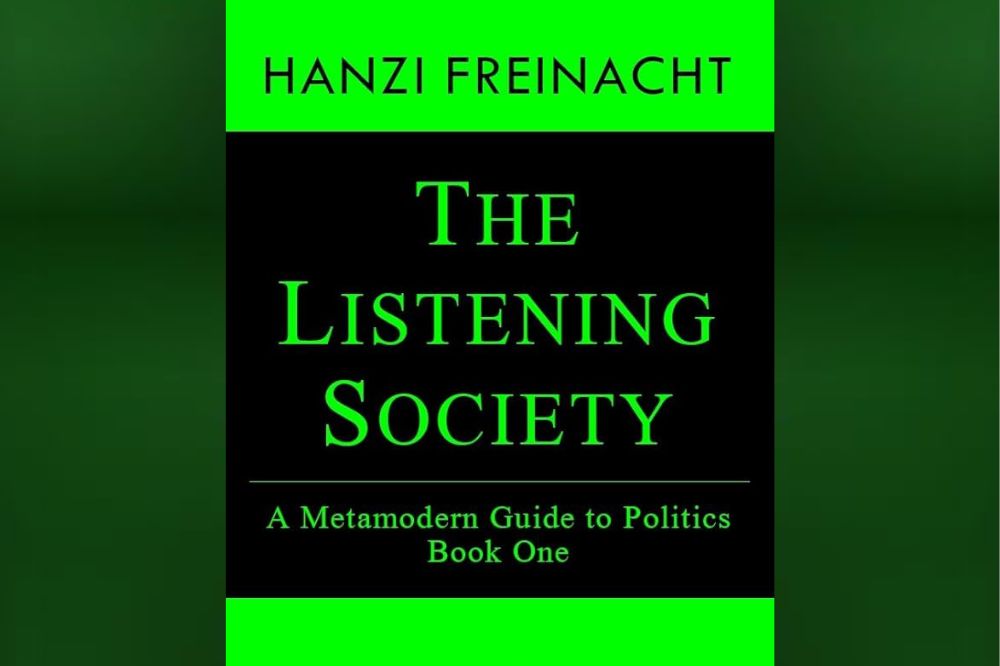
Book review: ‘The Listening Society’ by Hanzi Freinacht
Aran Jones, Author SaySomethingIn
You’re not likely to see ‘The Listening Society’ on the shelves of a bookshop near you.
Distributors and publishers aren’t all that fond of books which explicitly map out how to organise and run a revolution.
They shouldn’t really be that nervous, though.
What Hanzi proposes is a very different kind of revolution, and it’s probably already inevitable (and extremely difficult to stop by falsely accusing him of terrorism).
Hanzi (if he actually exists, and isn’t just an amalgamation of several different people) starts in an unusual way. He’s keen to try and understand what makes people tick, and he looks at a wide range of developmental theories, before rejecting them as incomplete.
I should mention at this point that there is a fair chance you will find Hanzi a bit like Marmite. He will either make you laugh frequently, or he’ll get under your skin and irritate the hell out of you. This is deliberate – he wants to be talking to metamodernists, and he thinks that if he can get under your skin, you’re not really a metamodernist.
Hanzi’s own proposed developmental theory is based on two axes – as in, plural of axis, not as in things to chop down trees with! The first is the individual’s capacity for complex thought – the second is the individual’s capacity for higher states of being.
It’s in our hands
Complex thought – whether or not we feel capable of it ourselves – is a familiar idea. It’s somewhere we often go wrong as a society, falling into hero worship of people we believe are incredibly clever (perhaps until we hear them talk on the social media site they bought in order to silence dissent).
States of being, however – that’s a lot less familiar, and for many of us it will set off a woo-woo alert.
It’s very straightforward, though.
It’s really just about how we feel.
If we frequently feel despair, shame, self-hatred, misery – that’s right down at the bottom of the states of being axis.
If we regularly feel joy, love, connection, bliss – that’s right up at the top.
Perhaps the most important point that Hanzi makes in this discussion is that just as we can increase our capacity for complex thought by educating ourselves, we can also increase our capacity for higher states of being.
We can practise being happier, and the more we do, the happier we get. There’s nothing secret or mysterious about this – Hanzi references a lot of the major wisdom traditions to show how it’s possible to learn to practise these skills.
Testing time
The top right quadrant is where Hanzi’s interest are. People capable of complex thought, who as a result of practice spend a lot of their time in states of happiness, playfulness, love and joy. Or what he calls metamodernists.
They don’t sound like the vanguard of a revolution, do they?
They sound more like scientists crossed with hippies.
That’s about as far as ‘The Listening Society’ goes.
It turns out that the entire book has been a test. Hanzi really, really only wants to be talking to metamodernists, so he spends the whole of ‘The Listening Society’ trying to put you off reading any further. He engages in what looks a lot like postmodern playfulness, but he suggests that the difference with metamodernism is that you are being playful because it is the only way to win, and you are passionately committed to winning. You put yourself down before anyone else can, not to be humble but to become bullet-proof.
If you pass the test, you move on to his next book, ‘Nordic Ideology’.
It’s much less playful.
It’s about getting down to business.
A better way
Hanzi proposes that if you can collect enough metamodernists together, you can start to build an entirely new approach to politics. An approach that moves beyond personal attacks and lies and the hunger for power, and bases itself instead on communication and cooperation and testing new ideas.
Hanzi isn’t misty-eyed about this possibility. He’s got on the ground experience of parties that are beginning to operate within more metamodern patterns, like the Pirate Party in Sweden.
In fact, Hanzi says bluntly that all the existing parties will absolutely hate a new metamodernist party.
But, crucially, they will all hate the metamodernist party a little bit less than their traditional opponents. Tories will hate metamodernists, but find slightly more common ground with them than with Labour. Labour will hate metamodernists, but not as much as they hate the Tories. The Greens will think metamodernists don’t understand their urgency, but they’ll see that they have more in common with them than anyone else.
As a result of this, Hanzi claims, a metamodernist party – even without many seats – will be able to achieve a soft but important political power by operating as a neutral zone where actual discussions can happen.
When those discussions lead to improved results, the metamodern party will gain more seats, and with its unusual ability to speak to the voters of all the other parties, that process will be difficult to reverse.
It’s a fascinating idea.
It sounds to me like genuinely grown-up politics. But grown-up politics with a capacity to reimagine how we do things, and to aim higher for everyone.
I absolutely can’t wait for the first metamodern party in Wales.
Support our Nation today
For the price of a cup of coffee a month you can help us create an independent, not-for-profit, national news service for the people of Wales, by the people of Wales.


