


Book Review: Truth Like Water by Carys Shannon
Niall Griffiths
It’s an alluring, liminal place, the estuarine, an elemental slippage in that it’s neither fully land nor water, a place of reliability and steadiness with the mappable pattern of the tides yet also with an unpredictable quality; what might those tides bring from the wider sea beyond? And what might it take of yourself out into those greater waters? It’s a place that invites a wish, a dream, a longing, whilst also seeming to, however spuriously and fleetingly, satisfy that longing. It’s a place for secrets.
So Catrin has returned to the place of her upbringing, on some Welsh delta (the afterword tells us that it’s on the north of the Gower peninsular, although it remains unnamed in the text). It is also the scene of her mother’s death some years ago, in somewhat mysterious circumstances – this we discover in an arresting opening as Catrin recalls the sight of her mother’s body: ‘she looked mythical, lying like a mermaid in the shallow estuary water; her skin the lightest shade of blue, an ebbing tide pulling at her dark curls making them stream out like black algae’ (surely the echo of MIllais’s Ophelia is intentional here).
The year is 1992. Catrin’s familial history is murky: ‘My mother made an enemy of my father, the farm, of everything else about this place that she claimed was keeping us stuck’, and, a little later: ‘My father has never spoken about where he went the day after my mother died. And no one will tell me why she didn’t notice the rushing water or didn’t care’. Mysterious. Catrin is an artist, her mother was a photographer. There is a missing girl, Emily. There is a history of cockling, a dead industry now, to this clasped and huddled community which, as will be slowly revealed, is a petri dish for secrets and shames (or what should be shames) and rattling skeletons.
Dai, who runs the stud farm, wants Catrin’s dad’s land. He and his alcoholic wife, Bev, have lost a son, Rhys, who, despite being an adroit rider, was thrown by a horse called Charlie. Catrin’s close canine buddy, Swift, was given to her by Dai. On a walk with Swift, Catrin finds a pink jumper on the marsh; she reports this to WPC Quinn, who was an investigating officer at Catrin’s mother’s demise. Threads start to unspool. Catrin saw Emily talking to Mr Thomas, an ex-English teacher at the village school:who, like her, has returned: ‘I never gave him a second thought until he turned up here on our estuary, a strangely broken version of the man who’d proclaimed sonnets so passionately’ (Mr Thomas will, spoiler alert, become the target of vigilantism, inaccurately so). Emily’s brother, Robby, appears, as does her mother, Lorna, who dabbles with the occult.
There is the gossipy, nosey shopkeeper. There is a creepy, cringy bus driver. There is a web of interconnectedness and a mausoleum of interred secrecies and shenanigans ensue, the common denominator of which is the usage of women, by men, in their myriad psychodramas, their gulping needs to mask or exorcise in some ways their own inadequacies. So it always goes. And behind it all pulses the sea-marsh, ‘the undertow that you can’t see, pulling and shaping the mud. Sucking the twigs and branches down, turning them over then throwing them up in another place’. Calamities are visited upon human lives time and time over even as ‘the water [returns] to its cold, glass-like form, hiding everything that lies underneath’.
There is an appreciable occasional lyricism and the characterisation is largely convincing but the problem, for me, is that the novel’s texture – its fathom – is at permanent high-tide, flood alert; there is too much somewhat clumsy exposition, too many revelations, too many lies to be uncovered, too much weather, too much running, too much staring pensively at the sea (and that bloody pink jumper!), a glut of everything so that the sustain of the elegiac tone, usually grounds for praise, becomes, here, exasperatingly unrelieved; the book is entirely devoid of humour (dark or otherwise), or any sense of absurdity (in whatever shade) or, indeed, observational and descriptive quirk. What has happened to Emily, when revealed, comes as not so much a shock as a mild surprise, like finding out you’re wearing odd socks when you cross your legs in the doctor’s waiting room.
There are moments when Catrin’s internal weathers and those of the estuary elide that hint at the more compelling novel that lies within the one we have; take this passage, from the denouement: ‘I expect to feel a hardness in me, the way I think of this place as belonging only to my mother and I – to our memory. But instead, there is something as soft as moss that wants to spill out into the world. Where I had built tight walls, I want to let that tide drag them all away and leave me glistening, washed clean of grief and other people’s stories’. What beautiful and magnetic words with which to open a novel, not close one. Ah well.
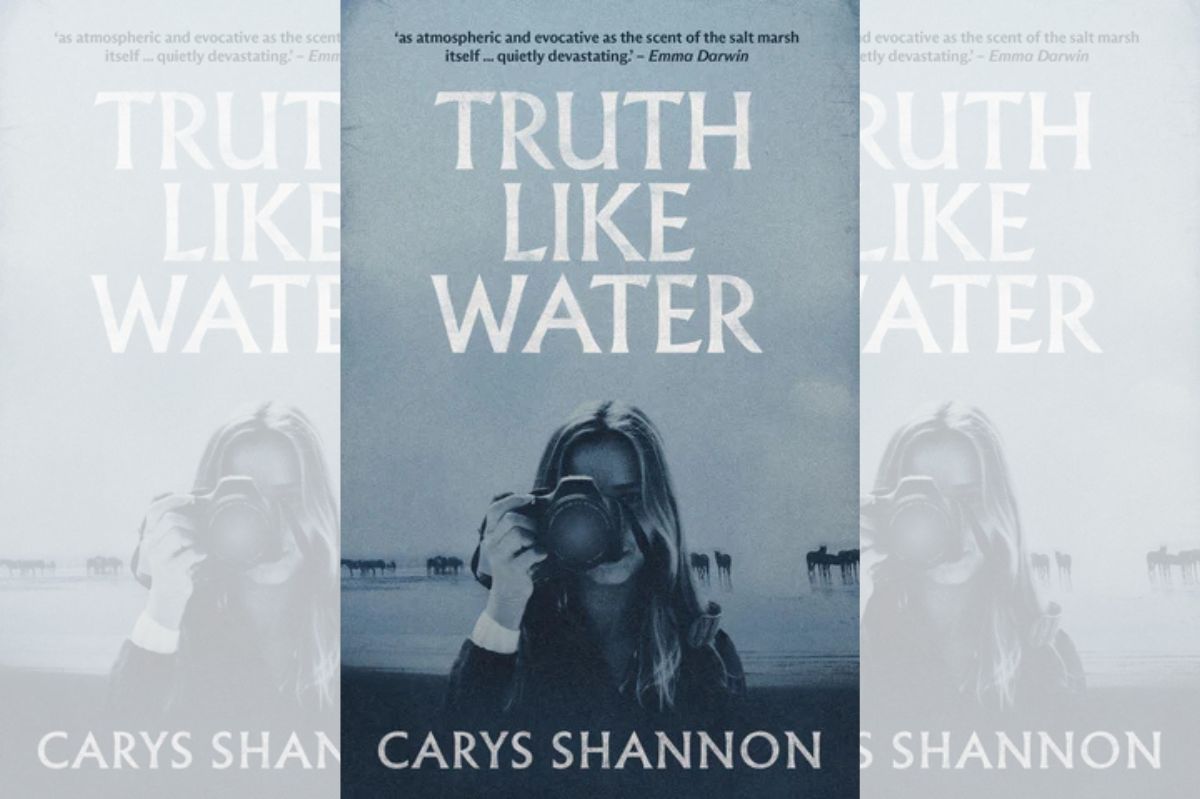
Truth Like Water by Carys Shannon is published by Parthian and is available to purchase now.
Support our Nation today
For the price of a cup of coffee a month you can help us create an independent, not-for-profit, national news service for the people of Wales, by the people of Wales.
Get more trusted Welsh news
Choose Nation.Cymru as a preferred source in Google News to see more of our journalism.


