


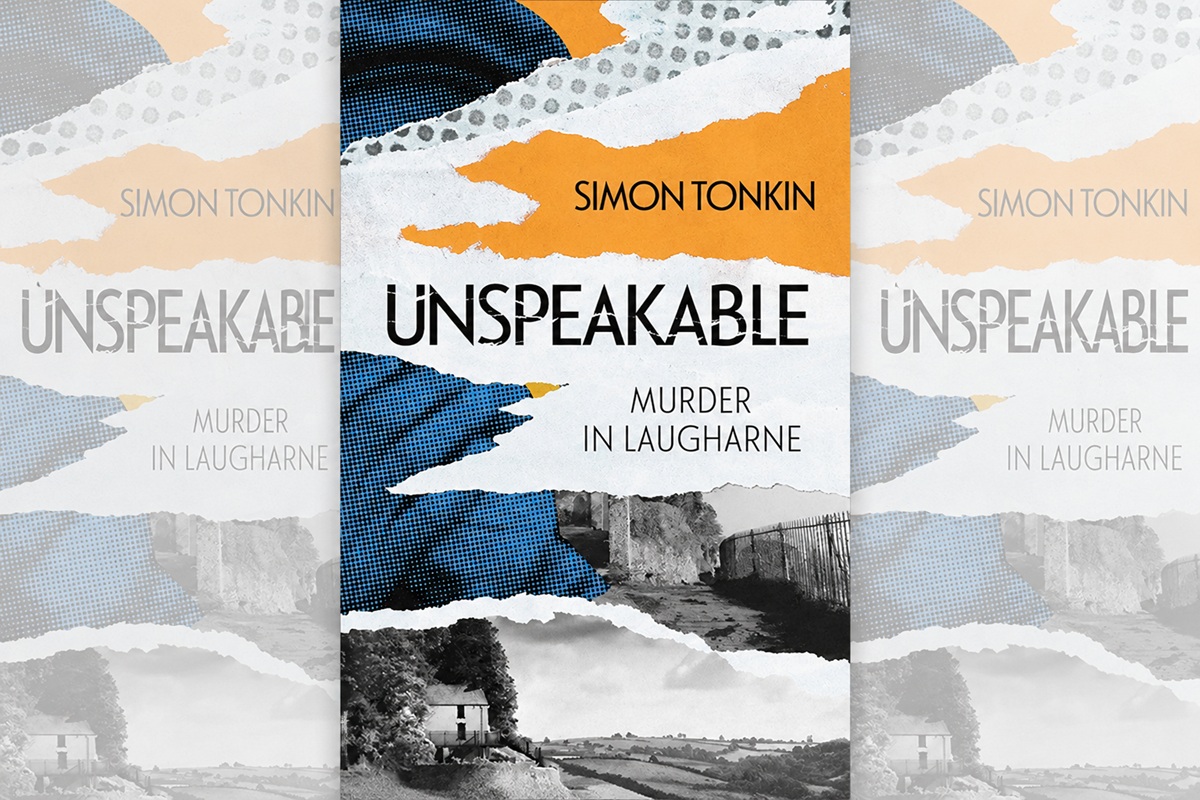
Book review: Unspeakable: Murder in Laugharne by Simon Tonkin
Desmond Clifford
True crime has been a reliable staple of publishing for 150 years or so. While it never really goes out of fashion, the genre in recent times seems to have become especially ubiquitous.
It’s on television practically every night, a flood of podcasts and a never-ending flow of books. True crime is the nearest thing to reliable in the publishing industry.
Unspeakable: Murder in Laugharne records a celebrated murder in 1953, widely reported at the time and since.
The victim was a defenceless elderly lady, 77-year-old Lizzie Thomas. She was attacked in her own home, seemingly with a piece of wood found in the house. She died the next day.
Lizzie lived alone but had nephews close by and was a popular contributing part of the community. She had money in the house, but it was left untouched and seems not to have been a motive. In fact, no motive for the killing was ever established.
An early arrest was made, of George Roberts, a local man who was frequently seen in the vicinity; he lived nearby at the ferry house. Roberts was deaf, couldn’t speak and illiterate.
He lived with relatives and made a basic living through performing odd labouring jobs for a range of neighbours and locals, including for the area’s most famous residents, the Dylan Thomas family.
Roberts lived a simple, basic life. He drank little and had no apparent interest in money or material possessions. He was generally accepted and trusted in the community, though some had doubts about him.
As was common in those days, an investigator was called in from Scotland Yard; “regional” forces saw few murders and were judged inexpert at investigation. So arrived Detective Superintendent Reginald Spooner.
Translated
George Roberts was interrogated at the police station through a convoluted questioning process. Spooner of the Yard asked a question in English to a local woman who translated it into Welsh for her husband who then “translated” this into a home-made version of “illiterate” Welsh sign language for George Roberts.
Roberts knew no formal sign language, or any other language, and responded with grunts, signs and drawings.
Whatever meaning Roberts conveyed was relayed back by the same route in reverse to Spooner.
Incredibly, this convoluted and inherently unreliable method was used to compile a ten-page statement in which George “confessed” to the killing. It’s not clear that Roberts even really knew what was going on.
The police seem to have followed no other real lines of enquiry.
At trial in Cardiff, it transpired that Roberts had been kept at the police station for questioning for three days – with his agreement, according to the police. He had been offered no legal representation and, although clearly unable to look after his own interests, nor was he offered any kind of support as a vulnerable person.
This is how policing was sometimes done in those days. Under today’s rules the police would have broken multiple laws.
Fortunately for Roberts, the trial judge, Justice Devlin, was not one who simply took the police’s word for everything, as some judges were once inclined to do.
No motive
The trial fell at the first hurdle and, in the event, it was the prosecution who withdrew the case when legal arguments indicated that Roberts was simply not fit to plead.
If the judge had been less exacting, Roberts might have been one of the last men hanged in Wales on the back of his “confession”, in spite there being no forensic evidence and no motive.
As an interesting footnote to the story, Dylan Thomas and his family knew George Roberts, as they knew most everyone in such a small community.
Both Dylan’s wife Caitlin, and their daughter, Aeronwy, refer to the case in their respective memoirs. They seem to have thought George not guilty at the time, as did many in the village.
Unaccountably, Caitlin later changed her mind and in her 1980s memoir, well after George’s death, assumes his guilt – underpinned by no evidence whatever.
The book is thorough and the author Simon Tonkin is a “completist” in squeezing every drop from the source material.
Occasionally the narrative thread gets a little lost under a weight of detail which obscures rather than enlightens the story. He refers to interest in the case from the Home Secretary, Sir David Maxwell Fyfe; several aspects of George Roberts’ treatment had wider legal implications.
Dai Bananas
Oddly, having mentioned him once, the author subsequently refers to him as “Sir Fyfe”, instead of Sir David – strange editing. (In passing, he also missed the chance for a paragraph on Maxwell Fyfe’s interesting backstory. He was Britain’s deputy chief prosecutor at the Nuremberg trials and, although Scottish by birth, served as the Welsh affairs minister in Cabinet as well as Home Secretary – he was known in Wales as “Dai Bananas”).
The book tells the story in detail and could be used as source material for a dramatic tv production. In some ways, it’s surprising no one’s done it before (at least not to my knowledge), not least because the Dylan Thomas connection offers some star pulling power.
Problematically, no one was ever convicted of the crime and nor does a strong suspect emerge from these pages. There was no justice for Lizzie Thomas.
George Roberts died of natural causes in 1974.
Support our Nation today
For the price of a cup of coffee a month you can help us create an independent, not-for-profit, national news service for the people of Wales, by the people of Wales.
Get more trusted Welsh news
Choose Nation.Cymru as a preferred source in Google News to see more of our journalism.



Many thanks for your review of my book, Unspeakable – Murder in Laugharne. It is by and large a very accurate summary but as a ‘completist’ as you describe me, I feel compelled to highlight a few issues. The interpreters the police used were from Llanelli so I’m not sure they could be regarded as local and George’s actual confession only ran to barely two pages. It was an interrogation from six days before that consumed the ten pages you mention. The exclusive inclusion of Caitlin’s poem dedicated to George, where she clearly states her belief in his guilt, she… Read more »