


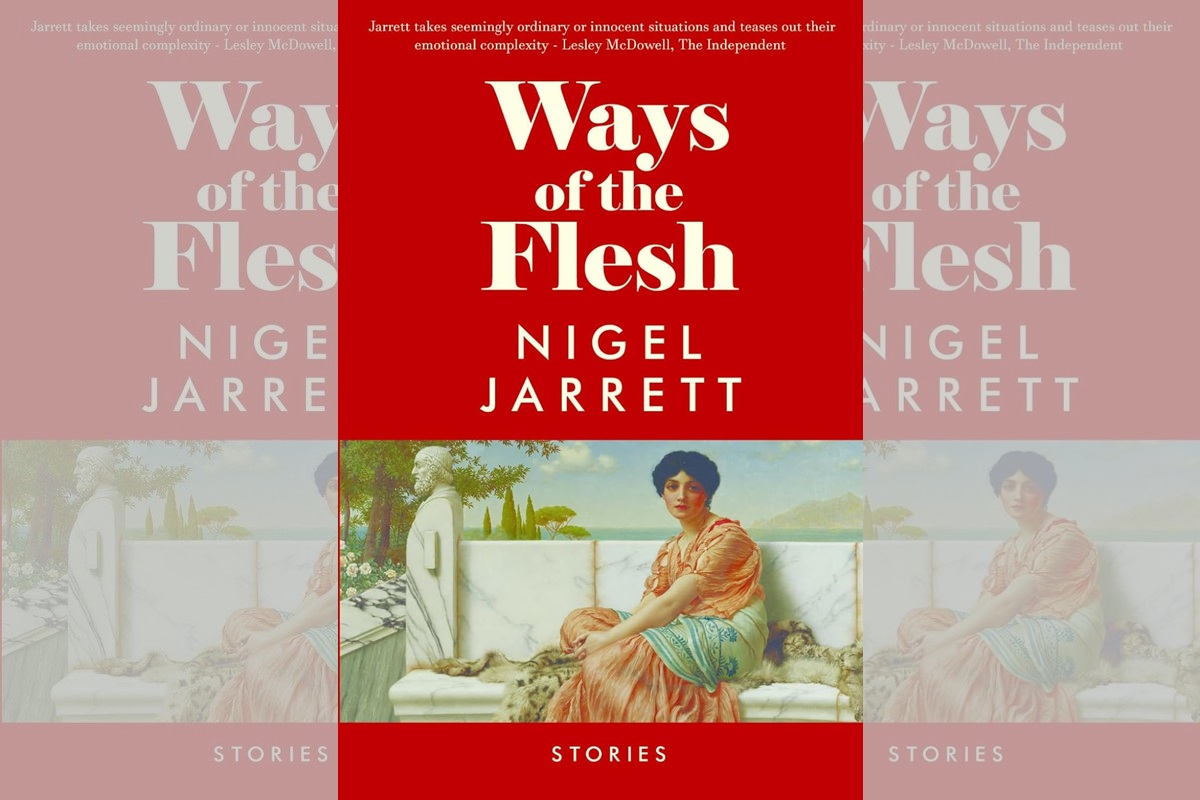
Book review: Ways of the Flesh by Nigel Jarrett
Jon Gower
It may be a little tired to say that a writer has a vivid imagination but in the case of Nigel Jarrett’s latest short story collection it’s abundantly true and, indeed, takes on a livelier meaning.
The 28 stories in this, his fifth collection, have a vitality akin to sucking in great draughts of mountain air, zesty with oxygen.
They are jam-packed with ideas which wander thither and hither with gay abandon and they have geographical range too – tightly-wrought and delightfully-told tales about a man lost in an Amazonian swamp; the perils of pickpocketing in Barcelona; matters of life after death in India and an account of an Irish archbishop being summoned to the Vatican in Rome to account for a legion of misdeeds.
One of the stand-out stories is one which carries a good deal of risk. After all, writing a story based on one of the most famous stories ever written is to be judged by the standards of the original.
When that story is Franz Kafka’s ‘Metamorphosis’ the bar is set very high. But, in ‘A Kafka Story’, Jarrett pulls it off.
In Kafka it’s Gregor Mendel turning into an insect overnight but here it’s Blumfeld, an elderly bachelor plausibly turning into a dragonfly, albeit one with a death wish, who knows ‘why bees and flies in their home thrash against the window pane, eager to re-join their raptorial world. I wanted to fly out, if necessary, into the gizzard of a diving swift.’
This story is a real Russian doll, containing the biography of Kafka’s hero and musings on the nature of story and the transformations of an author, not to mention the basic business of turning dragonfly.
Not a huge dragonfly, mind: ‘I didn’t occlude the bedroom, scraping my ovipositor on the floorboards with the sound of someone’s nails being drawn across a school blackboard, or bump my head on the ceiling, or have to make sure that my outstretched wings didn’t bend to breaking-point against the walls. But I was pretty sizeable, bigger than you average Dipteran skitting from plant to plant across the pond.’
You can see from this Dipteran description the delight in language and its precisions which are fully on display in Jarrett’s fiction. It’s as if he’s harnessing the skills of his newspaperman career – Jarrett was for many years a daily newspaper sub-editor and reporter – at the same time as he lets his imagination fly away from the emprisonings of facts and fact-checking.
Cinematic scenes
Film references often occur. In ‘Strelnikov’ we hear about Beth, who knows the soundtrack of Dr Zhivago by heart and hear about days when film buffs smoked like Belmondo and watched Truffaut, Fellini and Bergman.
In the story called simply ‘Movies’ there’s a plotline that follows that of Last Orders, a film about a dead man’s friends fulfilling his final wish to have his ashes tipped into the sea.
In Jarrett’s story a ‘film mad’ widower – who cries like ‘something out of a bad B feature’ – is taking his late wife’s ashes to scatter in Lyme Regis. Carrying an urn along the coastal cob reminds him of The French Lieutenant’s Woman even as he worries about what might happen to the ashes in the gusting wind, which threatens to blow them back at him like a swarm of bees.
But he can’t complete his task because a young woman tries to take her own life, invoking a scene when Nicole Kidman does the same in The Hours. And by the story’s close we are, tellingly, in the world of The Remains of the Day. It is as if life is all a film.
Playing with words
One of the characteristics of the collection is the author’s dancing playfulness, most obviously on show in a brisk little story called ‘Reading Age.’
You might have expected to meet Janet and John but this one has other characters: ‘This is John. This is Megan. John loves Megan. John and Megan have loved each other for years. John and Megan live together but are not married. Julia and Ben are best friends with John and Megan.’ And soon we are meeting Julia’s ex and setting a course for relationship calamity.
‘Ben is living with Megan in a flat. John is very sad.’ Then the wheels of love come off completely. ‘This is the house where John and Megan lived. This is a For Sale sign. John is getting over things. This is John’s new bed-sit. This is John’s carton of milk curdling.’
Jarrett, throughout, has contagious fun with both language and literary form and the whole concertina of a collection squeezes out a joyful sound, providing a jaunty soundtrack to life, to accompany a sprightly dance performed by a bright host of characters.
Support our Nation today
For the price of a cup of coffee a month you can help us create an independent, not-for-profit, national news service for the people of Wales, by the people of Wales.
Get more trusted Welsh news
Choose Nation.Cymru as a preferred source in Google News to see more of our journalism.


