


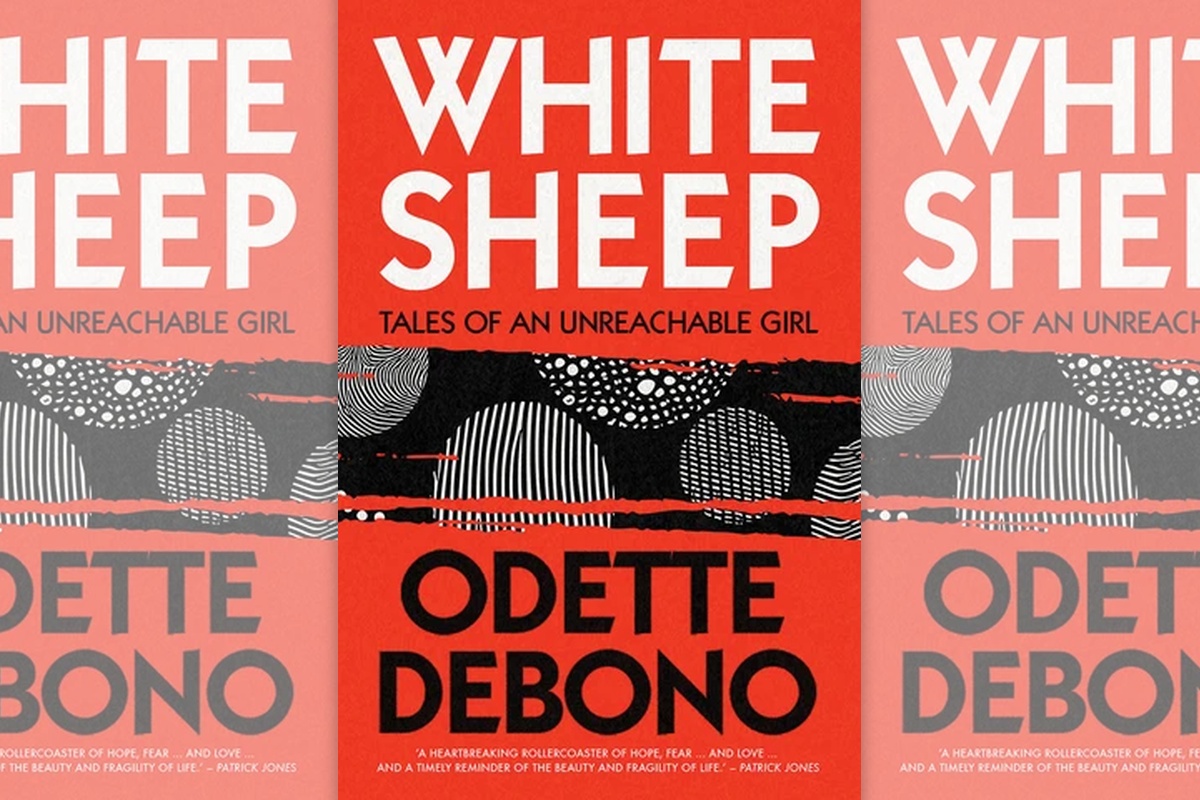
Book review: White Sheep by Odette Debono
Jon Gower
It takes a kind of defiant courage to write a memoir such as this as it involves considerable emotional exposure on the part of the author, equivalent, perhaps, to open-heart surgery.
You can see it in books such as psychologist Katriona O’Sullivan’s bestselling Poor, about living in extreme poverty in Ireland or Bad Blood, Lorna Sage’s dark mixture of biography and memoir about growing up in the Welsh borderlands. And in White Sheep, Debono’s debut book, we encounter this sort of storytelling fearlessness in spades.
In the case of White Sheep, the setting is south Wales, mainly Newport, which is briskly conjured up in scenes set in the city’s outlying estates, around Pill and featuring the iconic transporter bridge over the Usk. This ‘journeys over the muddy water: black and spiky, it etched itself against the clear cornflower sky. Looking down, I saw its huge concrete feet disappear into the thick muck of the river: shoes and shopping trolleys and bits of old cloth poked up, interrupting the triangular footfall of seabirds.’
Testing poverty
Debono depicts a life fraught with difficulty and full of upset. This isn’t a working-class memoir as most of the cast list is generationally unemployed, and even Odette’s occasional jobs – in shoe shops, and, once, memorably on an archaeological dig in Caerleon – come courtesy of government schemes to get folk off the dole.
The testing poverty she and her siblings faced is matched by a material lack of love, such that lovelessness is one of the abiding themes of the book, along with race, parentage and how to live on next to nothing. Odette’s mother, Annette, is a prostitute, working ‘on her back’ as she puts it in Newport docks, which accounts for the Norwegian and German sailors who occasionally stay over and send money when they’re at sea. We see how starved she is of love when we meet her chain-smoking mother, Odette’s grandmother, and as we see Annette’s increasing intake of vodka, which is soon off the chart.
Seeking refuge
At one point life seems to change for the better when Annette meets Paul, a seemingly solid character and former boxer who precipitates a move to Merthyr but when the couple start to drink more and quarrel violently it isn’t long before the family has to seek the sanctuary of a home for battered women. The regime within those four walls is tolerable but there is worse in store when mother and kids are forced to live in a squat without furniture, indoor plumbing or electricity.
Over the course of Debono’s growing up the family’s suffering is seemingly remorseless, that is until they finally manage to get to the top of the housing list and are given the keys to somewhere they can nominally call home. Set at the end of a row of flat-roofed houses, all joined together ‘like some concrete caterpillar,’ the place doesn’t make a favourable impression at first:
I looked up; little yellow weeds hung lifeless from the guttering. My eyes drifted to the steep steps, grey and narrow between twin slopes of overgrown dandelions and dock leaves, up to the broken fence, past the pointed roofs of real houses, and on to the blue sky and its high white clouds – always out of reach.
The family knuckles down to scrubbing the place clean, but it is difficult to make a home when there are no carpets, just a concrete floor, and the front room lies entirely empty as they simply don’t have the furniture. But the kids make friends with the neighbourhood children and soon Odette falls in love for the first time, even if Jason, the ‘little golden god’, is more interested in football than flirting. Other boyfriends follow, including one who looks like John Denver and, much later on, one called Kevin, who introduces her to dark nightclubs and all-night dancing in venues such as The Stowaway and the cave-like Seicos.
Disarming candour
The mother-daughter relationship which is the fulcrum of White Sheep is not one seemingly shored up by love of any kind and, in her forensic examination, Debono shows, with somewhat disarming candour, just how deeply she hated her mother and also for how long. It’s of some consolation to find out that the book was written with Annette’s blessing; her daughter searched her eyes for any hint that she wasn’t happy:
‘Are you absolutely sure, Mum?’ My eyes concerned.
‘Odette,’ her face shining, ‘I am so proud of you – a fuckin author-ess in the family!’
‘But…I’m going to write about –’
Shaking her head, ‘No, I’ve never bin scared of the truth, or ashamed of wha I done.’ Her freshly dyed hair glowed coppery in slanted sunshine coming through the nets in bits.
Reconciliation is a long time coming, and indeed, the reader has to wait for the epilogue to see anything even resembling a happy ending. Which all serves to underline the inner steel required to tell this troubling story of a troubled life, all delivered with the sort of lacerating honesty of which Odette’s mother clearly approved.
Support our Nation today
For the price of a cup of coffee a month you can help us create an independent, not-for-profit, national news service for the people of Wales, by the people of Wales.
Get more trusted Welsh news
Choose Nation.Cymru as a preferred source in Google News to see more of our journalism.


